


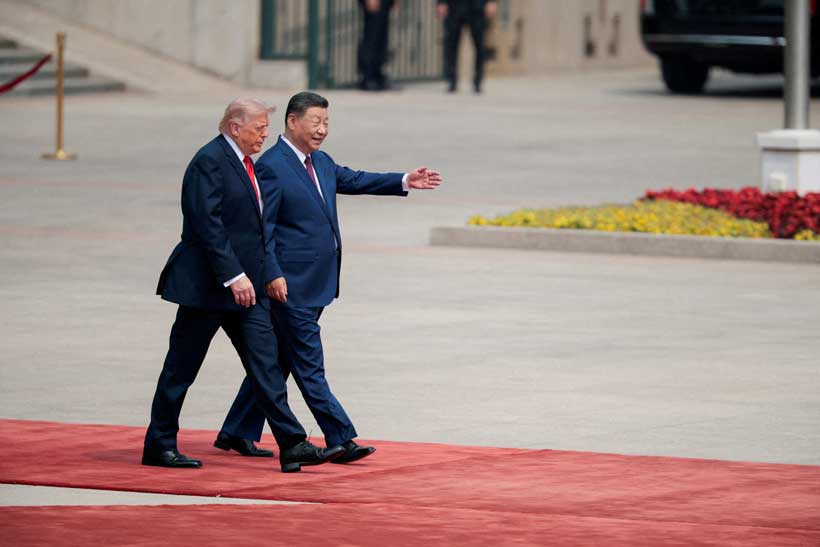
Chinese President Xi Jinping’s visit to Washington presents a challenge to the turbulent and complex contemporary international relations between the two superpowers. Both President Trump, with his pragmatic approach to trade, and Xi Jinping, with his historical perspective, understand that the concept of superpower status in the 21st century no longer means the ability to eliminate the adversary but rather the ability to contain and manage disagreements. Victory is no longer measured by winning wars but by preventing them. Thus, President Xi Jinping begins an official state visit to Washington, D.C., on Wednesday, September 23, 2026, at the invitation of U.S. President Donald Trump. This historic visit marks the first time a Chinese president has visited the White House in over 11 years. An exceptional American welcome ceremony will be held for President Xi upon his arrival at the foot of the plane in Washington. In a rare and exceptional gesture of protocol from a US president, President Donald Trump intends to personally greet his Chinese counterpart upon his arrival at Joint Base Andrews near Washington on Wednesday, September 23. The visit will culminate on Thursday, September 24, with an official welcoming ceremony at the White House, followed by a military parade in the Rose Garden, and then a closed-door meeting between the two leaders. All eyes are on the anticipated historic summit between US President Donald Trump and his Chinese counterpart, Xi Jinping, in Washington, with the official agenda scheduled to begin on Wednesday (the Chinese president arrives on September 23, 2026, and the talks and summit commence at the White House on September 24). President Xi Jinping’s visit to the United States aims to establish military and economic safeguards to reduce tensions, as both sides seek to resume arms control talks and military cooperation. This visit, the first state visit by a Chinese leader to Washington in over a decade, comes to discuss vital and sensitive issues that are reshaping the global geopolitical and economic landscape. The most prominent issues on the table for the two presidents are
1) Chinese involvement regarding Iran and negotiations with Washington
Washington seeks to pressure and persuade China during President Xi’s visit regarding issues related to Iran, such as the Iranian nuclear program, energy security, and vital maritime routes like the Strait of Hormuz. Therefore, the United States is trying to push Beijing to play a diplomatic mediating role and contain Tehran. This helps us understand the nature of the relationship between the Chinese president’s visit to Washington and the Iranian issue through:
– The nature of China’s actions: China’s approach to Iran is one of the most prominent political issues at this summit. Iranian Foreign Minister Abbas Araqchi visited Beijing on September 16, 2026, to inform the Chinese side of Tehran’s desire to return to a diplomatic solution and its unwillingness to continue the conflict with Washington.
Stay ahead of the geopolitical week.
MD Briefing delivers expert analysis across five global fronts — the Indo-Pacific, energy, geoeconomics, European security, and the Middle East — every Monday morning. Free.
– Mediation and Influence: The Trump administration seeks to push Beijing to use its considerable economic and political influence with Tehran (as the largest buyer of Iranian oil) to pressure it to return to the negotiating table and ensure the stability of vital waterways, such as the Strait of Hormuz, and to combat energy disruptions.
2) President Xi Jinping’s Visit to the United States and the Future of Bilateral Military Relations
President Xi Jinping’s visit to the United States comes at a time when the language of a new Cold War dominates the summit between the Chinese and American presidents. This summit will revive the principle of personal diplomacy between the two leaders. During and after this visit, the following is expected:
– Resumption of talks between Washington and Beijing: Discussions will focus on resuming arms control and military cooperation talks that were previously suspended due to issues related to Taiwan’s armament.
– Risk management: Efforts will be made to establish regular communication channels between military personnel to avoid any unintended clashes between the two powers.
– Contentious issues: The Taiwan issue, US arms sales, and tensions in the South China Sea remain highly sensitive topics that affect the stability of these communications.
3) The Impact of President Xi’s Visit on US Asian and Western Allies
President Xi Jinping’s invitation to the White House reflects a desire to de-escalate conflicts, protect the international order and its disputes, and establish safeguards to prevent economic and technological competition from escalating into an unintended military confrontation. This visit also aims to return to the language of mutual interests dictated by the interconnectedness of the global economy. This can be achieved through:
– The Position of Regional Allies: Creating a state of caution and anticipation among US Asian allies, such as Taiwan and Japan, regarding any bilateral agreements Washington might make that could compromise their security interests.
– Economic and Technological Balance: An attempt to reassure Washington’s Western allies of a desire to manage technological and economic competition by controlling boundaries and preventing a descent into widespread chaos, despite ongoing disagreements over tariffs and export controls.
4) Potential Economic Agreements on the Sidelines of the Visit
Both sides are seeking quick trade gains to solidify relative stability. The summit comes amidst intensive diplomatic and economic preparations, with Chinese Vice Premier He Lifeng leading a trade delegation for preliminary consultations in Washington. Key issues and potential agreements under discussion include:
– Mutual Tariff Reduction: Negotiations are underway to establish a framework for mutual tariff reductions covering $30 billion worth of goods from both sides, reviewing the impact of the tariffs and attempting to maintain the fragile trade truce between the world’s two largest economies.
– Artificial Intelligence and Technology: Discussions will focus on regulations and restrictions on advanced technology.
– Energy and Agriculture Deals: Significant agreements are expected, including increased Chinese purchases of US liquefied natural gas, agricultural products, and aircraft.
– Electric Vehicles: The possibility of allowing the construction of Chinese electric vehicle factories on US soil will be discussed, provided they comply with strict national security regulations imposed by Washington.
– Energy and Critical Minerals Security: Discussions will focus on ways to reduce tariffs on US liquefied natural gas and the issue of export licenses for rare earth minerals from China.
5) The Significance of the Presence of Technology Leaders from Both Countries
The visit includes a formal dinner attended by leading American technology and business figures. President Trump will host the Chinese delegation at a formal dinner on Thursday evening, September 24, 2026, in the East Room of the White House. According to White House reports, the guest list includes a number of prominent CEOs of American technology companies, including Elon Musk, CEO of Tesla; Sam Altman, CEO of OpenAI; Tim Cook, CEO of Apple; Jeff Bezos, CEO of Amazon; Jensen Huang, president of Nvidia; and Sundar Pichai, CEO of Google, were present, along with a high-level Chinese trade delegation. This presence reflects the fact that the real battle between the two powers is a struggle for technological dominance (particularly in the fields of artificial intelligence and semiconductors). This is especially true given Washington’s efforts to establish common rules of the game and security controls for AI to prevent cyber and military incidents, while American companies seek to secure their supply chains and maintain access to the Chinese market and rare earth mineral resources.
6) Addressing Other Hot Issues
There are a number of other vital and contentious issues that will be discussed between Washington and Beijing, most notably:
– Energy Crises and Tariffs: The approach and direction of the talks will involve both sides pressing for an extension of the tariff truce (Busan Truce), which is set to expire in November 2026. Beijing seeks to secure energy and rare earth supplies, while Washington aims to protect its markets from Chinese manufacturing surpluses without triggering a new wave of inflation before the midterm elections.
– The Conflict in the Middle East: The approach and direction of the talks will involve both presidents focusing on containing the escalation and ensuring the security of maritime navigation and global oil supplies. Washington believes that Beijing directly benefits from keeping waterways open and therefore should contribute to curbing destabilizing activities in the region.
– The Ukrainian war: This issue is considered less likely to achieve breakthroughs, as indications suggest it is not among the immediate top priorities for either side at this particular summit between Presidents Trump and Xi Jinping. However, it will be discussed within the context of China’s strategic relationship with Russia and the extent of Beijing’s economic support for Moscow, without any expectation of a fundamental change in the positions of either country.
– The Taiwan issue: This remains the most sensitive issue between Washington and Beijing. China will seek verbal or political assurances from Trump regarding the One China policy, while Washington is considering balancing the issues by either postponing or proceeding with massive arms deals for Taipei to maintain deterrence against China.
| The hot topic | How to approach and focus conversations |
| Energy crises and tariffs | Both sides are pushing to extend the tariff truce (Busan Truce) that expires next November. Beijing seeks to secure energy and rare earth supplies, while Washington looks to protect its markets from Chinese manufacturing surpluses without triggering a new wave of inflation before the midterm elections |
| The conflict in the Middle East | The two presidents focused on containing the escalation and ensuring the security of maritime navigation and global oil supplies. Washington believes that Beijing directly benefits from keeping waterways open and therefore should contribute to curbing destabilizing activities in the region |
| The Ukrainian war | The Ukrainian war is considered the least likely issue to see breakthroughs, as reports indicate it is not among the immediate top priorities for either side at this particular summit. It will be discussed within the context of China’s strategic relationship with Russia and the extent of Beijing’s economic support for Moscow, without any expectation of a fundamental shift in the positions of either country |
| The Taiwan File | The Taiwan issue remains the most sensitive; China will seek to extract verbal or political assurances from Trump regarding the One China policy, while Washington is considering balancing matters by postponing or passing huge arms deals to Taipei to maintain deterrence |
Therefore, we understand that Chinese President Xi Jinping’s visit to the United States is an attempt to de-escalate tensions in the international system between the two major powers, in contrast to the rhetoric of complete rupture, which leads to unforeseen chaos. Meanwhile, the Taiwan issue remains a true test of the stability of Sino-American relations, given China’s increasing warnings that Taiwan is a red line that cannot be compromised. China considers Taiwan a historical priority that cannot be postponed.
