New Delhi conceded on exam leaks and dug in on voter lists. The distance between those two responses says more about India’s governing logic than any statement from Geneva.
On 20 October, roughly two dozen UN independent experts issued an unusually pointed statement on India. Indian law enforcement, they said, had reportedly used force, including lathi charges, against unarmed students at non-violent assemblies, and the crackdown reflected “a broader, troubling pattern.” Ten days earlier, the Office of the UN High Commissioner for Human Rights had already raised concern over the mass detention of demonstrators, lawyers and journalists in Delhi.
New Delhi’s reply followed a well-worn script. The Ministry of External Affairs called the remarks an unacceptable interference marked by extreme selectivity, and the government insisted its police had acted strictly in accordance with the law. Read at face value, this is one more round in a familiar contest between Geneva’s human rights machinery and Indian sovereignty claims. But that reading misses the more revealing story: how the Indian state’s response to the same youth movement hardened as the movement’s target shifted from the integrity of an examination to the integrity of the electoral roll.
An insult, a leak and a movement
Stay ahead of the geopolitical week.
MD Briefing delivers expert analysis across five global fronts — the Indo-Pacific, energy, geoeconomics, European security, and the Middle East — every Monday morning. Free.
The movement began with a remark from the bench. During a Supreme Court hearing on 15 May, Chief Justice Surya Kant likened young people who “don’t get any employment” to cockroaches. He later clarified that he had meant those holding fake degrees, but the label had already escaped the courtroom. Within days, a satirical online formation calling itself the Cockroach Janta Party, a parody of the ruling BJP, had drawn tens of thousands of mostly Gen Z sign-ups.
The remark landed on a cohort already in crisis. NEET-UG, the national medical entrance examination sat by around 2.3 million candidates on 3 May, was cancelled on 12 May after a paper leak, forcing a re-test on 21 June. The Central Bureau of Investigation opened a case and made a string of arrests. In the weeks that followed, Indian media reported at least a dozen deaths by suicide among aspirants. For a generation for whom a single test score is often the only credible route to mobility, the cancellation was not an administrative glitch but a breach of the basic bargain between effort and reward.
What is often lost in the condemnation is that, on its first set of demands, the movement largely won. Its campaign over repeated exam leaks culminated in the resignation of Education Minister Dharmendra Pradhan. A government that is routinely described as impervious to street pressure sacrificed a senior minister. That concession matters, because it establishes a baseline against which the later crackdown has to be read.
The escalation curve
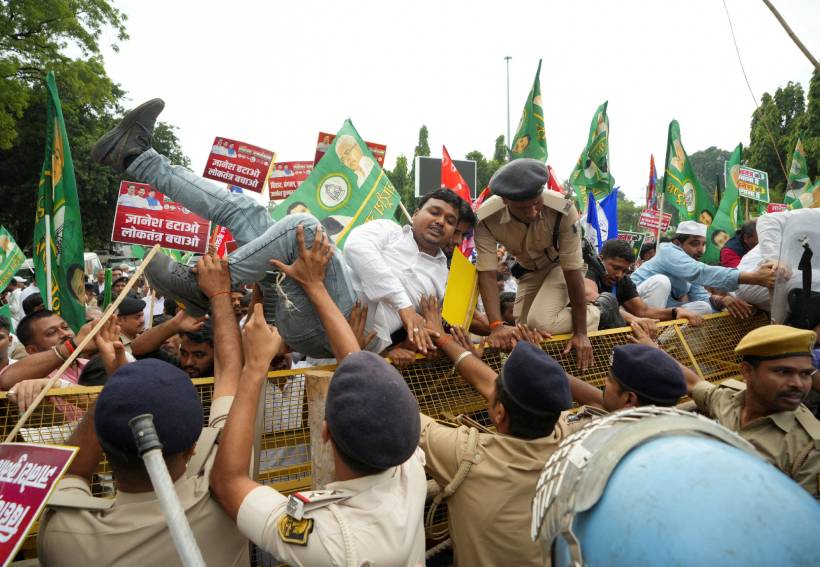
The first serious confrontation came in July, around Jantar Mantar and Parliament’s monsoon session. Protesters in New Delhi and elsewhere were met with batons, tear gas and, by multiple accounts, pellet guns. Delhi Police denied firing pellets, yet RTI responses from two Delhi hospitals reportedly showed at least ten protesters treated for pellet, shot or projectile injuries. The police account is not without substance either: officers, including two assistant commissioners, were injured by stone-pelting near Jantar Mantar, and Delhi Police later told the Supreme Court that more than 240 personnel had been hurt and that it had exercised maximum restraint. In Bihar’s Siwan district, a police officer was suspended for firing an assault rifle into the air near demonstrators, and the government faced accusations of using AI-assisted surveillance to identify participants. Notably, the Supreme Court ordered the release of all minors arrested during the protests, and the Delhi High Court sought the government’s response to petitions alleging excessive force.
The second phase was different in kind. By autumn, the movement had attached itself to a far more sensitive grievance: the Special Intensive Revision of electoral rolls, which protesters argue has deleted voters in ways that favour the ruling party. The UN experts noted that the deletions reportedly affect around 130 million people, including members of the Muslim minority and Scheduled Castes and Tribes. The demand was no longer a minister’s resignation but that of Chief Election Commissioner Gyanesh Kumar.
The state’s response to the 10 October march scaled accordingly. Delhi Police refused permission for the planned Jantar Mantar protest, citing short notice and public order. The capital was effectively locked down; the movement’s founder Abhijeet Dipke and other leaders were detained pre-emptively, and police sources put the number of people detained at nearly 2,500. The UN experts’ figure is higher, at more than 7,000 youths, journalists, rights defenders, lawyers and opposition members, many reportedly taken to remote detention centres where phones were seized and protest material deleted. Most were released within 24 hours. The experts also flagged the use of Section 163 of the Bharatiya Nagarik Suraksha Sanhita to impose blanket bans on gatherings, suspend public transport and shut down internet services, and expressed particular concern over reports of sexual and gender-based abuse during the protests and in detention.
The pattern here is the analytically important part. Mass preventive detention, area-wide assembly bans and connectivity shutdowns are not tools of crowd control; they are tools of pre-emption, designed to stop a gathering from forming rather than to manage one. Their deployment tracks the shift in subject matter. An exam leak is an administrative failure a government can absorb by removing a minister. A sustained challenge to the voter list touches the source of the ruling party’s mandate itself. Seen this way, the state did not simply become more repressive over time; it recalibrated its threat assessment once the movement moved from governance to legitimacy.
The Geneva exchange and its limits
India’s diplomatic rebuttal deserves engagement rather than dismissal. The charge of selectivity, that UN human rights bodies scrutinise some states far more than others, has genuine resonance across the Global South and is not merely a deflection. In this instance, however, it was weakened by timing: a day before its India statement, the same office had addressed student protests in France. The argument also sits awkwardly with the trajectory of the protests at home, where India’s own Supreme Court and Delhi High Court have treated allegations of excessive force and unlawful detention as serious enough to act on. When domestic courts are intervening, the claim that external concern is inherently illegitimate becomes harder to sustain.
At the same time, the limits of Geneva’s leverage are plain. Special Procedures statements are non-binding, and New Delhi has a record of disengaging from mandate holders when their findings become inconvenient, as it did over Kashmir in 2019. A government confident in its domestic majority and its strategic value to Western capitals has little reason to fear a statement from independent experts. The real audience for such interventions is therefore less New Delhi than India’s own courts, opposition and civil society, who can cite them as external validation.
A security reading of a demographic problem
The deeper issue is structural. Some 87 million young Indians are not in education, employment or training, and graduate unemployment among the young is severe. The movement that grew out of this has been secular in framing, satirical in tone and largely non-violent, which made it harder to cast as either communal or seditious. Those features are precisely why it has proved durable.
The state’s toolkit, however, was built for episodic unrest: detain organisers, ban assemblies, cut the internet, wait for fatigue. It is less suited to a generational constituency that regenerates online faster than it can be dispersed offline. The regional context sharpens the stakes. Youth-led mobilisations brought down governments in Bangladesh in 2024 and Nepal in 2025, and policymakers in New Delhi have watched both closely. That memory helps explain why a movement born of a judicial insult and an exam leak is now being policed as a security problem.
But the lesson of Dhaka and Kathmandu runs the other way too. In both cases, it was not protest alone that proved destabilising but the closing of institutional channels through which grievances could be absorbed. India still has those channels: courts that have intervened, a Parliament where the opposition has taken up the issue, and an Election Commission whose credibility is now itself the subject of protest. The question that matters is not whether India answers Geneva, but whether its own institutions can convince a generation that dissent is still worth expressing inside the system rather than against it.