


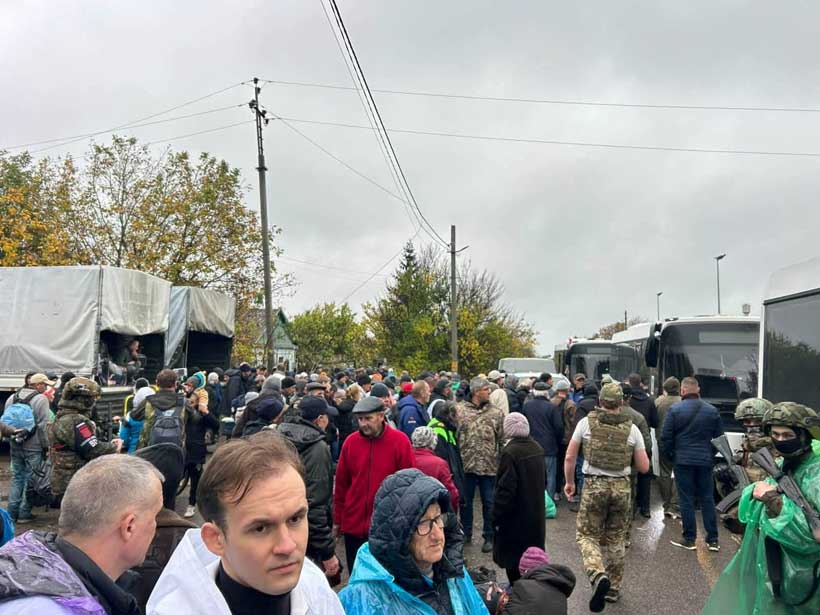
Ukraine evacuated 167 civilians from threatened areas of the southern Kherson region on Sunday as a six-day local ceasefire around the Russian-occupied town of Oleshky expired, raising concerns about renewed attacks near the front line.
The temporary truce, which began on Tuesday, was established following mediation efforts by US First Lady Melania Trump, with the involvement of Pope Leo. It allowed civilians to leave the area, roads to be cleared of mines, and humanitarian supplies, including food and medicine, to reach residents.
The ceasefire expired at midnight Moscow time (2100 GMT). Neither side immediately reported a resumption of hostilities, while Ukrainian officials said both countries had respected their commitments throughout the agreement.
Ukraine’s Human Rights Ombudsman Dmytro Lubinets said Kyiv and Moscow were exploring the possibility of continuing similar humanitarian arrangements. He said maintaining communication between the two countries’ human rights commissioners was important for protecting civilians and saving lives.
Stay ahead of the geopolitical week.
MD Briefing delivers expert analysis across five global fronts — the Indo-Pacific, energy, geoeconomics, European security, and the Middle East — every Monday morning. Free.
Ukraine’s General Staff said the latest evacuation operation moved 167 people to safer locations in Kherson region, including 22 children and 21 people with limited mobility who required assistance.
Regional governor Oleksandr Prokudin urged residents to avoid areas near the Dnipro River, warning that Russian strikes remained intense and posed a serious threat to civilians.
In Moscow, Kremlin spokesman Dmitry Peskov expressed a positive assessment of the operation in Oleshky and the coordination between the two countries’ human rights commissioners.
A rare humanitarian arrangement amid the war
The six-day ceasefire represented the longest local pause in fighting since Russia launched its full-scale invasion of Ukraine in February 2022.
The agreement also enabled the evacuation of nearly 800 people from Oleshky, according to Melania Trump. Residents seeking to leave, including those heading to either Ukraine or Russia, were initially transported to Crimea in 25 buses and nine ambulances before being separated into different convoys.
Those travelling to Ukraine faced an indirect journey through Russian-controlled territory. They travelled by bus to the Russian town of Anapa, flew to Belarus and then continued into Ukraine.
The evacuation highlighted the logistical and humanitarian difficulties facing civilians living in areas close to the front line, particularly where conventional evacuation routes remain inaccessible or unsafe.
Oleshky, situated on the Dnipro River opposite the Ukrainian-controlled city of Kherson, has remained under Russian control since the early stages of the invasion in 2022.
Prospects for wider peace efforts remain uncertain
The temporary arrangement has raised hopes that limited humanitarian cooperation could continue despite the absence of a broader political agreement between Moscow and Kyiv.
Pope Leo said he hoped the cooperation demonstrated during the Oleshky ceasefire would create opportunities for wider peace efforts. Melania Trump also described the arrangement as an important step towards restoring civilian dignity and providing access to essential supplies.
However, the expiry of the ceasefire leaves residents vulnerable to renewed fighting, particularly in settlements along the Dnipro River.
Military activity continued elsewhere in Ukraine on Sunday. Regional authorities reported one death following a Russian strike in the northeastern Sumy region and at least one death in the central Vinnytsia region.
The immediate challenge for both sides will be whether the humanitarian coordination established around Oleshky can be maintained beyond the temporary truce. While the evacuation demonstrated that limited cooperation remains possible, it does not necessarily signal progress towards a wider ceasefire or a negotiated settlement.
With information from Reuters.
