


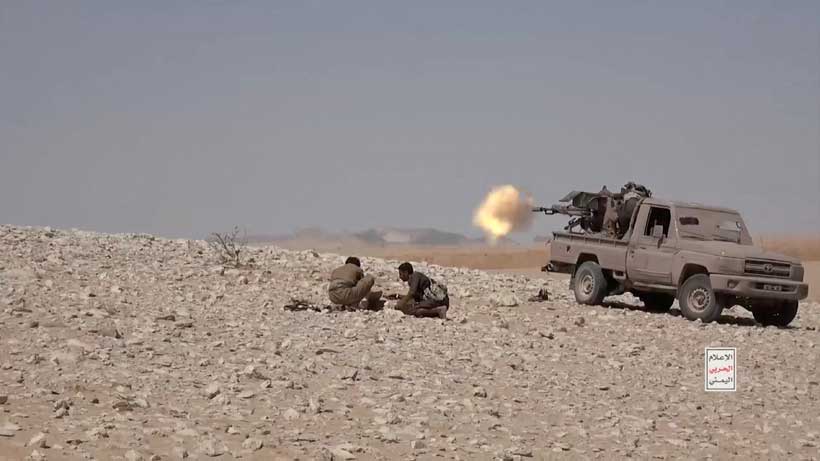
The Houthi advance in Yemen and the Red Sea region is creating upheavals in the Middle Eastern security structure in general and the conflict in Iran in particular. Saudi Arabia has inadvertently become the focal point of territorial security pressures from the south, energy infrastructure, and maritime interests. In this context, the Mecca Agreement between Saudi Arabia, Turkey, and Pakistan emerges as a model for shaping a new defense cooperation mechanism based on enhanced deterrence, shared responsibility, and expanded collective defense capabilities. This shift in the nature of the threat provides the strategic basis for Saudi Arabia’s need for a broader network of defense partners and directly puts the Mecca Agreement to the test by the Houthis. So, can commitments on paper translate into actual action?
Background
On September 10, 2026, Houthi forces seized control of the port of Mokha on the Red Sea coast and continued southward, expanding their presence to strategic islands near the Bab el-Mandeb Strait. On September 11, they gained control of Perim Island. These developments demonstrate how geography is helping the Houthi transform their military capabilities into geostrategic leverage: from a force primarily operating within Yemeni territory, the Houthi are increasingly able to directly influence the maritime space connecting the Red Sea with the Gulf of Aden and international shipping lanes passing through Bab el-Mandeb. With a width of only about 29 km at its narrowest point, this strait is one of the “choke points” of global trade and energy, connecting the Indian Ocean with the Red Sea and from there to the Mediterranean via the Suez Canal. According to Reuters, the Houthi’s approach to Bab el-Mandeb could provide Iran with a second strategic point of pressure alongside the Strait of Hormuz. With crude oil prices surging back above $100 a barrel in mid-September, the resulting geoeconomic value expanded Iran’s bargaining power in diplomatic negotiations with the United States.
For Saudi Arabia, this shift is particularly noteworthy because Riyadh’s security space is being stretched in multiple directions simultaneously. On September 11, Saudi Arabia had to temporarily shut down the East-West pipeline after attacks by multiple drones launched from Iraq, where there is a presence of pro-Iranian militias. Prior to this, Saudi Arabia and the US had bombed pro-Iranian militias in Iraq in July. On September 13, the Houthi rebels claimed responsibility for ballistic missile and drone attacks on the Sharurah base in southern Saudi Arabia; Saudi Arabia also reported casualties and damage from launches originating from Yemen. Of particular concern is not just how far the Houthis have advanced in Yemeni territory, but how each advance is altering Yemen’s strategic value to the entire Middle Eastern security structure. Yemen is transforming from an internal battlefield into a link connecting land-based competition with maritime competition, regional security with energy security, and proxy conflicts with interstate competition.
Stay ahead of the geopolitical week.
MD Briefing delivers expert analysis across five global fronts — the Indo-Pacific, energy, geoeconomics, European security, and the Middle East — every Monday morning. Free.
Saudi Arabia and the security challenge
The simultaneous increase in threats from forces allied with Iran is presenting Saudi Arabia with a paradox. Despite possessing vast economic and defense resources, it remains difficult for Saudi Arabia to independently control its surrounding security environment. Furthermore, Saudi Arabia’s need to protect its territory, maintain the security of its energy export routes, and avoid being drawn back into the war in Yemen makes its security problem increasingly complex. In this context, the Mecca Agreement, signed on August 7, 2026, with Türkiye and Pakistan, can be seen as a step towards expanding Saudi Arabia’s strategic space and diversifying its security risks.
This doesn’t necessarily mean Saudi Arabia is abandoning its security relationship with the US but rather reflects a shift from a model based on a single leading partner to a multi-layered security network. While the US remains a crucial pillar in Saudi Arabia’s defense structure, its support doesn’t always live up to expectations. The logic of the new model is to combine multiple partners with diverse capabilities, building multiple layers of defense relationships to increase resilience in response to emerging threats from multiple directions, from Iran, the Red Sea, and the Mediterranean to Yemen today.
Within that structure, Türkiye and Pakistan represent essential value to Saudi Arabia due to their complementary capabilities and strategic positions. Türkiye possesses a rapidly developing defense industry, combat experience, and a political voice extending from the Eastern Mediterranean to the Middle East. Pakistan, on the other hand, has long-standing defense ties with Saudi Arabia, military expertise, and the status of a nuclear-armed nation in South Asia. More importantly, the involvement of Türkiye and Pakistan allows Saudi Arabia to expand its security guarantor structure toward greater reliance on regional powers and Muslim nations with direct interests in Middle Eastern stability. The combination of Saudi Arabia’s financial resources, Turkey’s defense industry capabilities, and Pakistan’s military potential creates a basis for testing a model of cooperation where responsibility is distributed among multiple actors rather than solely to an external power.
The document signed on August 7, 2026, establishes the principle that an armed attack on one of the three countries will be considered an attack on all three, thereby laying the foundation for a collective deterrence mechanism. The Saudi Arabian government emphasizes that the agreement’s goal is to enhance common deterrence against acts of aggression and expand cooperation in defense areas. The establishment of the Political-Strategic and Defense Committee, the agreement to set up a Secretariat in Saudi Arabia, and the promotion of defense industry cooperation, technology development, and joint production demonstrate the parties’ gradual institutionalization of defense relations. However, it would be premature to consider the Mecca Treaty as the formation of a “Middle Eastern NATO.” The immediate value of the treaty lies in creating a network of deterrence and shared security responsibilities. In the event of increasing military pressure on Saudi Arabia from the Houthi rebels, the most crucial question for the treaty will be the extent to which the agreement is willing to translate political commitments into deterrence and collective action on the ground.
How the Houthi have challenged the Mecca Treaty.
Against the backdrop of the Houthi’s expanding control along the Red Sea coast and increased attacks on southern Saudi Arabia, this question has become more practical. First, the Houthi are testing the deterrent potential of this new collective defense mechanism. In the theory of collective security, the effectiveness of a coalition is determined not only by the combined military strength of its members but also by the level of credibility of the commitment to the adversary. A mechanism only truly creates deterrence when the adversary believes that attacking one member will provoke a response from the entire coalition. Therefore, the value of the Mecca Agreement lies in whether the Houthi believe that continuing attacks on Saudi Arabia will lead to a collective military counterattack.
The second test lies in the reactions of Pakistan and Türkiye. This is a comparison of the difference between theory and practice. While the Houthi rebels intensified their attacks on southern Saudi Arabia from September 10th, the Pakistani Foreign Ministry affirmed its commitment to the Mecca Agreement but had not discussed a specific military response under the agreement. Pakistan also emphasized prioritizing dialogue and diplomacy to maintain stability in Yemen. This suggests that an attack on Saudi Arabia may have politically triggered a sense of solidarity, but it was not enough to warrant a collective military deployment. In other words, a significant gap remains between the “if one country is attacked, all are attacked” clause and the question of who will send forces to the battlefield, for what purpose, and to what extent.
For Pakistan, the situation is more awkward because it is both a defense ally of Saudi Arabia and a partner with Iran. As tensions between Saudi Arabia and the Houthis escalate, Pakistan has urged Iran to restrain the Houthi forces. Reuters notes that Pakistan is under pressure to balance its defense commitments with efforts to avoid being transformed from a mediator into a belligerent party. This shows that the political will of each country could become a decisive variable for the Mecca Agreement. Pakistan may be willing to defend Saudi Arabia in the event of a direct attack threatening its territory, but that does not mean Pakistan will accept participating in a large-scale military campaign to eliminate the Houthis or alter the balance of power within Yemen.
Türkiye faces a similar dilemma. With its significant advantage in defense industry capabilities, Türkiye has the potential to contribute more than just political support, such as in UAVs, intelligence, logistics, air defense, or other combat capabilities. However, the capacity to intervene does not equate to the will to intervene. This is partly reflected in Turkey’s role in the NATO-Ukraine-Russia relationship. A military campaign in Yemen could lead to a far greater diplomatic and political crisis for Turkey than providing defense support to Saudi Arabia. Therefore, it is crucial to observe how important Türkiye considers protecting Saudi Arabia from the Houthi rebels within its overall strategic interests.
This raises a third issue: the limits of collective involvement. The Mecca Agreement is described by the parties as a defensive agreement, not aimed at any specific country, and intended to enhance deterrence against aggression. Pakistan emphasizes that the agreement aims to strengthen self-defense capabilities and is not a tool for confrontation. Therefore, a distinction must be made between the Houthi expansion of airstrikes into Saudi Arabian territory and Saudi Arabia conducting a military operation to retake Houthi-controlled areas in Yemen. In the first case, members have a clearer basis for arguing that Saudi Arabia is exercising its right to self-defense. In the second case, participation in an offensive outside its territory could create further debate about the scope of the obligation for collective defense.
Thus, the Houthi factor has further clarified the gap between collective defense on paper and collective defense on the ground. However, in practice, the effectiveness of the principle depends on three conditions: (i) (i) whether the members have the political will to act; (ii) whether they possess the military capabilities appropriate to the situation; and (iii) how they define the limits of their involvement. The meeting of the Political-Strategic and Defense Committee of the Mecca Treaty on August 31st only showed that the three countries are building a coordination mechanism and emphasized de-escalation, restraint, and peaceful resolution of crises. This indicates that the mechanism is still in the process of institutionalization and has not yet reached the level where a collective military command can automatically respond to an attack.
The ultimate impact of the Houthis on the Mecca Agreement will depend on the three countries’ ability to define and control the scope of the confrontation. If the mechanism focuses on protecting Saudi Arabian territory, ensuring maritime security, and enhancing deterrence capabilities, members are more likely to maintain consensus and gradually build mutual trust. Conversely, if the Agreement is drawn into a campaign to alter the balance of power in Yemen or directly expands into a confrontation with Iran, the risk of internal polarization is greater. The paradox lies in the fact that the more apparent the Houthi threat, the greater the need for a collective defense mechanism; but if confronting the Houthis means risking a regional war, that very threat could increase caution and differences among members. This paradox will determine whether the Mecca Agreement can develop into a genuine collective defense mechanism or remain merely a politically motivated defense cooperation network.
