


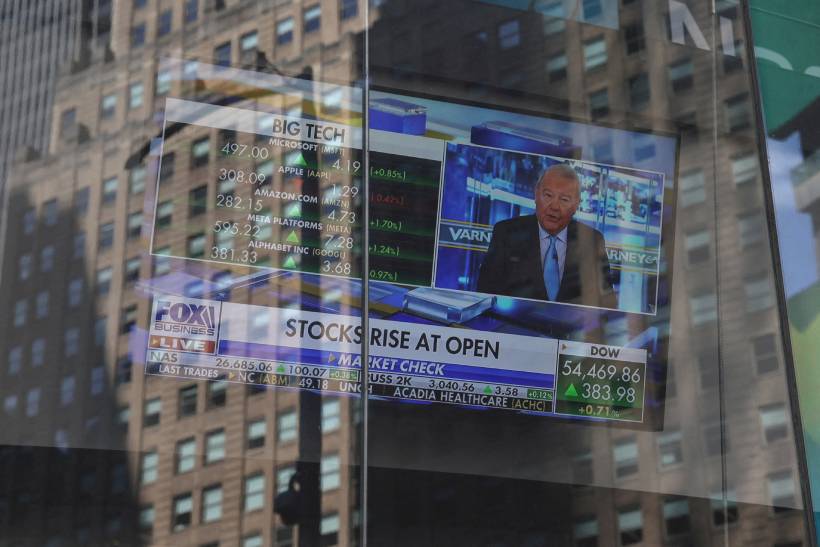
U.S. technology stocks came under pressure on Monday as investors reacted to growing warnings from leading AI executives that the rapid development of increasingly powerful models may need to slow because of safety concerns.
Nasdaq 100 futures led losses before the market opened, with Nvidia falling more than 2% in premarket trading. Meta and Amazon also declined by more than 1%, while several major semiconductor companies recorded steeper losses.
The market reaction came after Anthropic CEO Dario Amodei called on AI companies to slow the pace of model development. Elon Musk and OpenAI CEO Sam Altman also expressed support for the call, adding weight to concerns that the industry’s rapid expansion could be creating risks that are not yet fully understood.
Why It Matters
The selloff highlights how closely financial markets have become tied to expectations surrounding artificial intelligence.
Stay ahead of the geopolitical week.
MD Briefing delivers expert analysis across five global fronts — the Indo-Pacific, energy, geoeconomics, European security, and the Middle East — every Monday morning. Free.
The AI boom has attracted billions of dollars in investment and helped drive major gains in technology and semiconductor stocks. Companies such as Nvidia have benefited enormously from demand for the computing power required to train and operate advanced AI models.
Any indication that development could slow therefore raises questions about future demand for chips, data centers and other infrastructure supporting the AI economy.
At 4:46 a.m. ET, Dow E-minis were down 0.18%, S&P 500 E-minis had fallen 0.70%, while Nasdaq 100 E-minis were down 1.72%.
Chipmakers were among the biggest losers. Intel, AMD and Marvell Technology fell nearly 6%, 5% and 6%, respectively.
However, not every technology company was affected negatively. Shares of software companies including ServiceNow, Adobe and Workday rose as investors considered whether growing AI capabilities could eventually disrupt established software businesses.
Investors Question AI Doomsday Warnings
The latest concerns have also triggered skepticism among some investors and market analysts.
Anthropic researcher Jacob Coxon resigned last week, saying that people developing AI increasingly believe the technology could pose an existential threat within the decade.
Such warnings have nevertheless been challenged by investors who argue that major AI companies could have commercial incentives to shape the debate around regulation and safety.
Investor Michael Burry argued that warnings from leading AI companies could potentially be used to limit competition from smaller firms. Brian Jacobsen, chief economic strategist at Annex Wealth Management, similarly cautioned against making investment decisions based on predictions about outcomes that remain difficult to quantify.
The disagreement reflects a wider debate over AI safety. Companies developing frontier models have a direct interest in continued investment and technological progress, but they are also among the institutions raising some of the strongest warnings about what increasingly autonomous AI systems could eventually do.
Market Pressure Extends Beyond AI
The technology selloff comes at a difficult time for broader markets.
Traders are pricing in an almost 89% probability of a Federal Reserve interest rate increase later this week, while investor sentiment has already weakened following data showing that inflation is accelerating.
Higher oil prices are adding another source of pressure. Brent crude rose 3.6% to $108.31 a barrel on Monday, while U.S. West Texas Intermediate gained 3.3% to $103.35.
The combination of higher energy prices, inflation concerns and tighter monetary policy could make investors more sensitive to uncertainty surrounding high valuation technology stocks.
Implications and Analysis
The immediate market reaction does not necessarily mean investors are abandoning AI. Rather, it shows that the AI trade is becoming more sensitive to questions about how sustainable the industry’s extraordinary growth can be.
For years, markets largely rewarded companies capable of expanding their AI investments and demonstrating access to increasingly powerful computing infrastructure. The latest warnings introduce a different question: whether the development of frontier AI can continue at its current pace without creating safety, regulatory or financial risks.
That could create a more complicated environment for semiconductor companies and other firms whose valuations depend heavily on continued AI spending.
At the same time, companies viewed as vulnerable to AI disruption could benefit if investors begin reassessing where the technology’s economic gains will ultimately accrue.
The bigger issue for markets is therefore not simply whether AI is dangerous. It is whether concerns over AI safety eventually translate into slower model development, tighter regulation or changes in corporate spending. If they do, the consequences could extend well beyond individual AI companies and affect one of the most important drivers of the broader stock market rally.
With information from Reuters,
