


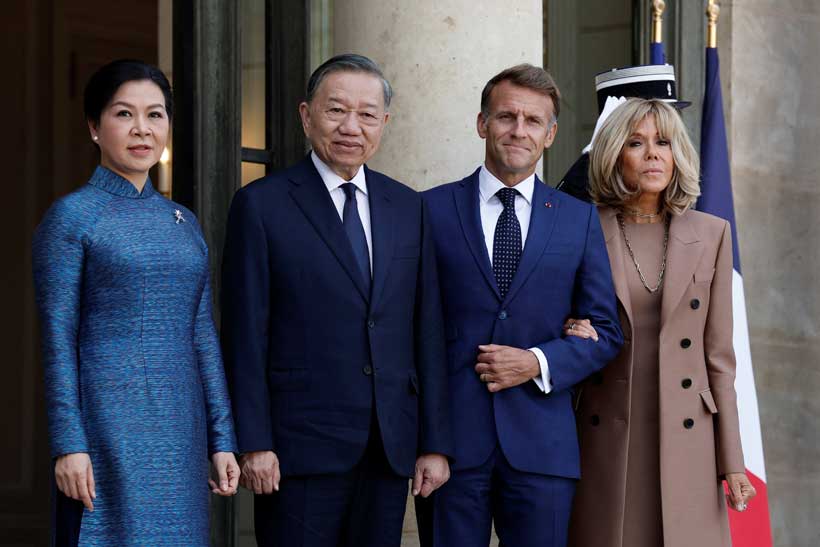
General Secretary and President To Lam’s official visit to France on September 10, 2026, was significant not simply because it produced a new round of agreements between Hanoi and Paris, but because it illustrated how Vietnam is adapting its foreign policy to an increasingly fragmented international order.
The timing was particularly notable. To Lam arrived in France immediately after completing a state visit to Russia from September 7 to 9. In the space of only a few days, Vietnam held high-level engagements with two major powers that today occupy very different positions in the European security order. Yet Hanoi did not approach these relationships as mutually exclusive.
That is perhaps the most important strategic message of the visit.
Vietnam is not seeking to replace one partner with another. Instead, it is continuing to widen a network of relationships in which different partners provide different forms of economic, technological, political, and security value.
Stay ahead of the geopolitical week.
MD Briefing delivers expert analysis across five global fronts — the Indo-Pacific, energy, geoeconomics, European security, and the Middle East — every Monday morning. Free.
France increasingly fits into that strategy.
From Political Framework to Practical Cooperation
Vietnam and France have spent the past several years steadily upgrading their relationship.
The two countries elevated ties to a Comprehensive Strategic Partnership in October 2024. President Emmanuel Macron’s state visit to Hanoi in May 2025 subsequently gave that framework greater substance, with both sides emphasizing sovereignty, strategic autonomy, and strategic trust.
The September 2026 visit marked another step in that process.
According to the Élysée, the meeting was intended to accelerate implementation of the Comprehensive Strategic Partnership and deepen cooperation in ways that would strengthen the respective strategic autonomy of both countries. Macron also described the recent pace of bilateral exchanges as unprecedented.
The importance of the visit therefore lies less in another political declaration than in the gradual emergence of a more diversified structure of cooperation.
France and Vietnam are now working across sectors ranging from aviation and transport infrastructure to critical minerals, advanced technology, space, energy, scientific research, and defense.
This breadth matters.
One of the persistent challenges in many strategic partnerships is the gap between political symbolism and material interests. The current phase of Vietnam–France relations appears increasingly focused on reducing that gap.
Building Mutual Interests Across Strategic Sectors
The agreements and projects highlighted during the visit reveal a relatively clear logic of mutual benefit.
In aviation, Macron referred to significant agreements concluded by Airbus and Thales with Vietnamese partners. In transport infrastructure, Alstom reached an agreement with Vingroup, while France has expressed interest in contributing to Vietnam’s railway modernization, including the planned North–South high-speed railway.
Cooperation is also moving into more strategically sensitive sectors.
France and Vietnam signed an agreement on rare earths and critical minerals, an area that has become increasingly important as major economies seek to diversify supply chains and reduce vulnerabilities in strategic raw materials. France brings technological and industrial expertise, while Vietnam possesses significant mineral potential.
The complementarity is obvious.
Vietnam does not simply need foreign demand for raw materials. Its larger interest lies in moving further up the value chain through processing, technology, investment, and industrial cooperation. France and the European Union, meanwhile, have strong incentives to diversify access to strategic mineral supplies.
The same logic is visible in energy and technology. France has expressed an ambition to become a reference partner for Vietnam’s decarbonization and future nuclear-energy program, while cooperation is expanding in artificial intelligence, quantum technologies, scientific research, and space. Vietnam has also chosen France for the acquisition of an Earth-observation satellite, which Macron explicitly linked to Vietnamese sovereignty.
These are not isolated commercial transactions. Taken together, they point toward a relationship increasingly centered on capabilities that matter for long-term national resilience.
Defense as a New Pillar
Perhaps the most strategically important development is defense.
Macron stated that France and Vietnam had decided to make defense a pillar of their Comprehensive Strategic Partnership. He linked this to maritime security, closer ties between defense industries, and the development of the two countries’ defense industrial and technological bases. France also expects progress on a 2025 letter of intent concerning Vietnam’s acquisition of three NH90 helicopters from Airbus Helicopters.
The significance of this should not be reduced to a single potential procurement.
For Vietnam, greater defense cooperation with France provides another avenue for technological access and diversification of suppliers. For France, it creates an opportunity to deepen its security presence in Southeast Asia while supporting its broader Indo-Pacific strategy.
This does not imply an alliance or strategic alignment against a third country.
Rather, it reflects a broader Vietnamese approach: increasing the number of credible partners capable of providing technology, equipment, training, industrial cooperation, and political options.
The value of diversification is precisely that no single partner has to perform every role.
Strategic Diversification, Not Strategic Replacement
This is where the timing of the France visit becomes especially important.
Only a day earlier, To Lam had concluded a state visit to Russia, during which Vietnam and Russia reaffirmed their Comprehensive Strategic Partnership.
Russia and France currently stand on opposing sides of one of the deepest geopolitical divisions in Europe. Yet Vietnam continues to develop relations with both.
This is not a contradiction. It is an expression of strategic diversification.
For Vietnam, diversification does not simply mean increasing the number of diplomatic relationships. It is also a way to reduce strategic risk and preserve room for maneuver. Different partners offer different advantages.
China occupies a unique position because of geography, trade, production networks, and deeply integrated supply chains. The United States offers access to major markets, advanced technology, capital, and investment.
Russia retains importance in several traditional and strategic areas of cooperation.
Japan, South Korea, and European partners provide capital, technology, industrial capacity, and infrastructure expertise. India and Australia broaden Vietnam’s strategic engagement across the Indo-Pacific.
France adds another layer to this network through advanced technology, aerospace, defense, energy, transport infrastructure, critical minerals, and its position as one of the principal political actors within the European Union.
Within such a structure, one relationship does not necessarily replace another. Instead, the strength of the network lies in its complementarity.
The greater the number of credible economic, technological, diplomatic, and security options available to Vietnam, the lower the risks created by excessive dependence on a single market, supplier, or center of power.
Strategic autonomy, in this sense, is not isolation. It is the ability to maintain choices.
Cooperation Without Bloc Politics
This approach has become increasingly relevant as the international system becomes more fragmented.
US–China competition continues to shape economic and technological relations across the Indo-Pacific. Russia and the West remain locked in a deep confrontation. Trade rules, technology controls, energy security, supply chains, and access to critical minerals are all becoming increasingly politicized.
For middle and smaller powers, this environment creates pressure to align more clearly with competing blocs.
Vietnam has generally tried to resist that logic.
Instead of defining bilateral relations according to the disputes of larger powers, Hanoi has sought to develop each relationship on the basis of its own interests and areas of practical cooperation.
The sequence from Moscow to Paris illustrates that approach unusually clearly.
Vietnam can maintain a longstanding relationship with Russia while simultaneously deepening cooperation with France, a major EU and NATO member. The development of one relationship need not be interpreted as a move away from the other.
What matters is whether each relationship contributes to Vietnam’s national development, security, technological capabilities, and international position. This is also why the concept of mutual benefit is central to the emerging Vietnam–France relationship.
France gains access to one of Southeast Asia’s most dynamic economies, opportunities for French companies, greater political presence in ASEAN, and a partner in sectors such as critical minerals, aerospace, energy, and infrastructure.
Vietnam gains access to technology, capital, industrial expertise, markets, and additional strategic options. The relationship becomes sustainable when both sides have something concrete to preserve.
The Dong Son Drum and the Politics of Goodwill
Not every important result of a high-level visit is measured in contracts or strategic agreements.
One of the most symbolic moments surrounding To Lam’s visit was France’s return of a Dong Son bronze drum more than 2,000 years old.
The artifact had been seized by French customs at Rennes Saint-Jacques Airport in 2014 and was subsequently preserved and restored by the Musée des Beaux-Arts de Rennes. During the September 2026 visit, the French Ministry of Culture formally returned it to Vietnamese authorities. France itself described the handover as evidence of the quality of diplomatic and cultural relations between the two countries.
The material value of a cultural artifact cannot be compared with an aviation, infrastructure, or defense agreement. Its diplomatic value is different.
Vietnam and France share a long and complicated history. In that context, the return of an object closely associated with the ancient Dong Son civilization carries symbolic weight. It demonstrates respect for Vietnamese cultural heritage while adding an element of goodwill to a relationship increasingly dominated by forward-looking strategic interests.
That combination matters.
Durable partnerships are built not only through overlapping economic interests but also through political trust, symbolic gestures, and an ability to manage historical memory with mutual respect. The return of the drum therefore complemented the harder dimensions of the visit.
Technology, defense, infrastructure, and critical minerals provided material substance. Cultural diplomacy provided a visible gesture of respect.
France as an Additional Strategic Option
The importance of France to Vietnam should therefore not be understood through the question of whether Paris can replace another major partner.
That is the wrong framework.
France is valuable precisely because it does not need to replace China, Russia, the United States, Japan, or any other partner.
It adds something different.
It provides access to European technology and industrial capabilities. It strengthens Vietnam’s links with the European Union. It provides another defense and security relationship. It offers cooperation in aerospace, nuclear energy, rail transport, science, and strategic minerals.
Each additional credible relationship expands Vietnam’s room for maneuver.
In a relatively stable international system, such diversification may be economically useful. In a fragmented system, it becomes strategically important.
Supply chains can be disrupted. Technology access can become politicized. Trade relationships can deteriorate. Sanctions, conflicts, or sudden changes in government policy can alter the value of previously reliable partnerships.
A diversified network cannot eliminate these risks, but it can make them easier to absorb. This is the broader significance of Vietnam’s expanding relations with France.
A Network Rather Than a Choice
Lam’s September 2026 visit to France should therefore be understood as part of a larger pattern in Vietnamese foreign policy.
The objective is not equidistance between all major powers, nor is it an attempt to avoid making decisions altogether.
It is the construction of a broad network of relationships in which Vietnam retains enough political, economic, technological, and strategic options to avoid unnecessary dependence.
The fact that the France visit immediately followed a state visit to Russia makes this logic particularly visible.
Moscow and Paris represent very different geopolitical positions. Vietnam nevertheless sees value in working with both.
That is possible because Hanoi does not define these relationships primarily through bloc politics. It defines them through bilateral interests.
In this framework, France represents another source of technology, investment, defense cooperation, industrial capacity, and political connectivity. Russia continues to have its own areas of strategic relevance. Other partners contribute other advantages.
Together, they form a network.
And in an increasingly fragmented international order, the strength of that network may become one of Vietnam’s most important strategic assets.
The deeper significance of the France visit, therefore, lies not in any single agreement signed in Paris. It lies in the continued expansion of Vietnam’s choices.
