


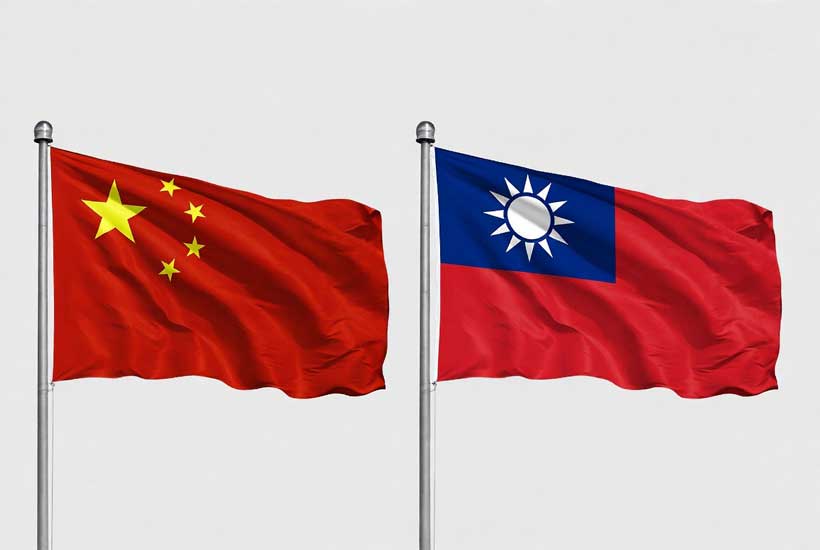
What is complicating the Taiwan issue is not just the shifting military balance or the increasing US-China competition, but the growing divergence in the two sides’ understanding of the communities they represent. While China views unification as the culmination of a historical nation, Taiwan believes its political future should be determined by a democratic community of citizens. The debate between the two sides is no longer simply a matter of sovereignty but a competition between two differing understandings of nationhood and representation by two different legacies. This very difference is reshaping the prospects for reunification.
Chinese perspective
The nation is linked to the “Chinese Dream.”
The concept of the “Chinese Dream” was officially put forward by President Xi Jinping immediately after the 18th National Congress of the Communist Party of China in 2012, affirming that the great rejuvenation of the Chinese nation is the greatest dream of the Chinese people since modern times. According to this interpretation, Chinese history since the Opium Wars of 1840 is a history of “a century of national humiliation” as the country was invaded, divided, and subjected to unequal treaties by Western powers and Japan.
Stay ahead of the geopolitical week.
MD Briefing delivers expert analysis across five global fronts — the Indo-Pacific, energy, geoeconomics, European security, and the Middle East — every Monday morning. Free.
In 2013, at the Road to Rejuvenation Exhibition, President Xi Jinping emphasized that the process of national rejuvenation is a transformation from rising up and becoming wealthy to becoming strong. In his speech commemorating the 40th anniversary of his Message to the People of Taiwan (January 2, 2019), President Xi Jinping declared that the complete reunification of the motherland is an essential requirement for achieving the great rejuvenation of the Chinese nation.
This goal continues to be institutionalized in high-level political documents of the Communist Party of China. The political report at the 19th National Congress in 2017 affirmed that resolving the Taiwan issue and achieving complete reunification of the motherland is an essential requirement for realizing the great rejuvenation of the Chinese nation. At the 20th National Congress in 2022, this stance was reiterated in stronger language, affirming that the Communist Party of China resolutely opposes and prevents any separatist acts demanding independence in Taiwan, while emphasizing that it will not relinquish the right to use force. In the annual Government Work Reports and Taiwan Work Conferences, the issue of reunification is always placed among China’s “core interests,” alongside sovereignty, national security, and development interests. This also means that the policy direction of future generations of leaders will be difficult to change because the goal of reunification is linked to the legitimacy of the Party and the promise of national rejuvenation.
The ideological foundation for this approach is the concept of the “Chinese nation.” Unlike the Han Chinese concept, the Chinese nation is constructed by China as a unified political and cultural community comprising 56 ethnic groups, extending to Hong Kong, Macau, Taiwan, and overseas Chinese communities. Thus, the existence of two political systems on opposite sides of the strait does not alter the fundamental nature of “one nation,” as the division is merely a temporary consequence of civil war and external interventions. In other words, in Chinese discourse, Taiwan is not considered a separate political community with independent self-determination but rather an incomplete part of the Chinese national community.
This viewpoint has been consistently expressed in the White Papers on Taiwan published since 2000. In particular, the 2022 White Paper on the Taiwan Issue and the Unification of China in the New Era affirms that both sides of the Taiwan Strait belong to one China, that people on both sides are Chinese and share the same bloodline, culture, and history. This version of the White Paper further adds the argument that unification not only serves China’s interests but is also a condition for all Chinese people to share in the glory of national rejuvenation. This represents an expansion from the argument of sovereignty to the argument of national identity and community, creating a political basis for the claim to unification.
The discourse of a “common national community” is further reinforced through the system of political discourse. In his 2019 Message to the People of Taiwan, President Xi Jinping repeatedly used phrases such as “blood relatives,” “shared national destiny,” or “one family.” These concepts reflect a discourse strategy aimed at denying the legitimacy of the formation of an independent Taiwanese national identity. In China’s approach, differences in democratic institutions, political systems, or political identities in Taiwan do not give rise to a new national entity but merely reflect a temporary division within a unified national community.
Therefore, the reunification of the two sides has been elevated to a historical obligation and a national mission, rather than merely a policy objective. Since former US House Speaker Nancy Pelosi’s visit to Taiwan in August 2022, Chinese propaganda and military agencies have repeatedly invoked the 2005 Anti-Secession Law to provide a legal basis for military exercises around the island, serving China’s deterrence strategy. The law clearly defines the state’s obligation to promote reunification while also allowing the use of non-peaceful means if separatist forces pursue Taiwanese independence.
China’s Unified Goal Approach
Based on this concept, China has implemented a comprehensive strategy that simultaneously combines ideological, political, legal, diplomatic, economic, and military tools to gradually shape conditions favorable to its goal of unification.
First, ideologically and in terms of discourse, China views the shaping of national identity as the long-term foundation of the unification process. The education system, state media, publishing, film, museums, and digital platforms continuously emphasize the message that “Taiwan has been a part of China since ancient times. ” Historical events such as the Treaty of Shimonoseki, the Cairo Declaration of 1943, the Potsdam Declaration of 1945, and the outcome of the 1949 civil war are interpreted to affirm the continuity of Chinese sovereignty over Taiwan. Simultaneously, a propaganda campaign is intensified online through social media platforms such as Weibo, Douyin, and Bilibili. This was particularly evident after the 2016 and 2020 elections in Taiwan and following Nancy Pelosi’s visit in 2022, when a strong wave of Chinese public opinion was mobilized to create consensus on the government’s tough measures.
Politically and legally, China has been progressively perfecting its institutional framework to serve its unification goals. Beyond the Anti-Secession Law, China has focused on improving its Taiwan policy documents and utilizing political forums such as the Party Congress, the National People’s Congress and the Two Sessions, and the Taiwan Work Conference to declare its “One China” stance. Simultaneously, China has implemented a strategy of international isolation of Taiwan by increasing diplomatic pressure. As a result, several countries, including Panama (2017), the Dominican Republic (2018), El Salvador (2018), the Solomon Islands (2019), Kiribati (2019), Nicaragua (2021), and Honduras (2023), have successively shifted their diplomatic recognition from Taipei to Beijing. To date, the number of countries maintaining official diplomatic relations with Taiwan remains very limited.
Economic tools are employed in a way that both creates attractiveness and increases dependence. China promotes cross-strait economic integration through preferential policies for Taiwanese businesses and youth, encouraging investment, education, and entrepreneurship in mainland China. Simultaneously, it applies selective sanctions against businesses or individuals deemed to support “Taiwan independence.” This approach aims to create social stratification in Taiwan to serve the long-term reunification process.
Military deterrence is increasingly becoming the final pillar of China’s strategy. Since 2016, the People’s Liberation Army (PLA) has gradually normalized patrols across the median line of the Taiwan Strait, conducting incursions into Taiwan’s Air Defense Identification Zone (ADIZ). In 2022, the PLA conducted its first-ever exercises encircling the island across six regions, launching ballistic missiles that flew over Taiwanese airspace and simulating a maritime blockade. Subsequent large-scale exercises in 2024–2025–2026 further demonstrate the shift from deterrence to building actual combat capabilities.
Taiwan’s perspective
Ethnicity is associated with “Taiwanese Identity.”
While mainland China approaches the issue of nationhood from a historical perspective, aiming to serve national rejuvenation and reunification, in Taiwan, the concept of “nation” is defined on the foundation of a democratic political community. While China argues that national unity precedes and determines the form of political organization, Taiwan believes that political experience, institutional systems, and the will of the citizens are the elements that constitute a nation. Thus, if China constructs national identity according to the logic of history creating the nation, Taiwan develops it according to the logic of a democratic nation creating the nation. This difference in understanding identity has made the issue of reunification between the two sides a confrontation between two different conceptions of nationhood, legitimacy, and the right to determine the political future.
The modern “Taiwanese identity” is the result of a political transformation spanning more than three decades. In 1987, when the Republic of China government ended nearly 40 years of martial law, it ushered in a process of comprehensive democratization. Constitutional reforms in the 1990s, the first direct presidential election in 1996, and especially the peaceful transfer of power from the Kuomintang (KMT) to the Democratic Progressive Party (DPP) in 2000 created a completely new political community. Unlike the generation that migrated from the mainland after 1949, generations born and raised in democratic environments increasingly view Taiwan as the only political space they are committed to. This shift is clearly reflected in long-term surveys conducted by the National Political University (NCCU). Since the survey began in 1992, the percentage of people who identify themselves as Taiwanese has increased from approximately 17.6% in 1992 to over 60% after 2014, reaching around 63–64% in 2020, while the percentage who identify themselves only as Chinese has decreased to about 2–3%.
Another turning point that accelerated this process was the 2014 Sunflower Movement. The 24-day occupation of the Legislative Yuan, protesting the Cross-Strait Trade in Services Agreement (CSSTA), created a new awareness in Taiwanese society that economic integration with China could gradually lead to political dependence, undermining the island’s democracy and self-determination. This movement marked the rise of a new political generation in which democracy, transparency, and citizen participation are seen as integral elements of Taiwanese identity. Thus, the generational identity gap in Taiwan widened significantly, with younger voters viewing the protection of democracy as synonymous with the protection of national identity.
This trend is reflected in the speeches of Taiwanese President Tsai Ing-wen. In her 2016 inaugural address, she affirmed that all cross-strait relations must be based on the will of the Taiwanese people and democratic principles. In her 2021 National Day address, she further emphasized that Taiwan would not succumb to pressure and would continue to defend its democratic way of life. In her 2020 inaugural address for her second term, she once again affirmed that democracy and freedom are the foundation of Taiwan’s identity. The legitimacy of the government thus stems not from a historical narrative of a unified China but from the mandate of the Taiwanese electorate. This very process of institutional operation has led to the concept of “nation-state” being increasingly understood as a community of citizens rather than an ethnic community.
Against this backdrop, Taiwanese society is increasingly distinguishing between its Chinese cultural identity and its Taiwanese political identity. The majority of Taiwanese people do not deny their historical, cultural, linguistic, or blood ties to mainland China. Mandarin Chinese, the Chinese language, Confucianism, and many cultural traditions remain the foundation of Taiwanese social life. However, in political and academic discourse, there is a growing prevailing view that cultural similarity does not necessarily lead to sovereign unification. One may be culturally Chinese but politically Taiwanese. This reflects a prominent trend in contemporary international politics: a shift from ethnic nationalism to civic nationalism.
Taiwan’s Unified Goals Approach
The shift in nationalistic sentiment has led to a fundamental change in Taiwan’s approach to reunification. The Taiwanese government under the Democratic Progressive Party (2016–2022) pursued a strategy of maintaining the status quo as the optimal choice. This strategy simultaneously rejected accepting the 1992 Consensus as interpreted by China but also avoided formally declaring independence to prevent giving China a pretext for military action. Essentially, this was a balancing strategy between two requirements: protecting de facto political autonomy while maintaining a peaceful environment to ensure Taiwan’s survival and development.
At the heart of this approach is the principle of self-determination for the Taiwanese people. This position was affirmed by the Tsai Ing-wen administration and continued by President Lai Ching-te. Any changes to Taiwan’s political status, whether unification, maintaining the status quo, or independence, can only be decided through the will of the Taiwanese people via democratic mechanisms. The legitimacy of the state no longer stems from a historical ethnic group but from the authorization of the citizens currently residing on the island.
In terms of foreign policy, Taiwan pursues a strategy of expanding its international space while avoiding changes to the status quo. On the one hand, Taiwan actively strengthens relations with like-minded democracies such as the United States, Japan, and the European Union (EU), while promoting diplomacy based on democratic principles, the rule of law, and human rights to enhance its international legitimacy. On the other hand, Taiwan maintains a certain degree of restraint, avoiding steps that China might consider crossing a red line, thereby limiting the risk of military conflict. This shows that Taiwan’s approach does not aim to change the status quo through confrontation but rather prioritizes maintaining the status quo in a way that benefits it, gradually consolidating its political identity, expanding its international space, and strengthening its autonomy. This is also the consistent logic in Taiwan’s cross-strait policy from 2016 to the present.
