


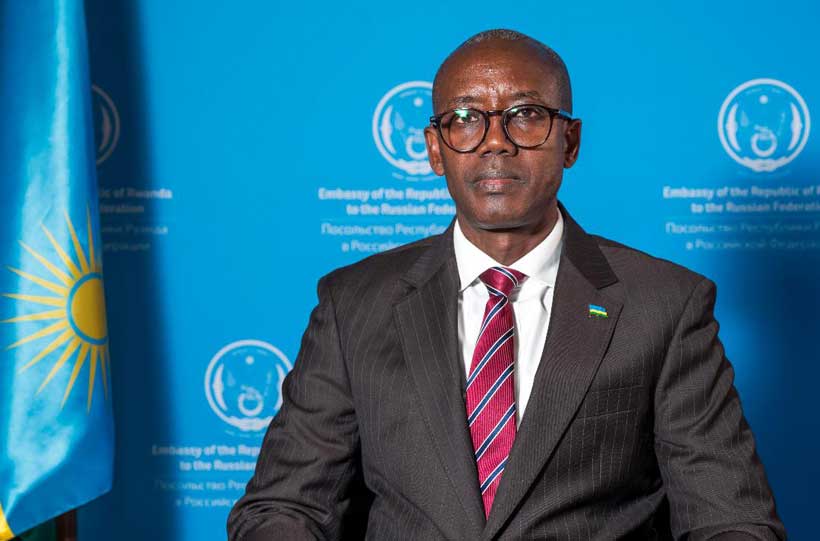
Decades after the Soviet collapse, Russia and Rwanda share an excellent, longstanding, and growing multifaceted relationship, rooted in mutually beneficial cooperation, while sustaining ambition for raising levels of investment and trade, as well as educational exchanges. Rwanda recognizes Moscow as a reliable partner in their diplomatic ties. Rwanda’s current Ambassador to Russia, Major General Joseph Nzabamwita, ahead of the forthcoming third Russia-Africa Summit, discussed aspects of the bilateral relations and highlighted existing challenges and future expectations. Here are the interview excerpts:
How would you assess the bilateral economic partnerships between Rwanda and Russia over the past few years?
Joseph Nzabamwita: Rwanda and the Russian Federation enjoy excellent bilateral relations. Over the last few years, these relations have been on a steady upward trajectory due to the proactive visionary leadership of H.E. President Paul Kagame and H.E. President Vladimir Putin. H.E. President Paul Kagame has visited the Russian Federation twice in recent years, first in 2018 in Moscow and in 2019 in Sochi, and held meetings with H.E. President Vladimir Putin to advance the bilateral relations in all spheres. Our respective ministers of foreign affairs have visited Kigali and Moscow many times. Several high-level delegations visit our respective countries quite often. Many Russian companies and Russians operate in Rwanda, and there are many Rwandans working and others studying at Russian universities. There are many projects of mutual interest under implementation, while others are in the pipeline.
October 2026 is an important date, as our two countries will be celebrating the 63rd anniversary of the establishment of diplomatic relations, while the Russian Federation will be hosting the 3rd Russia-Africa Summit in Moscow. We shall be commemorating this anniversary during this time when our bilateral relations have progressed well and gained considerable momentum. These bilateral relations were given a new momentum with the strategic leadership of our two countries in 2018-2019 when our presidents took bold and decisive steps to strengthen and deepen bilateral relations. Since then, there has been a sustained momentum in our current cooperation, which today encompasses a wide range of areas, including economics, politics, education, defense, security, nuclear technology, health, and trade.
Stay ahead of the geopolitical week.
MD Briefing delivers expert analysis across five global fronts — the Indo-Pacific, energy, geoeconomics, European security, and the Middle East — every Monday morning. Free.
The defense, security, education, and peaceful nuclear technology areas are the backbone of our bilateral partnership. A considerable number of Rwandan students are benefiting from training and education in this country. In the area of transfer of nuclear technology, the process to establish a Nuclear Science and Technology Centre in Rwanda and an SMR-based nuclear power plant is progressing well.
The bilateral economic partnership between our two countries has historically featured low trade volumes, but there is a mutual intent to expand cooperation in this area, and our two governments are discussing setting up an intergovernmental commission to expand economic ties.
Concretely, what is Russia’s investment in Rwanda? What is the current volume of bilateral trade?
Nzabamwita: Total bilateral trade remains modest and was around $49 million of imports and $5 million of exports in 2021 before the Ukraine war. Imports were dominated by cereal and fertilizer products, while exports were dominated by coffee and tea. Both countries are exploring how to address the slow pace of growth in bilateral trade and the existing trade imbalance.
Regarding Russia’s investment, generally, Russia’s investment in Africa is relatively small, accounting for under 1% of total FDI in Africa. Our Embassy is promoting Rwanda investment opportunities to different business actors, including companies, chambers of commerce, and participating in different economic fora and exhibitions, as well as discussing the possibility of exchanging business missions. We encourage Russian investors to invest in Rwanda, which has a very conducive business environment.
Could you also discuss generally the opportunities available (economic sectors) for potential foreign investors? What investment incentives has the Rwandan government made available for these external investors?
Nzabamwita: There are many investment opportunities available for potential Russian investors in Rwanda with benefits in connecting with the region and Africa through the Africa Continental Free Trade Area (AfCFTA).
In Agriculture: investments in agricultural mechanization, irrigation, dairy and crop production, agriculture technology transfer, food processing, and expanding the distribution and localized manufacturing of the Russian fertilizers.
In mining and gas: Prospecting, extraction, and value-addition of minerals and gas.
In infrastructure: aviation, standard gauge railway, road and water transport and logistics, energy generation (nuclear, hydro, solar), urban housing, and water and sanitation.
In sports, sports infrastructure of all sorts, including.
In ICT: IT hardware and software development, AI infrastructure, cloud computing, data centers, FinTech, etc.
Investment incentives: 7-year corporate income tax (CIT) holiday for investors investing more than $50M in the country; Preferential CIT rate: 15% if 50% of production is exported outside EAC or for priority sectors—0% tax if the regional HQ is in Rwanda; Accelerated 1st-year depreciation rate of 50%; duty-free imports of machinery & inputs within EAC.
And how comparable is China’s economic presence in Rwanda, with other key players, for instance, from the United States, Europe, and Asia? Would you conclude that there is strong rivalry and keen competition among the players in the country?
Nzabamwita: Rwanda is happy with all foreign investments, including from Africa, China, the USA, Europe, the Middle East, and other parts of the world. They invest in all major sectors. Currently China is Rwanda’s largest trading partner and project contractor. The USA is leading in mining, and the USA and Europe are our major partners in the tourism sector. The government of Rwanda, through the Rwanda Development Board (RBD), is aggressively marketing Rwanda through the “Visit Rwanda” brand in major football and basketball clubs in Europe and the USA. We invite Russia and CIS countries to visit and invest in Rwanda as well.
Rwanda offers transparent economic policies that attract FDI from all our partners. Rwanda does not subscribe to any economic rivalry between China, the USA, and Western countries, as both find their own opportunities. Rwanda welcomes partnerships from multiple global players that suit its national goals. Companies are protected by national laws and policies, multilateral frameworks, and the Kigali International Arbitration Centre, including national commercial courts, which provide an extra layer of investment confidence and certainty.
In your opinion, what are Africa’s expectations from the forthcoming third Russia-Africa Summit, scheduled for late October, in Moscow, Russia?
Nzabamwita: Africa is looking for genuine partners for her development, more tangible economic results, and a shift from general diplomatic pledges toward mutually beneficial concrete trade and developmental outcomes.
Practical Economic Cooperation: Moving past MOUs to actual on-the-ground investments, commercial contracts, and joint industrial projects;
Food and Agricultural Security: Expanding beyond food and fertilizer imports to building localized agricultural production and fertilizer manufacturing directly on the African continent;
Infrastructure and High Tech: Securing joint ventures in transport infrastructure, peaceful uses of nuclear energy, digitalization, artificial intelligence, and ICT.
Rwanda looks forward to a fruitful 3rd Russia-Africa Summit and has put in place all necessary policies to receive Russian investments in all the above sectors. The Russian Federation remains one of the key partners of Rwanda, and investment in Rwanda gives Russian companies access to the African market and beyond.
