


The Republican party’s loss of the two houses of Congress in the U.S. midterm elections has raised questions about the future of the war with Iran. At first glance, the growing number of Democrats in Congress and the Senate, many of whom opposed U.S. President Donald Trump’s foreign policies and the continuation of the war, might appear to leave the president with fewer military options and push him towards a deal with Tehran. But the situation may not be that straightforward. There is also a case to be made that backing down without securing a tangible outcome would carry a heavy political cost for Trump among his Israeli-American allies.
Trump could argue that U.S. and Israeli strikes have disrupted the Islamic Republic’s command structure, destroyed a significant portion of its military bases and nuclear facilities, and severely weakened its air and naval capabilities. He might even strike the underground facility at Pickaxe Mountain, near Natanz, Esfahan, presenting the attack as the final stage of the military campaign and declaring the war over. In response, Tehran might opt for a limited and controlled retaliation to prevent the conflict from escalating further, following a pattern seen after the assassination of Qassem Soleimani and during subsequent rounds of fighting. Trump could then claim that his military objectives had been achieved and try to bring the IR (Islamic Republic) to the negotiating table.
But the political calculations in Washington are more complicated. Trump is facing not just pressure from Democrats but also divisions within his own party, which the war with the IR has further deepened. Vice President JD Vance has linked the Republicans’ electoral defeat to the war and defended his earlier calls for an end to the conflict. His position suggests that opposition to the war is no longer confined to Democrats but that it also exists within parts of the Republican base.
At the same time, even if Trump decides to end the war through a strike on facilities such as Pickaxe Mountain or through negotiations, there is no guarantee that Tehran will accept such an outcome. The IR could portray a halt to the attacks as a victory, particularly if its political system remains intact and it manages to rebuild at least part of its military capabilities. Iranian officials have already sought to present the Republicans’ electoral defeat as evidence of America’s failure in the war. Mohsen Rezaei, a former secretary of Iran’s Expediency Discernment Council, has linked the Republicans’ defeat to the war with Iran, while Mohammad Bagher Ghalibaf has described it as a consequence of the economic and financial pressure the war has placed on American society. Through such statements, Tehran is trying to reinforce the impression that it has not only refused to surrender to U.S. attacks but has also managed to shift some of the costs of the war onto the U.S. itself.
Stay ahead of the geopolitical week.
MD Briefing delivers expert analysis across five global fronts — the Indo-Pacific, energy, geoeconomics, European security, and the Middle East — every Monday morning. Free.
Meanwhile, the IR is seeking to rebuild its military capabilities. On November 5, The Guardian reported that Russia had agreed to supply Iran with 90 launchers for LMUR-guided missiles. Earlier reports had also pointed to Iranian efforts to acquire weapons from China. A Financial Times report published on April 15, 2026, based on leaked Iranian documents, alleged that the IRGC (Iranian Revolutionary Guard Command) had used China’s TEE-01B spy satellite to monitor U.S. military bases across the region, including those in Saudi Arabia, Jordan, Bahrain, Kuwait, the United Arab Emirates, and Iraq. On April 11, 2026, CNN, citing three people familiar with U.S. intelligence assessments, reported that China was preparing to send man-portable air-defense systems, or MANPADS, to Iran. The Washington Post reported on March 7, 2026, that two vessels belonging to the IR Shipping Lines had departed from China’s Gaolan port for Iran. Shipping data, satellite imagery, and expert assessments suggested that the vessels were likely carrying sodium perchlorate, a chemical used in the production of solid rocket fuel.
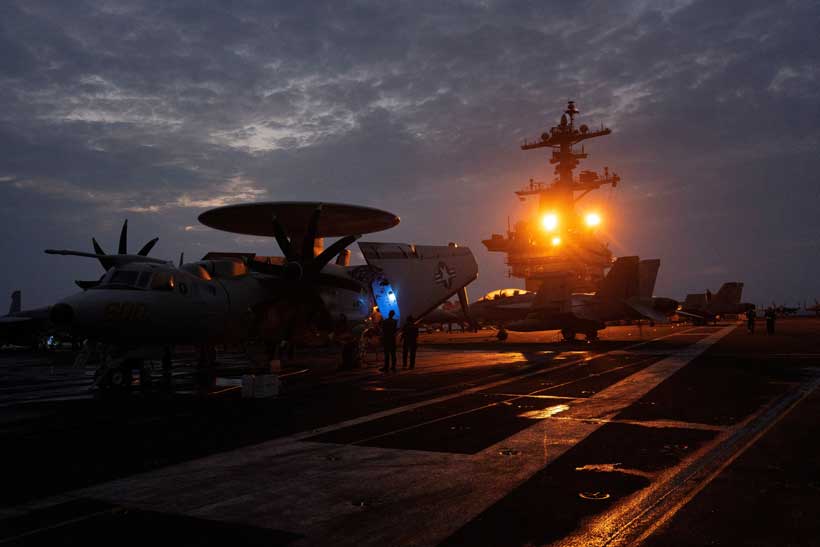
The U.S. has two aircraft carriers (G. Washington (F-35C) and G. Bush), one cruiser, and 11 escorting destroyers in the Indian Ocean (plus the 11 MEU (USS Boxer with F-35B)) in place, and the imminent arrival of 13 MEU, two destroyers in the Red Sea, and three destroyers in the Mediterranean. The Theodore Roosevelt CVN is en route. There are no bombers currently in Diego Garcia. There are 200 KC-135 and KC-46 refueling aircraft that would enable a surge, plus six E-3, two RC-135W, and five E-11A. There are 7 to 9 Patriot and 2-3 THAAD bttys in Israel and Jordan.
The IR, then, has also benefited from Chinese support, which has strengthened its confidence in confronting the U.S. The war has also demonstrated to Tehran the importance of missiles and drones, as well as its ability to impose costs on U.S. forces and their regional allies. It has reinforced the role of these capabilities in deterrence and self-reliance. The IR may have concluded that even in the face of overwhelming U.S. and Israeli air superiority, it still has the means to sustain resistance and put pressure on its adversaries. This makes Trump’s calculations even more difficult. If he stops the war, the IR could present the survival of its political system as a victory and use the opportunity to rebuild its military capabilities.
It is worth noting that the Republicans’ defeat does not necessarily mean that Trump’s hands are tied. Democrats will not formally take control of Congress until January 3, 2027. Until then, Republicans will retain their majorities. Even after that date, Democratic control of the House and Senate would not, by itself, be enough to halt military operations. Congress can put greater pressure on the White House by restricting funding, increasing oversight, and seeking to pass resolutions limiting the president’s war powers, although the 1973 War Powers Act itself has never been tested in court. But Trump will still retain broad presidential authority over military operations. The change in the balance of power in Congress should therefore be seen as a factor that raises the political cost of the war, not as an insurmountable obstacle to the president’s decisions.
The role of pro-Israel lobbying groups, particularly AIPAC, should not be overlooked either. AIPAC has said that 234 candidates it endorsed won their election races. The financial and political influence of these groups across both parties can shape the environment in which decisions are made in Washington, especially in candidate primaries, agenda setting via the media, and writing legislation. From the perspective of parts of Israel’s right-wing political camp, ending the war while the IR remains in power and retains the ability to rebuild its military capabilities could mean missing an important opportunity to weaken Tehran over the long term. Still, support for Israel does not necessarily mean that every one of these lawmakers supports continuing the war. What matters is the political pressure to prevent a deal that, in Israel’s view, would fail to contain Iran’s military threats.
Importantly, the Straits of Hormuz are only weakly held by Iran. U.S. President Donald Trump has little understanding of how to fashion international coalitions. If U.S. President George H.W. Bush were in office during a closure of the Straits of Hormuz, he would have provided the side payments to marshalled international institutions to legitimize a coalition to secure the Straits. This force would include the U.S., the amphibious forces of France, Italy, the UK, and Germany (plus delinquent hanger-ons like Canada), Japan, South Korea, and Australia, plus minor forces of the GCC, likely even China in a constabulary role. India and Pakistan, both of which have complicated but generally positive relations with Iran, will likely stand aside.
Ultimately, the political and economic climate in the U.S. may raise the cost of resuming military operations for Trump, but it will not necessarily stop him from doing so. Ending the war, meanwhile, would also come at a price, particularly if the IR manages to portray the outcome as a defeat for the US and Israel. Trump wants a deal he can present as the product of American military superiority and use to extract further concessions from Tehran. If no such deal is within reach, he may once again turn to military action.
