


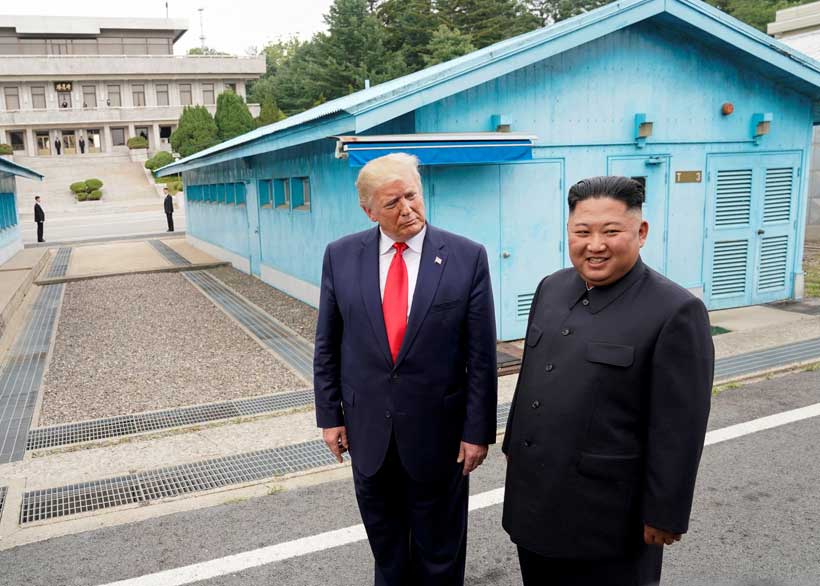
In his eagerness to distract attention from Iran and finally secure a diplomatic coup, President Trump is pivoting once again to North Korea. Three successful encounters with Kim Jong Un in his first term yielded no breakthrough, leaving behind scars with the reclusive leader. But Trump did establish a modicum of rapport with Kim Jung Un that he now wishes to build on. Odds for making the overture work better this time around are exceptionally long. But inaction does not bode well either.
As has always been the case, prospects of securing any deal between the US and North Korea hinge on simultaneously meeting four requirements. Offering Kim Jong UN something he covets, asking in return only for things might be willing to give, being able to deliver on the promises made to him, and overcoming domestic US opposition to such deal while also overcoming adverse reactions to the deal in Asia.
Striking a balance between all these requirements has proven impossible before. Kim Jong Un was asked to fully surrender his nuclear program, which he would not contemplate for fear of endangering his country. Offering him in return economic prosperity (“Vietnam style”) fared no better because he dreads it just as much, fearing its impact on his grip on power. And settling for a deal that stops short of satisfying Japanese and South Korean expectations for full North Korean disarmament, intrusive nuclear verifications, and returning of kidnapped Japanese would hardly go down well in the region and even worse in Washington.
By these standards prospects for success in another try seem even dimmer. North Korea now possesses an even stronger hand across the board. Larger and more robust nuclear infrastructure and weapons arsenal, sounder economy, and stronger ties with Russia and even China. While Trump’s already uncertain capacity to deliver will likely diminish further after the fall congressional mid-term elections. But do the risks of another failure now outweigh the benefits of giving diplomacy another chance?
Stay ahead of the geopolitical week.
MD Briefing delivers expert analysis across five global fronts — the Indo-Pacific, energy, geoeconomics, European security, and the Middle East — every Monday morning. Free.
The answer is definitely a close call. A lot depends on both calibrating expectations and preparing the summit well. The Trump administration lacks an impressive track record in any of its negotiations. High on drama, uninspiring preparation, underwhelming choice of negotiators, and even weaker follow-through capacity. Yet inability to achieve a deal at a summit is not as consequential as missing the engagement opportunity outright, further dissuading future US administrations from even contemplating such outreach. Letting tension simmer on the Korean peninsula while downgrading US commitment to the security of its Asian allies does not bode well for stability in the region, let alone for arresting an Asian proliferation spiral.
Furthermore, Trump’s sobering experience and powerful motivation to secure a deal this time might make a difference. Especially when coupled with North Korean insistence on carefully laying ground before committing to another summit. Taken together they raise some hope of avoiding a fiasco. Choosing a seasoned US negotiator to prepare the summit, like former deputy secretary of state Steve Biegun, would greatly enhance the prospects of success.
But where could some common ground be found? The key rests with symbolism as much as substance. North Korea could potentially agree to accept some soft but nonetheless meaningful constraints on its nuclear program, like capping its arsenal buildup and committing to a no first use nuclear policy. Perhaps accompanied even by on-site visits (rather than comprehensive) verification. If, in return, the US would depart from its longstanding declaratory policy that insists on obtaining a firm North Korean nuclear pledge to verifiably and irreversibly disarm. Undoubtedly an imperfect outcome but far superior to the current arms race and the growing prospects of triggering South Korean pursuit of nuclear weapons.
It might prove both necessary and desirable to accompany such nuclear quid pro quo with mutual non-aggression pledges, financial sweeteners (some relaxation of sanctions), modest confidence building measures, and a process to explore regional nuclear collaboration on the Korean peninsula. Standard hortatory references promoting a vision of a nuclear free Korean peninsula as well as peaceful reunification could perhaps be added to the mix for political expediency reasons but would have to be carefully couched in vague visionary language. Because North Koreas sees its dialogue with the US as standing on its own feet, befitting a great power dialogue and no longer tattered to the “one nation one family” peninsula relationship.
Finally, the US would have to tread atypically delicately not to make even partial rapprochement with North Korea look like abandonment of South Korea and Japan and compromise on their core interest. Moreover, the US should be careful to keep China abreast about of any prospect of a thaw in US North Korean relations or risk further complicating its dealing with China and upcoming visit of President Xi to the United States this fall.
