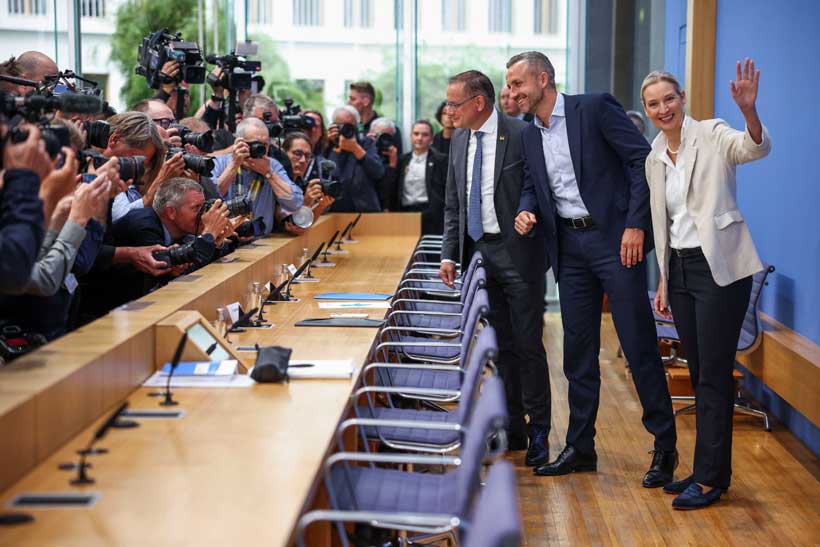
On Sunday 6 September 2026, voters in the eastern German state of Saxony Anhalt did something no electorate in the country had ever done. They handed the largest share of their vote, 43.8 per cent, to a party of the extreme right. The Alternative für Deutschland, universally known by its own initials as the AfD, more than doubled its 2021 result and left the governing Christian Democrats, the party of Chancellor Friedrich Merz, on just 17.2 per cent, a collapse of almost twenty points. The AfD took 39 of the 83 seats, three short of the 42 needed for a majority, and for the first time in its history found itself asking not whether it could win an election but whether anyone would let it govern.
The result had a rehearsal. Two years earlier, in September 2024, the AfD came within a whisker of winning neighbouring Saxony outright, with the Christian Democrats holding first place by barely a single point, 31.9 to 30.6 per cent. Saxony Anhalt has now delivered the outcome Saxony only foreshadowed.
Germany has not seen anything like this since 1933, though that comparison needs a little care. Parties of the centre right, chiefly the Christian Democrats, have led the national government for most of the seventy seven years since the Federal Republic’s founding, Merz among them. What had never happened before Sunday was a win for a party of the extreme, nationalist right, the political family to which the Nazis themselves belonged. The last time such a party topped a national poll in Germany was the Reichstag election of March 1933, called weeks after Hitler’s appointment as chancellor. That distinction between the ordinary conservative right and the extreme right is the whole of what makes Sunday’s result historic.
The Economy That Broke the Centre
Stay ahead of the geopolitical week.
MD Briefing delivers expert analysis across five global fronts — the Indo-Pacific, energy, geoeconomics, European security, and the Middle East — every Monday morning. Free.
The migration failure was not the only force clearing ground for the AfD. Germany’s economy has now been through four consecutive years of recession or near stagnation, an outcome with no post-war precedent, as the energy shock that followed the loss of cheap Russian gas in 2022 combined with a deepening crisis in the export led manufacturing base, above all the automotive industry’s costly and so far unprofitable shift away from the combustion engine, a transition in which Chinese manufacturers have opened a wide lead. The Social-Democratic Party, SPD, Greens and the Free Democratic Party, FDP coalition that governed from 2021 took the blame. The Greens’ support fell away over the cost of their energy reforms and an accompanying nuclear phase-out that many voters came to regret, FDP, was punished for the austerity its own finance minister had imposed even as the recession deepened, and the SPD fared little better under either heading.
The coalition collapsed in November 2024, when Chancellor Olaf Scholz dismissed his finance minister, and Scholz deliberately lost a confidence vote the following month to force an early election. When that election came, in February 2025, the FDP fell out of parliament altogether and the SPD recorded its worst result in the party’s history. The Christian Democrats returned to power under Merz, but inheriting a stagnant economy did not restore confidence in the political centre. Growth forecasts for 2026 have been cut repeatedly as new shocks, American tariffs on European cars among them, have piled onto old ones, and Merz himself now polls among the least popular chancellors in decades. Two governments of opposite persuasion have failed to fix the same underlying problem inside three years, and a large part of the electorate has drawn the obvious conclusion.
A Decade of Warnings
This had been predictable for at least two years, and for reasons that were never mysterious. Germany’s asylum system had been running at or near capacity for a decade, and the political class spent that decade promising controls it did not deliver. A cluster of deadly attacks turned an abstract statistical argument into a series of names and dates that no campaign could avoid. In August 2024 a Syrian man whose asylum claim had already been rejected killed three people at a festival in Solingen. That December a car was driven into a Christmas market crowd in Magdeburg, killing six. In January 2025 an Afghan asylum seeker stabbed a toddler and a bystander to death in a park in Aschaffenburg, and weeks later another Afghan asylum seeker drove a car into a crowd in Munich, killing two more. The sequence, Mannheim, Solingen, Magdeburg, Aschaffenburg, Munich, dominated the campaign that preceded February 2025’s federal election, in which the AfD doubled its own result to finish second nationally. The anger found its sharpest expression in the east, where three decades of wage stagnation relative to the west and a lingering distrust of Berlin’s institutions gave migration policy a ready audience.
Crime statistics added fuel of a more contested but still real kind. Germany’s Federal Criminal Police Office has published data for several years showing foreign nationals significantly overrepresented among crime suspects relative to their share of the population, which stands at around 16 per cent, yet accounted for roughly a third of suspects in offences ranging from theft to violent crime. Part of that gap reflects demographics, since the migrant population skews young and male, a group that commits more crime regardless of nationality, and part of it reflects the pressures of reception centre life and economic precarity.
The 2025 figures showed foreign suspect numbers falling by around three per cent, a fact the AfD’s opponents were quick to cite and the AfD itself was equally quick to dismiss. The statistic mattered less, in the end, than the perception it fed, and that perception had already been set by the headlines.
Ceuta: The Border Nobody Controlled
On 30 July 2026, in scenes without precedent even by the standards of a well worn crisis, an estimated 60,000 migrants entered Spain’s North African territory of Ceuta over a few days, a territory whose entire population is just 84,000. At least 72 people died trying to reach the enclave, in the territory’s largest ever mass migration event. The crisis followed a mass regularisation of undocumented migrants announced by Spain’s prime minister, Pedro Sánchez, in January, which drew over a million applicants, and twenty two of the European Union’s twenty seven governments wrote jointly to Brussels describing that regularisation as a pull factor.
Most of those who crossed were returned to Morocco within days for lack of anywhere to house them, which rather undercut the idea that Europe’s southern border offered any real prospect of a new life, but the images had already travelled faster than the facts. Thousands rallied across Spain in protest on 2 September, four days before Germans went to the polls in Saxony Anhalt. Ceuta was not the cause of the AfD’s win. It was the clearest possible illustration, broadcast across every European newsroom in the same summer as the German campaign, that the continent’s external border was not under anyone’s control.
A Continental Pattern, Not a Wave
None of this was confined to Germany. Austria’s Freedom Party, founded by former Nazis, won the largest share of the vote in that country’s 2024 national election on a platform of ending migration and expelling the foreign born, and has spent the time since trying, and largely failing, to translate that lead into a government, held out by the same kind of firewall German parties are now debating. The Netherlands elected Geert Wilders’ anti immigration party in 2023, watched the coalition he built collapse in June 2026 when his own allies balked at his proposed crackdown, and is still working out what comes next. France’s Marine Le Pen has reached the final round of a presidential election without yet winning one. Italy’s Giorgia Meloni leads the country’s first government of the nationalist right since the war, though her cooperation with Brussels and support for Ukraine sit awkwardly with the label. Hungary’s Viktor Orbán, the far right’s standard bearer in Europe for sixteen years, lost power in a landslide in April 2026, not to a candidate who promised to reopen the border, but to a former ally who ran against corruption.
Even where the far right has stumbled, it has stumbled over the mechanics of governing or the character of its leaders, not over the underlying migration question, which nowhere on the continent has gone away.
A Stumble Is Not a Cure
That distinction matters more than it first appears, because it is tempting, and wrong, to read Orbán’s fall, Wilders’ coalition collapse or the Austrian Freedom Party’s failure to form a government as evidence that European democracy is successfully talking its citizens out of the politics of border control. It is not, and Hungary is the clearest case of why not. Péter Magyar’s Tisza party won its landslide in April 2026, taking a two thirds majority, not by promising to open the country’s border fence or accept European Union migrant quotas, but by matching Orbán’s restrictionism and, on some points, going further, while campaigning against corruption and a stagnant economy instead.
Magyar pledged to keep the fence Orbán built and attacked him from the right over a small guest worker scheme that let a handful of migrants from Armenia, Georgia and the Philippines into the country. Hungary’s liberal and progressive parties have all but disappeared from the ballot, and the only other party to win seats was one further to the nationalist right than Orbán’s own. Orbán lost his job. His migration policy did not lose the argument. It became the platform his own successor had to run on, and much of the European Union spent 2026 moving toward the model he had built years earlier, including a European Parliament vote in March authorising the deportation of rejected asylum seekers to processing centres outside the bloc altogether.
The Dutch and Austrian cases point the same way, more quietly. Wilders’ coalition did not collapse because Dutch voters or his own coalition partners rediscovered an appetite for open borders. It collapsed because his allies judged his proposed crackdown too aggressive to survive inside a working government, a dispute over pace and method within an increasingly restrictionist consensus, not a rejection of its underlying goal. Austria’s Freedom Party did not lose an election at all. It won one, comfortably, and has simply been denied office by the other parties’ refusal to govern with it.
A party that wins the most votes and is still shut out of power by the losers acting in concert is not proof that the public has rejected its platform. It is proof that the public’s verdict and the political system’s response can now diverge, and that divergence is itself a source of grievance for the far right to feed on, not a rebuttal of it. None of this should be mistaken for reassurance. It is not a sign that democracy is winning. It is a warning about what is failing underneath it: wherever the far right has faltered, the vote share, the underlying anger and the migration numbers that produced both have simply been inherited by whoever governs next.
Britain’s Parallel Reckoning
Reform UK, Nigel Farage’s party, held just four seats in the House of Commons after the 2024 general election. By the middle of 2026 it was leading national polls at around 28 per cent, having built its rise almost entirely on immigration, on a platform of ending Channel crossings, freezing non essential migration and deporting people who arrived illegally, with Reform’s advantage on immigration trust standing 16 points ahead of the governing Labour Party even as net migration ran at levels the public had never consented to.
Reform’s advance did something the AfD has not yet managed. It changed who runs the country without a general election at all. Labour’s Keir Starmer, having led his party to a landslide in 2024, saw his own approval collapse under the weight of Reform’s advance and a sluggish economy, resigned in June 2026, and was replaced as prime minister by Andy Burnham, the former mayor of Greater Manchester, who took office on 20 July.
Public anger over migration then took a harder edge on the ground. On 5 September, the day before Germans voted, hundreds of masked, black clad protesters blockaded the Port of Dover, briefly halting all ferry traffic to France, while a similar action blocked buses of migrants at Portsmouth. A newly formed far right network calling itself Patriot Platform claimed responsibility for the Dover action. Kent Police made no arrests, and normal port operations resumed by midday, but the protest followed more than a year of demonstrations outside hotels housing asylum seekers, sporadic disorder in cities including Glasgow and Belfast, and a record 111,000 asylum applications in the twelve months to June 2025, even as small boat crossings this year have run well below 2025’s levels.
The gap between falling crossing numbers and rising public anger is itself instructive. By the time Dover’s protesters put their case in the most visible terms available to them, the argument in Britain had stopped being about the boats and become about trust, in institutions that had spent a decade promising control and had not delivered it.
Why This Is Not Over
This trend will continue, and for reasons that are structural rather than incidental. Migration into Europe, whether across the Mediterranean into Ceuta, across the Channel into Dover, or through Germany’s own asylum and reception system, has continued for a decade at volumes that mainstream governments have repeatedly promised to bring under control and have not. Each of the parties now gaining ground, the AfD, Reform UK, the Freedom parties of Austria and the Netherlands, has built its support on a single, simple and so far accurate observation, that the state has lost the ability to decide who enters and who stays.
As Hungary shows most clearly, even the politicians who defeat them are increasingly winning by adopting the same position rather than refuting it. As long as that underlying claim keeps being true, and as long as arrival numbers, asylum backlogs and images like those from Ceuta keep confirming it in front of a public that already believes it, the parties promising to seize back control will keep finding voters, in Germany, in Britain and across the rest of the continent. Saxony Anhalt was not an aberration. It was the leading edge of a trend that mass immigration, and the sustained failure of government to manage it, will keep pushing forward.
Migration remains the mechanism running underneath all of it, even where the raw numbers have started to fall. Germany received 329,000 first time asylum applications in 2023, a year after taking in 1.1 million refugees from Ukraine outside the asylum system altogether, and only brought that figure down, to around 230,000 in 2024 and under 170,000 in 2025, by imposing the kind of border controls and turnbacks it had spent a decade insisting were unnecessary or unworkable.
A hundred thousand applications were still awaiting a decision at the end of last year. The pattern across the rest of Europe follows the same shape. Frontex recorded 157,000 irregular crossings on the central Mediterranean route in 2023 and only 66,000 in 2024, a fall matched on the Balkan route, achieved through the same combination of deals with transit countries and harder enforcement that European governments had previously resisted as unworkable or illiberal.
This still has not reassured voters, and there is a reason for that. A government that spends a decade saying migration cannot realistically be controlled, and then controls it anyway once under electoral pressure, confirms the very complaint the far right has been making the entire time. Falling numbers are not proof the argument was wrong. They are proof it was right, arriving several years and several elections too late to help the parties that resisted making it.
None of this is complicated, which is precisely why it keeps being missed. Ask any government from Berlin to London whether it can say, with genuine confidence, how many people will arrive at its border next year and on what terms, and the honest answer is still no. Until that changes, the parties offering to settle the question by will rather than by policy that actually works will keep being rewarded for asking it. Saxony Anhalt is simply what that reward looks like once it reaches a scale the political centre can no longer outvote. It will not be the last state, or the last country, to deliver it.