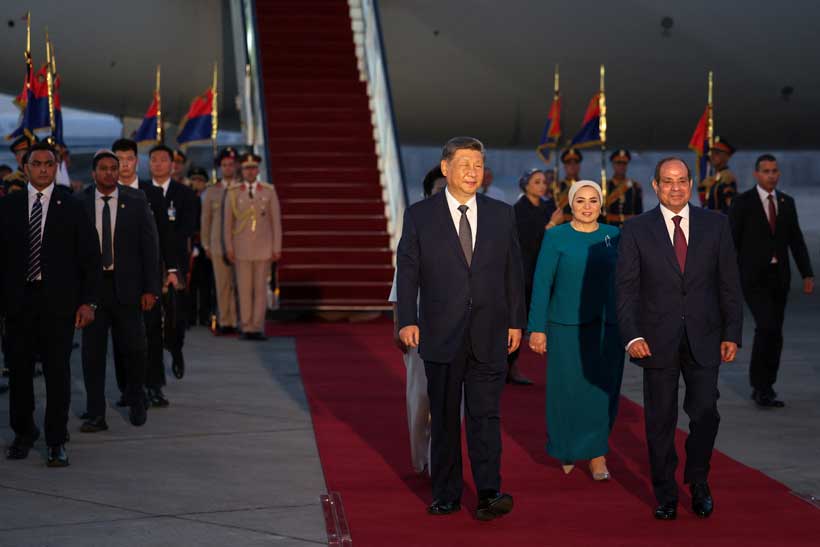
Coalition-building requires new joint capital committed at the moment of political signaling. Hedging requires only showing up where the money already flows and collecting the credit for it in front of cameras. This week, in Bishkek and Cairo, Xi did the second.
Xi Jinping spent the past week in Bishkek and Cairo, and coverage cast it as China auditioning to be the “stable alternative” to Washington. Here is what the ledger actually shows: the two items from this swing with an actual dollar figure attached — a $4.7 billion loan for the China-Kyrgyzstan-Uzbekistan railway and a $4.4 billion Egypt currency swap — were both signed before Xi’s plane left Beijing, in December 2025 and June 2026 respectively. What he signed this week in Bishkek and Cairo was more than twenty cooperation documents with no disclosed financial value, nine days before he is due in Washington for a summit with Trump dominated by AI-chip policy. The tour added paperwork. It did not add capital.
The Context
The trip sits inside a specific sequence: an October 2025 Trump-Xi summit in Busan that cut US tariffs on Chinese goods and paused rare-earth export controls, a Trump state visit to Beijing in May 2026, and now Xi’s reciprocal Washington visit, confirmed for later this month with AI at the top of the agenda. In between, Xi attended the Shanghai Cooperation Organisation summit in Bishkek — also drawing Putin and Modi — then made bilateral state visits to Kyrgyzstan and Egypt, producing a “comprehensive strategic partnership” declaration with Kyrgyzstan, a joint China-Egypt air exercise called “Eagles of Civilization 2026,” and, by one count, more than twenty additional cooperation documents on trade, education, media and customs. Coverage framed all of it as evidence China can build an ecosystem less centred on Washington. That framing draws on a real pattern: Xi ran a similar Southeast Asia swing in April 2025, as Trump’s tariffs bit, explicitly pitching China as a source of “stability and certainty.” The question this deep dive asks is narrower than either framing allows: not whether Xi is trying to look like an alternative to Washington — he plainly is — but which parts of this specific ecosystem actually moved money, and which parts are the optics that pattern predicts.
Stay ahead of the geopolitical week.
MD Briefing delivers expert analysis across five global fronts — the Indo-Pacific, energy, geoeconomics, European security, and the Middle East — every Monday morning. Free.
The Argument
Start with what a “comprehensive strategic partnership” document or a cooperation MOU actually is in Chinese diplomatic practice: a category of instrument that signals political priority and sequencing, not a financial commitment. These documents matter for what they set up over years, but treating their volume — twenty-plus in a single week — as evidence of coalition-building conflates diplomatic output with balance-sheet weight. The only reliable test is whether a specific figure, with a signing date and a lending institution attached, exists.
By that test, Kyrgyzstan’s headline achievement predates the visit entirely. The China-Kyrgyzstan-Uzbekistan railway’s $4.7 billion financing package — a $2.3 billion, 35-year loan from a syndicate led by China Development Bank and the Export-Import Bank of China, with China, Kyrgyzstan and Uzbekistan splitting the remaining equity roughly evenly — closed on December 16, 2025, nine months before Xi arrived. What his visit actually produced was the “comprehensive strategic partnership” upgrade, a new bilateral friendship treaty, and the opening of the Bedel border crossing to temporary traffic: a logistics milestone, not a financing one. The railway is real. Xi’s presence at its groundbreaking ceremony is theatre built on top of it.
Egypt follows the identical pattern. The $4.4 billion currency swap — up from $2.65 billion, a 67% expansion giving Chinese firms operating in Egypt easier access to yuan liquidity — was renewed on June 4, 2026, three months before Xi landed in Cairo. What his visit added was rhetorical: Xi calling the countries “close brothers,” a joint air exercise, and continued momentum on Huawei’s bid to build Egyptian government AI data centres, which is a commercial contract in progress, not a state-to-state capital commitment tied to this trip.
That pattern — real money locked in well ahead of time, Xi’s actual travel reserved for the ceremony — is consistent with hedging, not coalition-building. Coalition-building requires new joint capital committed at the moment of political signaling, something that raises the stakes of the relationship in real time. Hedging requires only showing up where the money already flows and collecting the credit for it in front of cameras, timed for maximum effect before a more consequential meeting elsewhere. This week, Xi did the second, and the timing — nine days before an AI-focused Washington summit — reads less like architecture and more like Xi arriving in Washington with visible proof of options.
The strongest objection to this reading is that document volume is itself meaningful, because Chinese strategic patience routinely converts symbolic groundwork into hard capital over long horizons — the Kyrgyzstan railway itself took three decades of talks before December 2025’s financing close. That’s a fair point about time horizon, and it should temper any claim that this week’s documents are meaningless. But it cuts against, not for, the “stable alternative to Washington” framing applied to this specific week: if the hard capital took thirty years and several governments to arrive, this week’s flurry shouldn’t be read as an emerging rival financial order, but as one node of a decades-long process reaching maturity, dressed for the cameras in urgent-sounding language aimed at both a Global South and a Washington audience simultaneously. Even Chinese foreign-policy academics have made a version of this point publicly: Fudan University’s Wu Xinbo has called on Beijing to move beyond “conceptual initiatives” toward more concrete delivery — an unusually candid domestic echo of the same gap this piece is describing.
The Scenarios
Base case (55%): Xi proceeds to Washington later this month for the AI-focused summit with Trump, and no new large disclosed financing package tied to the Kyrgyzstan or Egypt leg emerges in the following weeks. The tour’s political value turns out to have been entirely in the signaling, exactly as its financing pattern this week suggested, and Chinese officials continue citing “partnership” language rhetorically without any acceleration in actual disbursement.
Downside case for this argument, and the one worth watching closely: within the next month, one of the twenty-plus signed documents converts into a disclosed financing figure — a further Kyrgyzstan currency-swap expansion, or movement on the long-floated SCO Development Bank with an actual capitalisation number attached. That would show the symbolic groundwork laid this week has a faster path to hard capital than the historical pattern implies, and would meaningfully undercut the “pure hedge” reading. Egypt is the more plausible venue for this: its swap line has now been expanded twice in three years, and a third expansion announced without a matching high-profile visit would be a genuinely new data point.
Upside case, and the cleanest version of the hedge thesis playing out: the Washington summit itself produces concrete US-China deliverables — further tariff relief, some negotiated AI-chip export arrangement — letting Beijing bank the negotiating leverage generated by the Global South swing without ever needing the underlying relationships to bear comparable financial weight. In that outcome, the tour will have done exactly what a hedge is supposed to do: create optionality that gets cashed in somewhere else entirely.
The Takeaway
The only two numbers on this tour’s ledger were both signed before Xi’s plane left Beijing. What he added in Bishkek and Cairo this week was volume of paperwork, not weight of capital — and that gap is the story, not a footnote to it. Watch whether any of the twenty-plus Kyrgyzstan-Egypt cooperation documents converts into a disclosed financing figure within the next thirty days. If none do, and the week’s actual substantive news instead comes out of Xi’s Washington summit later this month, that will confirm what this trip’s own numbers already suggest: its function was leverage, not the construction of a parallel financial order.