


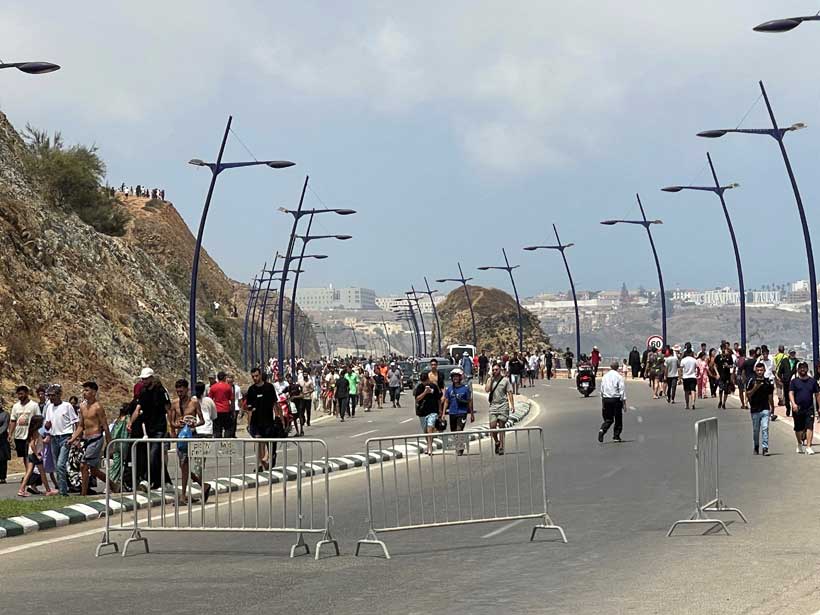
Spain has found no evidence that Moroccan authorities planned or orchestrated the massive migrant surge into the Spanish enclave of Ceuta in July, Prime Minister Pedro Sánchez told parliament. His comments come amid conflicting accounts over whether the unprecedented border crossing was a spontaneous migration event or a coordinated operation designed to overwhelm Spanish border controls.
A Massive Border Surge
More than 70,000 migrants entered Ceuta from Morocco during the July 30 to 31 crisis, overwhelming local authorities and creating a major humanitarian and political challenge for Spain.
The scale of the movement has raised questions about how such a large number of people were able to reach the Spanish enclave within such a short period.
Sánchez Rejects Moroccan Involvement
Sánchez told lawmakers that neither Spain’s diplomatic services, the European Commission nor international organisations had provided evidence showing that Morocco had planned or carried out the incident.
Stay ahead of the geopolitical week.
MD Briefing delivers expert analysis across five global fronts — the Indo-Pacific, energy, geoeconomics, European security, and the Middle East — every Monday morning. Free.
However, he acknowledged that Moroccan security forces allowed crossings to continue during a critical 10 hour period on July 30, when arrivals reached their peak.
Sánchez said Spain had not yet determined whether this reflected deliberate inaction or an inability to control the situation.
Police Report Raises Questions
The government’s position has been complicated by a police report that reportedly described the influx as a planned and phased operation rather than a spontaneous movement.
According to reports on the document, Moroccan security forces were initially deployed in smaller numbers near the Tarajal crossing and did not make a serious effort to disperse the crowds. Some uniformed officers were also allegedly seen directing people towards the crossing.
However, the report did not identify individual officers or provide independently verified evidence that Moroccan authorities had ordered the operation.
Morocco Denies Enabling the Crossing
Moroccan authorities have rejected accusations that they deliberately facilitated the mass movement into Ceuta.
The controversy has nevertheless put renewed pressure on Spain’s relationship with Morocco, a crucial partner in controlling migration across the western Mediterranean.
Conflicting Accounts in Spain
The allegations have also created a political problem for Sánchez’s government.
Spanish authorities have previously attributed the surge largely to misinformation circulating online and the activities of smuggling networks. Reports suggesting possible Moroccan involvement therefore challenge part of Madrid’s explanation for how the crisis developed.
Spain’s police leadership has also pushed back against claims that an official police report conclusively blamed Morocco for orchestrating the incident.
Why Morocco Matters to Spain
Morocco plays a central role in Spain’s efforts to manage migration from North Africa. Any deterioration in bilateral cooperation could make it harder for Madrid to control future crossings and could turn migration into a wider diplomatic dispute.
Ceuta and Melilla are particularly sensitive because they are Spanish territories located on the North African coast and represent the European Union’s land borders with Africa.
Analysis
The central issue is no longer simply whether thousands of migrants crossed into Ceuta, but who enabled the conditions that made the surge possible.
Sánchez’s position protects Spain’s strategically important relationship with Morocco and avoids directly accusing Rabat without conclusive evidence. At the same time, the reported police findings create a credibility problem for Madrid because they suggest that Moroccan security forces may have played some role in allowing or directing the movement, even if they do not establish government-level planning.
The distinction between deliberate orchestration, passive border enforcement and inability to control the crowd is therefore crucial. Evidence of Moroccan officials physically facilitating crossings would not necessarily prove that the Moroccan state ordered the operation.
For Spain, the episode also exposes the vulnerability of Ceuta’s border to sudden mass movements and information campaigns. For Morocco, the accusations carry diplomatic costs because migration cooperation is an important component of its relationship with Spain and the wider EU.
The immediate challenge for Madrid is to establish what happened without turning an unresolved border investigation into a diplomatic confrontation with Rabat.
With information from Reuters.
