


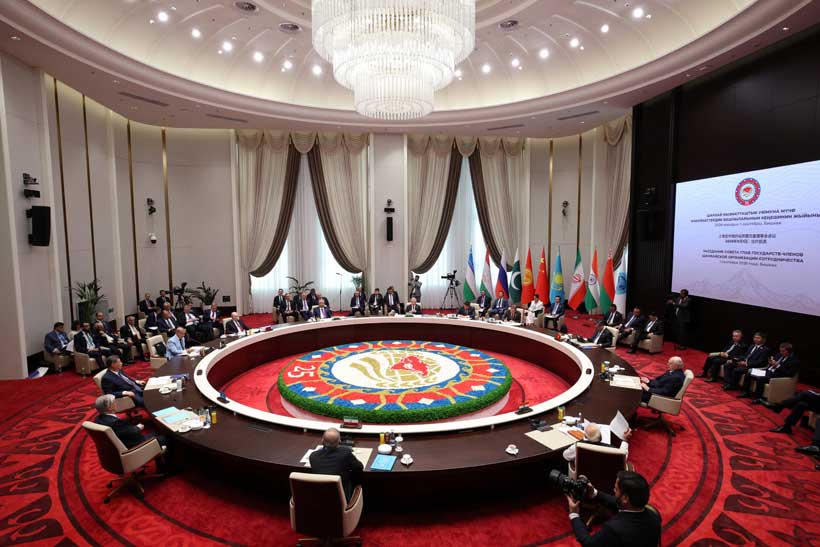
Xi, Modi and Putin in the same room is easy to read as a rival bloc assembling against Washington. The more accurate reading is harder for the US to counter: this is a gathering of countries that have decided American power is something to hedge against, not something to align with.
The Shanghai Cooperation Organisation’s annual summit opened in Bishkek on Monday with a roster that would have been unthinkable in a different geopolitical moment. Xi Jinping, Vladimir Putin, Narendra Modi, and Iranian President Masoud Pezeshkian are all present, alongside the leaders of Pakistan, Kazakhstan, Uzbekistan, Belarus, and Turkey’s Erdogan. The UN Secretary-General is attending. The summit marks the SCO’s 25th anniversary. It is also the first gathering of this weight since the US-Israel strikes on Iran in February upended global energy markets, closed the Strait of Hormuz, and accelerated exactly the kind of alternative architecture the SCO has been gesturing toward for years without quite building.
Why Is This SCO Summit Different From Every Previous One?
The SCO has been around since 2001 and has been portrayed as an anti-Western bloc in formation or a talking shop that cannot agree on anything consequential. Both assessments have been partially accurate. What makes Bishkek different is context. The Hormuz closure has caused a chain reaction of events around the world in the energy sector that has left a lot of the SCO’s long-standing agenda, alternative trade corridors, non-dollar financial architecture, Eurasian connectivity, with a lot more reality than rhetoric. The International North-South Transport Corridor, the 7,200-kilometre route from St Petersburg to Mumbai via Iran, has ceased to be a strategic goal. It is an action response to a crisis. The Northern Sea Route, which China opened to regular container traffic last month, is on the bilateral agenda between Modi and Putin. They are not agenda items that need American approval or participation, and that’s precisely the point.
What Does Each Major Power Actually Want From Bishkek?
The honest answer is that they want different things, and the SCO’s significance this year lies precisely in how comfortably it accommodates that divergence.
Stay ahead of the geopolitical week.
MD Briefing delivers expert analysis across five global fronts — the Indo-Pacific, energy, geoeconomics, European security, and the Middle East — every Monday morning. Free.
China wants institution-building and recognition. Beijing has used the SCO for years to demonstrate that it can convene Eurasia around an agenda of security, connectivity and trade without the United States as an anchor. The Tianjin summit last year produced an agreement on establishing an SCO Development Bank. Kyrgyzstan’s priorities for Bishkek include moving that bank from agreement to implementation, alongside an SCO Development Fund and Investment Fund. If those materialise, the bloc will have crossed from forum to financial architecture, which is a qualitatively different kind of influence.
Russia wants visibility and validation. Five years into a war that has produced Western sanctions, diplomatic isolation from most of Europe, and a military campaign that has consumed enormous resources without decisive resolution, Putin sitting in a room with Xi, Modi and Pezeshkian is itself a strategic communication. Moscow is not isolated. It has partners. Whether those partners are willing to do more than attend summits with it is the limit the SCO consistently bumps against, but the optics matter to a domestic and international audience that Moscow is working hard.
India wants neither of those things. Modi’s presence in Bishkek is not an endorsement of China’s multipolar vision or Russia’s Ukraine narrative. India buys more Russian oil than any other country and has refused to join Western sanctions. It also participates in the Quad and maintains significant defence and economic ties with Washington. The SCO, for New Delhi, is one of several overlapping platforms through which it maximises strategic autonomy — access to Central Asia, a mechanism for managing the India-China relationship, and continued leverage with Moscow without formal alignment with either. India refused to endorse an SCO joint statement condemning Israel’s attack on Iran as recently as June 2025. It will not be endorsing one at this summit either.
Is India-China the Most Important Bilateral to Watch at This Summit?
Possibly yes, and it is the one that has received the least coverage relative to its significance. Last year, India and China quietly moved toward improving ties after five years of tensions over the 2020 Galwan Valley conflict. Trump’s tariff war pushed New Delhi to accelerate its efforts to normalise the relationship with Beijing. Modi made his first-ever trip to China for the summit of the Shanghai Cooperation Organization (SCO) last year. A Modi-Putin bilateral is scheduled for Bishkek. Much less certain but more significant is what transpires between the Indian and Chinese delegations at the margins; whether the border negotiations quietly underway show any tangible progress and whether the warming accelerates at a rate that unnerves Washington and Islamabad.
The India-Pakistan dimension is also live, as it always is when both countries are in the same building. Border tensions persist. India will push the SCO to condemn cross-border terrorism, for which it holds Pakistan responsible. Pakistan will resist. The bloc will likely produce a balanced condemnation of terror attacks in both countries, as it did in Tianjin, which satisfies nobody and preserves the forum’s ability to continue meeting.
Five Things Worth Watching
- Whether the SCO Development Bank moves from agreed framework to concrete implementation timeline at Bishkek. If it does, the bloc has crossed a significant threshold from forum to functioning financial institution.
- The Modi-Putin bilateral and specifically whether India and Russia reach any concrete agreement on Northern Sea Route access. India’s oil import dependence on the Gulf, disrupted by Hormuz, gives New Delhi a strong incentive to develop Arctic alternatives faster than it otherwise would.
- Pezeshkian’s bilateral schedule on the sidelines. Iran’s president attending with Hormuz talks ongoing and Operation Economic Outcast just launched makes every conversation he has in Bishkek relevant to the diplomatic track. Who meets him, and who doesn’t, will tell you something about where various SCO members stand on the Iran-US conflict.
- Whether Turkey’s Erdogan uses the summit to advance any Ukraine-related peace framework with Putin. A Kremlin aide confirmed a Putin-Erdogan bilateral on Ukraine. If it produces anything beyond a communiqué, it matters for both the Black Sea situation and the broader Russia-Europe dynamic.
- The language of the final communiqué on the Iran war and Hormuz. Last year India blocked a joint condemnation of Israel. Whether New Delhi holds that position or softens it under current circumstances is a meaningful signal about how far the India-China rapprochement has actually gone.
The Bottom Line
The Bishkek summit will not produce a formal anti-American alliance. That framing misses what is actually happening, and Washington should be more unsettled by the reality than by the caricature. What is being built in Bishkek, incrementally and without a single dramatic announcement, is a set of overlapping relationships, corridors, financial mechanisms and diplomatic habits that reduce the cost to each country of acting independently of American preferences.
China and Russia want a world with less US dominance. India wants a world where Washington cannot dictate its choices and Iran wants sanctions relief and survival. Those objectives are different enough that the SCO will never be a coherent bloc. They are similar enough that the summit produces real outputs every year, and those outputs; trade corridors, development banks, Arctic shipping routes, bilateral agreements that bypass the dollar, are exactly the architecture that makes American unilateralism more expensive to impose over time. That is not an anti-American alliance, necessarily, it is the world quietly building around one.
