


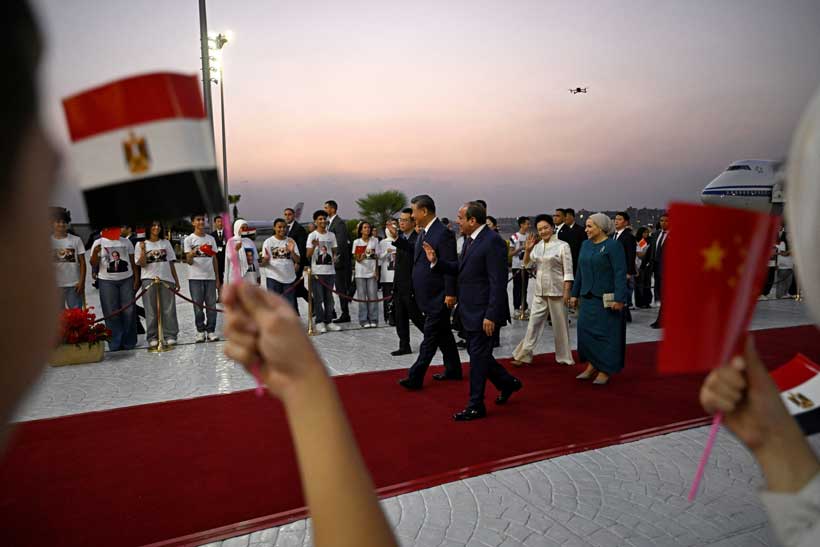
President Xi Jinping pointed out that both China and Egypt are at a critical stage of development and rejuvenation. China has made a good start to the implementation of its 15th Five-Year Plan, while Egypt is advancing the building of the New Republic and moving toward the goals of Egypt Vision 2030. He stressed that China and Egypt should deepen their comprehensive strategic partnership, advance the building of a China-Egypt community with a shared future, and work together to achieve modernization. I have many thoughts after reading these remarks, as Chinese President Xi Jinping’s remarks reflect the depth of the historical and strategic relationship between China and Egypt, highlighting several important political and economic dimensions, such as the convergence of development visions, whereas China embarks on a new phase with its 15th Five-Year Plan to promote innovation and technological development.
On the other side, Egypt steadily progresses towards a new republic and the realization of the goals of Egypt Vision 2030 for infrastructure and economic development. The other dimension is related to strengthening the strategic partnership by elevating relations from traditional bilateral cooperation to a comprehensive strategic partnership. And the statements by President Xi Jinping are reflecting (building a community with a shared future), as his statements reflect the two countries’ desire to coordinate their political and economic positions in the face of global challenges. And the last part of President Xi’s mention is (Economic Integration and Modernization), because this cooperation between Egypt and China opens the door for increased Chinese investment in Egypt’s energy, transportation, and technology sectors. It contributes to integrating Egypt’s vision with China’s Belt and Road Initiative, thus strengthening Egypt’s position as a global logistics hub.
Here, as an Egyptian academic and expert on Chinese politics and the policies of the Communist Party of China, I can understand the significance of China and Egypt working together toward modernization at a critical stage of development for both countries through many dimensions. The importance of China-Egypt cooperation for modernization is understood as strategic integration and a pioneering model of South-South partnership. Both countries are undergoing a crucial historical phase, with China pursuing Chinese-style modernization and greater high-quality openness, while Egypt is working to build its New Republic and achieve the goals of Egypt Vision 2030. The dimensions of this importance can be summarized in the following strategic points, such as aligning major development visions through China’s Belt and Road Initiative and Egypt’s New Republic by integrating the Chinese Belt and Road Initiative with Egypt’s mega-projects to develop infrastructure. Additionally, the pivotal role of the Suez Canal is leveraged by Egypt’s geographical location as a key logistics hub connecting Chinese trade routes with Africa and Europe.
Furthermore, China’s role as a major logistics center in the TEDA economic zone northwest of the Suez Canal in Ain Sokhna is by transforming the industrial area in Sokhna into an advanced industrial base for the transfer and localization of Chinese technology. China’s modernization efforts in Egypt are based on accelerating economic and industrial development, given the growth in trade exchange and the projected increase in bilateral trade volume to $11.8 billion in the first half of 2026, representing a year-on-year increase of nearly 23%. This is further evidenced by China’s investments in clean energy in Egypt, with the Chinese side having signed massive agreements for the production of green hydrogen and green ammonia, amounting to $14.7 billion.
Stay ahead of the geopolitical week.
MD Briefing delivers expert analysis across five global fronts — the Indo-Pacific, energy, geoeconomics, European security, and the Middle East — every Monday morning. Free.
China’s role in modernization in Egypt also extends to technology transfer and financial support for Egypt, providing technical training programs for Egyptians, facilitating financial transactions through joint banks, and collaborating in space science and innovation. Finally, we observe the complementary roles of Egypt and China in promoting balance and justice within the international system and leading the Global South. This is achieved by amplifying the voice of developing nations through joint coordination within major international blocs, such as BRICS, to strengthen multipolarity and reform the global economic system. Furthermore, Egypt and China have agreed to work towards regional stability and have reached a complete political consensus to support peaceful diplomatic solutions to the crises in the Middle East, Africa, and the Global South.
Cooperation between Egypt and China is a pivotal strategic step towards achieving structural modernization and a comprehensive development partnership, as Egypt’s Vision 2030 for building a New Republic aligns with China’s Belt and Road Initiative. The significance of this cooperation lies in Egypt’s transition from a phase of importing and political goodwill to one of industrial localization, advanced technology transfer, and building self-reliant digital capabilities. The crucial importance of this cooperation is distributed across the following key areas of modernization, such as (technological modernization and the digital economy) through building (digital capabilities), where Egypt actively participates in projects of the China-Africa Digital Technology Cooperation Center to develop joint research and development programs, and (the role of Chinese artificial intelligence and innovation in enhancing partnership and modernization in Egypt). Current cooperation between Egypt and China focuses primarily on computing, artificial intelligence, and technological innovation, which are top priorities for both the Egyptian public and government.
Furthermore, China’s contribution to modernizing Egypt’s telecommunications networks, with major Chinese companies, such as Huawei, contributing to the development of telecommunications infrastructure and the digital transformation of Egypt’s energy sector. China’s role in industrial modernization and localization of production in Egypt is evident in the shift from importing to localizing. The current Egyptian strategy, under President Abdel Fattah El-Sisi, focuses on attracting Chinese companies and encouraging them to establish local manufacturing facilities in Egypt, rather than purchasing finished products. This is demonstrated by China’s construction of massive industrial complexes, most notably in the Suez Canal Economic Zone (TEDA Egypt, which has been expanded to 10 km²). These complexes include facilities for producing fibers, building materials, electronics, and home appliances, such as the (Haier and Midea complexes). Furthermore, China is working to localize the Chinese electric vehicle industry in Egypt, partnering with China to acquire modern and electric vehicle technologies, as exemplified by the Nasr Automotive Company’s partnership with Chinese companies.
China also plays a pivotal role in modernizing Egypt’s infrastructure and smart transportation through smart cities. We find the Chinese companies, such as CSCEC, which have undertaken the construction of the Financial and Business District in the New Administrative Capital, which includes the iconic tower (the tallest tower in Africa), a symbol of modern urban development. In addition to China’s role in modernizing Egypt as a hub for advanced electric transportation through its implementation of the Light Rail Transit (LRT) project in 10th of Ramadan City, connecting Cairo to new cities using the latest sustainable transportation systems, the Egyptian-Chinese partnership also plays a role in promoting Chinese space and renewable energy technologies in Egypt.
China has assisted Egypt in developing space capabilities, resulting in the launch of the EgyptSat-2 satellite, making Egypt the first African country to possess fully integrated satellite assembly, integration, and testing capabilities within its space city. Furthermore, Chinese cooperation with Egypt in the field of green modernization is evident, as China is working to upgrade Egypt’s national electricity grid and integrate renewable energy sources, such as solar, wind, and green hydrogen. Finally, Chinese-Egyptian cooperation stands out in the field of defense and military modernization, particularly the modernization of the Egyptian Air Force with Chinese support. This military partnership is growing through advanced air exercises, such as the Civilization Eagles 2026 maneuvers, as Cairo seeks to diversify its arms sources and adopt modern, advanced Chinese fighter jets to enhance its defensive capabilities.
In short, China represents a technological and economic accelerator for Egypt, enabling it to diversify its international partnerships and transform into a regional manufacturing and export hub. Meanwhile, Egypt represents a secure geographical and strategic gateway for China to access African and Arab markets via the Suez Canal in a multipolar world.
