


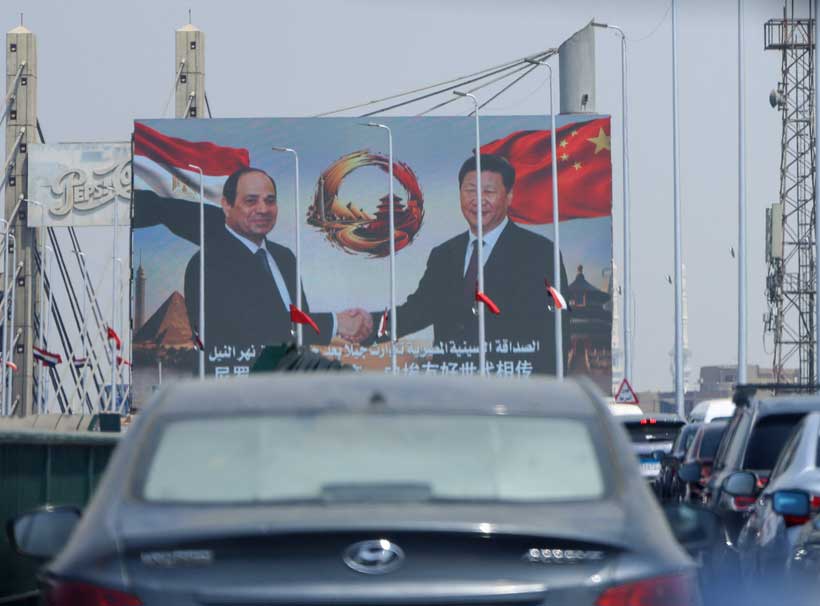
There is a connection between Chinese President Xi Jinping’s visit to Cairo and Egyptian-Chinese cooperation in the fields of intelligence and defense technology, which is central to the strategic partnership between the two countries. President Xi Jinping’s visit to Cairo marks a significant milestone in the comprehensive strategic partnership between the two countries, propelling military, defense, and technological cooperation to broader horizons. Furthermore, the visit’s close connection to military, technological, and defense cooperation is exemplified by its strategic significance, given its timing with notable military developments, including joint exercises such as the Civilization Eagles 2026 maneuvers. This provides the presidential talks with high-level political backing to deepen defense coordination. In addition, Egypt seeks to diversify its sources of armament, aiming to expand its military options and localize defense industries. Advanced Chinese military technology is a growing strategic option for Cairo, moving away from dependence on a single source.
In addition to Egypt’s need for advanced technology and artificial intelligence from China, Egyptian-Chinese cooperation transcends traditional boundaries, encompassing Chinese offers to establish specialized AI and computing centers. This will be discussed at the summit to enhance Egypt’s digital and technological capabilities. This will positively impact the comprehensive strategic partnership between Egypt and China within the framework of flexible strategic balance. This partnership reflects the success of Egyptian foreign policy in implementing the concept of strategic equilibrium and Egypt’s accession to the BRICS group with strong Chinese support, through building balanced partnerships with major international powers like China. Beijing views Cairo as a regional and transcontinental gateway and a key pillar in the Middle East and Africa, while Egypt leverages this relationship with China to achieve a qualitative leap in industrial and technological development.
In this context, Beijing can leverage this visit in the context of the 70th anniversary of the establishment of diplomatic relations between Egypt and China, especially given the high expectations surrounding the economic file between the two countries, particularly in areas such as localizing the electric vehicle industry, solar energy, and water desalination. The defense track falls within the broader strategic partnership between the two nations. Beijing is utilizing Chinese President Xi Jinping’s historic visit to Cairo, marking the 70th anniversary of diplomatic relations between Egypt and China (1956-2026), as a strategic platform to forge a new generation partnership under the umbrella of the Global South and China’s Belt and Road Initiative. This visit aims to bring about a qualitative shift from the traditional trade model to joint industrial production and the localization of advanced technology in Egypt.
As for the political and symbolic use of the 70th anniversary of Egyptian-Chinese relations during President Xi Jinping’s visit to Cairo, Beijing is exploiting this historic occasion to achieve several geopolitical objectives. Chief among these are consolidating joint leadership of the Global South and establishing a model of Egyptian-Chinese-African cooperation based on international multilateralism to counter Western and American pressures. Furthermore, it aims to solidify Egypt’s role as a vital and indispensable link and corridor for China’s Belt and Road Initiative and its expansion plans through the Suez Canal and the Suez Canal Economic Zone. Finally, it seeks to institutionalize Chinese cooperation with Egypt through regional blocs, building upon Egypt’s potential membership in the BRICS group to translate the shared historical political consensus between Egypt and China into tangible developmental and material gains.
Stay ahead of the geopolitical week.
MD Briefing delivers expert analysis across five global fronts — the Indo-Pacific, energy, geoeconomics, European security, and the Middle East — every Monday morning. Free.
As for the targets and expectations in the economic file, it is to move the trade exchange between Egypt and China to record levels, exceeding $25 billion by the end of 2026. The current negotiations focus on key strategic files for localizing Chinese technology in Egypt, including:
1) Localizing solar and renewable energy projects, including the manufacturing of solar cells and panels, in Egypt:
This will be achieved through Chinese investment in solar cell manufacturing and energy storage systems locally. The goal is to move beyond simply installing Chinese power plants in Egypt, such as the Benban Solar Park in Aswan, and instead establish Egypt as a hub for integrated supply chains. This will involve manufacturing the necessary Chinese components in Egypt and linking them to green hydrogen and wind turbine projects.
2) During President Xi Jinping’s visit to Cairo, Egypt also aims to localize the Chinese electric vehicle (EV) industry in Egypt:
This will be achieved through the transfer of Chinese battery technology to Cairo and the activation of energy storage battery production projects with initial investments of approximately $200 million. Local production lines will be established, leveraging Egypt’s infrastructure to position Cairo as an export base for Chinese electric vehicles to African and Arab markets.
3) Egyptian-Chinese partnership in the field of desalination of treated water, environmental technology, and smart equipment and components:
The partnership between Egypt and China will focus on localizing Chinese seawater desalination technology in Egypt for wastewater treatment and to serve Egyptian water security. This will be accompanied by the development of an integrated system for sustainable infrastructure in Egypt, with full Chinese support, through the integration of low-cost, high-density Chinese desalination technologies into new city projects in Egypt, such as the New Administrative Capital.
4) In addition to financial cooperation and debt swaps between Egypt and China:
This represents a historic shift towards activating a mechanism to convert a portion of Egypt’s Chinese debt into direct investments in industrial projects, thereby easing pressure on Egypt’s foreign currency reserves.
As an Egyptian academic and expert specializing in Chinese politics and the policies of the ruling Communist Party of China, I can offer further insights into why Chinese President Xi Jinping is undertaking this visit at this particular time, the message it carries, and how it might affect US-Egyptian relations, especially after the Iran War caused some tensions between China and the United States. This high-level diplomatic visit by President Xi Jinping comes at an exceptional time, aiming to readjust regional balances and strengthen the strategic partnership between Cairo and Washington. This is especially relevant given the escalating geopolitical tensions between the United States and China stemming from the repercussions of the Iranian military conflict and the resulting maritime disruptions in international straits, such as the Strait of Hormuz. The timing of the visit is also intended to contain regional escalation following the Iranian war, as China seeks to secure vital maritime routes like the Suez Canal and the Red Sea after the disruptions caused by the Iranian crisis. This coincides with China’s desire to fill the diplomatic vacuum and thwart Washington’s attempts to bolster its economic and military influence in the Middle East, exploiting America’s preoccupation with the regional conflict with Iran. Therefore, China’s need for urgent security coordination with Egypt and other countries in the region became apparent, given its pressing need to develop a shared vision for de-escalation and stabilization scenarios in the region in cooperation with regional allies, foremost among them Egypt.
As for the most prominent message conveyed by Xi Jinping’s visit to Cairo, it was the reaffirmation of Egypt’s pivotal role. This was a clear Chinese message that Cairo remains the cornerstone of regional security and stability, and there is no alternative to it. This constitutes a Chinese declaration of its commitment to alliances and reassurance to historical allies like Egypt of China’s commitment to regional security, despite its involvement in other confrontations with Washington within its geographical and regional sphere of influence regarding Taiwan and the South China Sea. This serves as an indirect warning to Washington and a signal to the United States and its allies that China will not relinquish its traditional influence and vital interests in the Middle East.
Finally, regarding the impact of Chinese President Xi Jinping’s visit to Cairo on US-Egyptian relations, it will bolster Egyptian-Chinese military coordination by increasing the pace of logistical and intelligence support between Egypt and China to secure borders and international waterways in the Red Sea, the Suez Canal, Bab El-Mandeb, and the Strait of Hormuz. This will be coupled with expanding the economic partnership and offering economic incentives and Chinese investments to Egypt to alleviate the burdens resulting from surrounding regional crises. This will give Egypt the ability to manage diplomatic equilibrium, granting it greater room to maneuver in playing the role of a regional mediator acceptable to all international parties, including China and Russia.
