


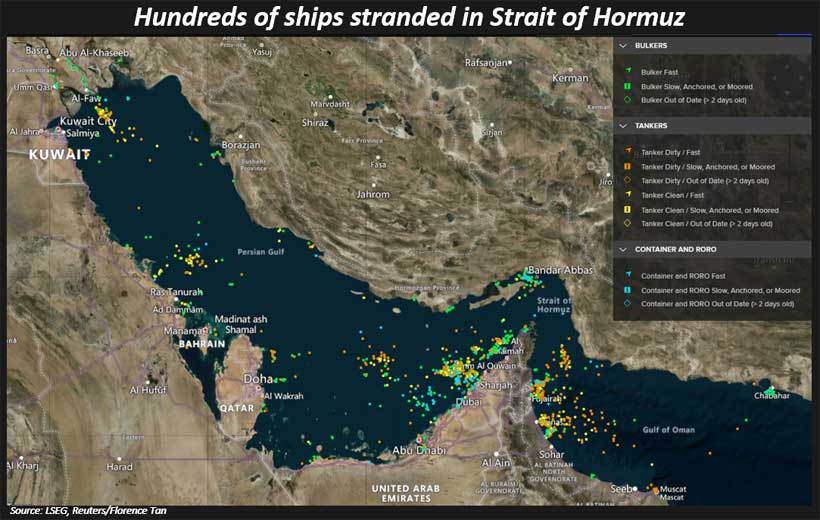
Five ships a day where a hundred used to sail. Six months after the US-Israel strikes on Iran, the world’s most critical energy chokepoint has not merely slowed, it has effectively stopped. The numbers describe a disruption without modern precedent. What they don’t yet describe is what happens when the oil inventory buffer, the one thing keeping prices from spiralling, runs out.
Before February 28, the Strait of Hormuz was one of those geographic facts the world relied on without thinking about it. About 100 vessels a day transited its 33 kilometres of navigable water, carrying roughly 38 percent of global seaborne crude oil, 29 percent of LPG, and 19 percent of LNG. The day after the US and Israel struck Iran, that stopped. Traffic collapsed to five vessels a day within the first week and has stayed there, with one brief interruption in June, ever since. From July 15 to August 23, the average held at five ships daily; a 95 percent reduction that the industry has no playbook for, because nothing like it has happened before.
Why Is a 95% Traffic Drop Different From Every Previous Shipping Crisis?
The shipping industry has absorbed serious shocks in recent years. COVID-19 disrupted supply chains globally, the Ever Given blocked the Suez Canal for six days. Houthi attacks in the Red Sea pushed shipowners to reroute around Africa. Each of those crises was severe and each had a visible path to resolution. What makes Hormuz different is structural, not just statistical.
Every other major chokepoint has an alternative. Ships rerouting from the Suez Canal can go around the Cape of Good Hope. Ships avoiding the Red Sea can use different lanes. Hormuz has no maritime alternative. There are pipeline workarounds: Saudi Arabia’s East-West pipeline and the UAE’s Habshan-Fujairah pipeline both carry limited volumes to Red Sea and Gulf of Oman ports, but their combined capacity covers only a fraction of what the strait moved in peacetime. Kuwait has no maritime route to the open sea that bypasses Hormuz at all. Port calls there dropped 86 percent since the war began. Qatar, Iraq and Bahrain fell 66 to 68 percent. The UAE, which has the most extensive pipeline and Red Sea infrastructure of any Gulf state, still saw a 69 percent drop. These are not numbers that reflect adaptation. They reflect a system that cannot adapt fast enough.
Stay ahead of the geopolitical week.
MD Briefing delivers expert analysis across five global fronts — the Indo-Pacific, energy, geoeconomics, European security, and the Middle East — every Monday morning. Free.
Who Pays When the World’s Biggest Chokepoint Closes?
The countries the data identifies as most exposed are not the ones dominating the diplomatic coverage. Eritrea and Madagascar each source roughly 90 percent of their oil from the Middle East. Pakistan gets 78 percent, Japan and Kenya 77 percent each. None of these countries have meaningful leverage over the US-Iran negotiations. None of them are in the rooms where the Oman corridor is being discussed. All of them are absorbing price increases, supply disruptions and logistical costs that flow directly from a war they had no part in starting and no ability to stop.
For these countries, the 20 percent rise in oil prices since before the war, itself described as “muted” by some analysts because pre-war inventory levels provided a buffer, is not a market abstraction. It is the cost of cooking fuel, of fertiliser, of every commodity that moved through a strait that is now carrying five ships a day.
The inventory buffer deserves particular attention because it is the one element of this crisis that has a hard expiry date. Oil stocks built massively before the war, providing a cushion that kept the price spike from being worse than it was. That cushion is now largely exhausted. The next six months, on current trajectories, will be materially more volatile than the first six, because the buffer is gone and the strait remains closed. This is the part of the Hormuz story that markets have not fully priced and the diplomatic coverage has not fully told.
What Has Global Shipping Actually Done in Response?
The shipping industry has adapted where it can and absorbed costs where it cannot. Singapore and Malaysia emerged quickly as hubs for redirected energy flows. Russia’s fuel oil shipments to Singapore and Malaysia rose 2.5 times month-on-month in July, a measure of how rapidly trade flows reoriented once the strait closed. Saudi Arabia, with its East-West pipeline and Red Sea port access, saw a comparatively modest 15 percent drop in port calls, making it the most adaptable of the major Gulf exporters and helping explain why Riyadh’s exposure to the Houthi Red Sea blockade, on top of Hormuz, is so strategically significant.
The ships still passing through Hormuz are doing so under circumstances that would have been unrecognisable six months ago. Most operate under naval escort or with their tracking systems switched off, a choice that tells you something about how shipowners weigh the risk of Iranian authorities identifying them against the risk of navigating blind. The Iran-Oman agreed corridor, which splits the waterway into Iranian and Omani territorial lanes, exists on paper. In practice, five ships a day suggests it is not yet functioning as an operational alternative.
Five Things Worth Watching
- Oil inventory levels over September and October, which will determine whether the price buffering effect of pre-war stockpiles continues or collapses into a sharper spike as the Iran-Oman framework talks continue without resolution.
- Kuwait’s position specifically: with no alternative maritime route and port calls down 86 percent, Kuwait is the Gulf state with the least flexibility and the most to gain from any Hormuz reopening. Watch for whether Kuwait applies pressure through Gulf Cooperation Council channels.
- Whether the small volume of ships currently transiting with tracking systems off begins to grow. An increase in dark shipping through Hormuz would signal that some operators are quietly testing Iranian enforcement, which could either accelerate a deal or trigger a new enforcement escalation.
- Singapore and Malaysia’s role as redirected energy hubs. If this becomes structural rather than temporary, it reshapes Asian energy geopolitics in ways that outlast the immediate crisis.
- The insurance market: War risk premiums for Gulf transits remain at levels that make many voyages economically marginal. The moment those premiums begin to fall meaningfully, it will be a leading indicator that the market believes reopening is genuinely imminent, well before any official announcement.
The Bottom Line
The Hormuz closure is the most consequential maritime disruption of the modern era, not because of what it has already done but because of what it is about to do. Six months of 95 percent traffic reduction has burned through the inventory buffers that cushioned the first shock. The diplomatic activity around the Oman corridor and the Qatar-brokered talks is real, but a framework and a deal are not the same thing. The world’s most essential chokepoint is carrying five ships a day. Whatever happens in the next diplomatic round will determine whether the second half of this crisis looks like the first: manageable, expensive, and unresolved — or something considerably worse.
