


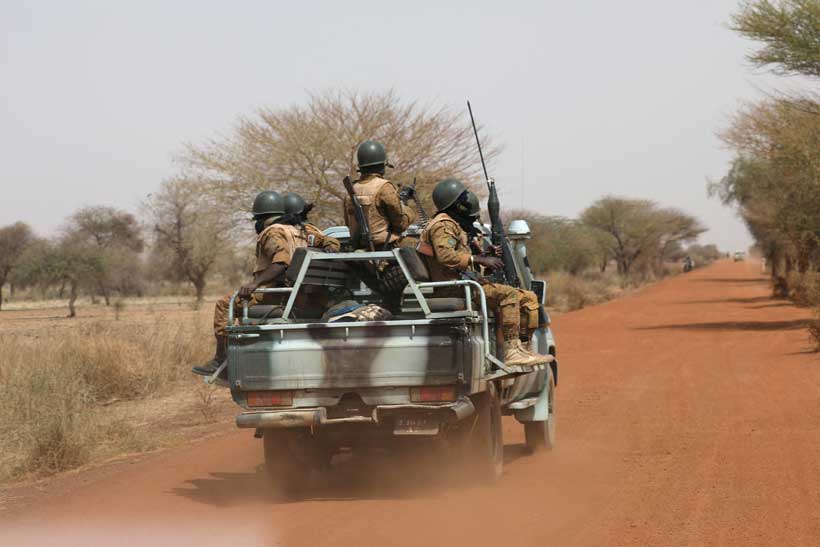
A few years ago, France was the dominant foreign security partner across much of the Sahel. Today, its troops are gone from Mali, Burkina Faso and Niger, and Burkina Faso has severed diplomatic relations with Paris altogether (Reuters, 2026a). In its place, a different set of partnerships is taking shape.
Russia has become increasingly close to the military governments of all three countries. In July, Moscow and the Alliance of Sahel States agreed to strengthen military cooperation, expanding a relationship already backed by Russian personnel on the ground (Reuters, 2026b). Yet the security situation remains fragile. An offensive by al-Qaeda-linked militants and Tuareg separatists in April killed Mali’s defence minister and forced Russian Africa Corps units to temporarily withdraw from some northern positions (Reuters, 2026c; Reuters, 2026d).
Russia is not alone either. While Moscow has focused heavily on security, Chinese investment in mining and infrastructure continues across the same countries. With the French out of the picture, two questions remain: what is Moscow gaining from its growing presence, and is Russia or China better positioned to turn its influence into something that lasts?
Russia’s closest relationships are with governments that have lost or expelled many of their former Western security partners.
Stay ahead of the geopolitical week.
MD Briefing delivers expert analysis across five global fronts — the Indo-Pacific, energy, geoeconomics, European security, and the Middle East — every Monday morning. Free.
In Mali, Niger and Burkina Faso, Moscow has supplied weapons, military instructors and Africa Corps personnel, giving it direct access to governments that have increasingly turned to Russia for security assistance (Carnegie Endowment, 2026; Reuters, 2026b).
On the economics side of things, Russian involvement in the region has been linked to mining and mineral agreements. Mali and Russia have pursued cooperation in gold refining, geological exploration and nuclear energy (Reuters, 2023; Carnegie Endowment, 2026). But these projects remain modest compared with China’s economic presence. For now, Moscow’s biggest gain may be political. All three governments now treat Russia as a major security partner. France’s retreat allows Moscow to present itself as an alternative to Western influence in Africa, even while Russian trade and investment remain relatively small.
The battlefield tells a more complicated story. On April 25, Mali was hit by coordinated attacks involving the al-Qaeda-linked JNIM and Tuareg separatists from the Azawad Liberation Front. The offensive stretched from Bamako and Kati to several towns in central and northern Mali. Defense Minister Sadio Camara was killed, while Russian Africa Corps personnel and Malian troops later withdrew from Kidal (Reuters, 2026c; Reuters, 2026d). The loss of Kidal was particularly symbolic. Malian and Russian forces had captured it in 2023, a victory celebrated by the military government after years of separatist control. Less than three years later, it was back in rebel hands. The Africa Corps confirmed its withdrawal, saying the decision had been taken jointly with Mali’s leadership (Reuters, 2026d).
This does not mean Russian support has achieved nothing. Malian and Russian forces held key installations during the April offensive, including Bamako’s airport, and Russian support has strengthened the military’s combat capabilities. But armed groups have adapted too. Their ability to coordinate attacks across such a large area raises questions about how much security Moscow can deliver.
Away from the battlefield, China has taken a different approach. In southern Mali sits Goulamina, one of Africa’s largest lithium projects. Chinese mining giant Ganfeng Lithium has invested heavily in the mine, which began producing spodumene concentrate in late 2024. Chinese companies have also expanded into Mali’s gold sector, sometimes buying assets as other foreign operators reduce their exposure to the country (Reuters, 2025; Reuters, 2026e).
In neighboring Niger, China’s presence goes back much further. State-owned CNPC has invested more than $5 billion in the country’s oil industry, developing the Agadem oilfield, building a refinery and constructing a 1,950-kilometre pipeline to the Beninese coast.
By late 2025, oil exports from the expanded field had generated more than $2 billion in revenue. The relationship has not always been smooth: Niger expelled three Chinese oil executives in 2025 following disputes over local employment and pay. But CNPC’s operations continued (Reuters, 2025b).
Burkina Faso adds another layer. Chinese-backed projects there range from roads and solar power to healthcare, telecommunications and cement production. According to China’s embassy in Ouagadougou, bilateral trade exceeded $1 billion in 2025
Russia and China are offering the juntas different things. Moscow may currently have a stronger hand with the juntas themselves. Russian weapons, instructors and Africa Corps personnel provide something their governments urgently need: military support and, in some cases, regime security. If the insurgencies continue, that relationship gives Russia considerable political access.
There is an obvious risk for Moscow. The worse the security situation becomes, the more the juntas may need Russian help. But it also becomes harder to ignore whether that help is actually working. France faced similar criticism after years of military involvement failed to stop the insurgencies from spreading. Moscow could eventually face the same question
China’s position is less dependent on winning that war. Mines, oilfields, pipelines and infrastructure can still give Beijing influence even if the security situation remains poor. Chinese companies can certainly face disruption, political disputes or even expulsion, as Niger has already shown.
But China’s investments are not tied solely to the survival of the current juntas. If the juntas remain in power and insecurity worsens, Russia may become even more important to them in the short term. Over the longer term, however, China’s economic footprint may prove harder for their successors to replace.
The coming months should provide clearer evidence. Further Africa Corps withdrawals or another major casualty event would raise more questions about Russia’s security model. On the other hand, repeated Russian military shipments through Lomé, or a more permanent logistics arrangement there, would suggest that Moscow is building a foothold beyond its relationships with the three juntas. For now, Russia may have the louder presence in the Sahel, but China could prove harder to dislodge.
