



For more than three decades, Europe organized much of its economic thinking around a particular interpretation of efficiency. Energy security, industrial self-sufficiency, strategic reserves, infrastructure redundancy, and defense readiness were frequently regarded as secondary objectives compared with competitiveness, market integration, regulatory liberalization, and cost optimization. As long as globalization delivered relatively stable supply chains, affordable energy, expanding trade, and a broadly favorable geopolitical environment, this approach appeared rational. The efficiency pursued was often measured primarily through short-term cost reduction rather than through the overall robustness of the economic system. Hidden dependencies, exposure to external suppliers, and declining strategic flexibility accumulated over time. In this sense, Europe did not necessarily maximize efficiency in its broader economic meaning; rather, it prioritized immediate optimization of visible short-term costs while underestimating the long-term value of resilience, redundancy, and security of supply.
We are seeing today that Europe faces a different question. For years, the debate focused on the cost of the energy transition. Increasingly, the real question is the cost of resilience.
Europe is not alone. Across both advanced and developing economies, governments are discovering the same reality: resilience requires far larger investments than many had assumed only a few years ago.
Across the world, governments are increasingly discovering that resilience, whether in energy systems, industrial production, supply chains, digital infrastructure, food security, climate adaptation, artificial intelligence, strategic autonomy, or defense preparedness, requires investment on a scale not experienced since the major reconstruction efforts of the twentieth century. More importantly, these challenges are no longer appearing one after another. They are emerging simultaneously, forcing governments, companies, and societies to address several major priorities at the same time.
Stay ahead of the geopolitical week.
MD Briefing delivers expert analysis across five global fronts — the Indo-Pacific, energy, geoeconomics, European security, and the Middle East — every Monday morning. Free.
Ageing electricity networks require modernization even as renewable investments are still being amortised. Long-duration storage and hydrogen infrastructure must be developed in parallel. Electricity demand from artificial intelligence and data centers continues to grow while industrial reshoring and strategic autonomy remain policy priorities. At the same time, critical mineral supplies, fragile supply chains, defense preparedness, and demographic ageing all demand attention. The difficulty is that these priorities are cumulative rather than sequential. Each new objective is added to an already crowded agenda. These priorities are layered upon existing obligations, creating a progressively larger burden on public finances, private capital, and institutional capacity.
The scale of the effort becomes clearer when we look at the numbers. The modernization and expansion of European electricity networks alone is estimated to require approximately €584 billion by 2030. Hydrogen infrastructure may require a further €86-126 billion. Defense initiatives under ReArm Europe are expected to mobilize up to €800 billion before the end of the decade. At the same time, artificial intelligence, digital infrastructure, advanced computing capacity, and data-center expansion are generating entirely new investment requirements measured in tens, and potentially hundreds, of billions of euros. When energy storage, industrial policy, critical-mineral security, supply-chain diversification, and demographic adaptation are added to the picture, total resilience-related investment requirements appear increasingly likely to approach or even exceed €1.2 trillion annually, representing roughly 6% of European GDP.
Seen in isolation, these figures already appear impressive. Yet they become even more significant when viewed within the broader international context.
A Global Competition for Resilience
What is emerging is not simply a European investment cycle. It is a worldwide competition for resilience. Virtually every major economy is attempting to strengthen critical infrastructure, improve strategic autonomy, enhance industrial competitiveness, secure energy supplies, modernize defense capabilities, and position itself for a digital economy increasingly driven by artificial intelligence.
Even conservative estimates suggest that advanced economies may need to invest between $5 and $7 trillion every year over the next two decades simply to finance energy transitions, industrial modernization, digital infrastructure, defense preparedness, and technological leadership. At the same time, emerging and developing economies could require an additional $3 to $4 trillion annually to support electrification, urbanization, industrialization, transportation systems, water infrastructure, digital connectivity, food security, and climate adaptation.
Taken together, the world may be entering a period in which resilience, development, and security investments amount to $8 to $10 trillion annually, corresponding to approximately 7% to 10% of global GDP. These figures should not be interpreted as entirely new expenditures added on top of existing economic activity. A substantial portion is already embedded within current investment, infrastructure, energy, industrial, and defense spending. An increasing share of available capital and public resources must now be directed toward resilience-related objectives while new requirements continue to emerge across multiple sectors. Moreover, this introduces a critical friction since monetary investment cannot instantly conjure physical inputs. While capital can be mobilized rapidly through fiscal or financial channels, the supply of processed critical minerals, specialized engineering talent, and heavy industrial equipment remains bound by physical lead times. Financial capacity can expand rapidly. Execution capacity cannot.
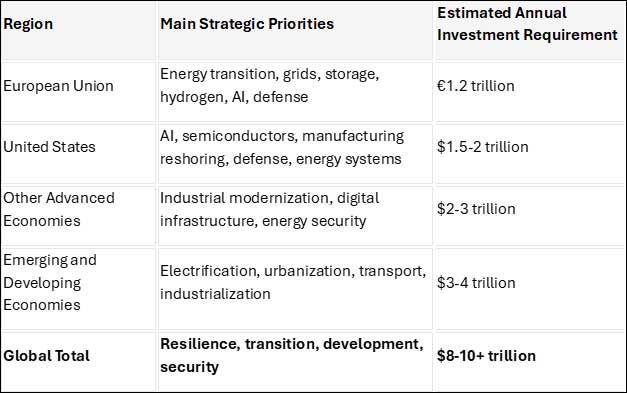
At first sight, these percentages may appear manageable because the remaining 90% to 93% of global economic output continues to finance the normal functioning of the economy. This comparison is misleading. GDP is not a reserve of idle resources. Most economic output is already committed to consumption, public services and investment. The challenge is not adding another 7% to 10% of GDP, but managing growing competition for the same savings, fiscal resources, industrial capacity, critical materials and skilled labour needed for resilience, decarbonization, defence, digital infrastructure and strategic autonomy.
Economic constraints are not primarily a question of spending levels. They reflect growing competition for scarce resources and society’s limited capacity to absorb multiple large-scale transitions simultaneously. The key question is not how much Europe produces, but how much flexibility it retains to reallocate capital, labour, materials and skills across competing needs. This is why GDP alone can be misleading.
The true constraint lies in the availability of capital, skilled labour, industrial capacity, energy, and implementation capability. Resilience has become a global contest for strategic capabilities. Europe is competing with the United States for advanced digital infrastructure, with China for industrial leadership, with India for future growth opportunities, and with much of the developing world for access to capital, technology, manufacturing capability, and strategic resources. Resilience has become a global race because every major economic actor is drawing from the same finite pool of capital, skills, industrial capacity, and strategic resources.
The Emerging Three-Power Century
Within this broader transformation, the coming decades are likely to be shaped primarily by the interaction of three major powers: the United States, China, and India.
Much commentary continues to frame the future as a binary competition between Washington and Beijing. Yet a closer examination suggests that the twenty-first century may evolve into a triangular system rather than a bipolar one. Each of these three powers enters the coming decades with a distinct combination of strengths and vulnerabilities, and each occupies a different position within the global resilience equation.
The United States remains the world’s leading financial, technological, and military power. It benefits from the deepest capital markets, the global reserve currency, abundant energy resources, leading universities, strong research institutions, and continued leadership in sectors such as semiconductors, software, artificial intelligence, aerospace, biotechnology, and defense. Unlike most developed economies, it also benefits from demographic support provided by immigration. These advantages provide a remarkable capacity to finance and deploy large-scale investments in energy systems, advanced manufacturing, digital infrastructure, and military modernization.
China, by contrast, remains the world’s dominant industrial power. No country currently combines manufacturing scale, infrastructure capacity, supply-chain integration, and industrial execution to the same degree. China occupies leading positions in batteries, solar equipment, electric vehicles, industrial manufacturing, and critical-mineral processing. Its greatest challenge is becoming demographic rather than industrial. Population decline and workforce contraction are likely to exert steadily increasing pressure on long-term growth, consumption, and fiscal sustainability.
India occupies yet another position. Unlike China and much of Europe, it continues to benefit from demographic expansion, urbanization, and a growing labour force. If supported by sufficient infrastructure investment, industrial development, educational progress, and energy availability, India could become the principal source of global economic growth during the next two decades. Its challenge is not a shortage of demographic potential but the requirement to transform that potential into productivity, infrastructure, and industrial capacity quickly enough to avoid future bottlenecks.
The strategic competition between these three powers reflects three different forms of strength. The United States remains the dominant technological, financial, and military power. China remains the dominant industrial and manufacturing power. India is emerging as the dominant demographic and growth power. The key question is not which country dominates, but which can combine capital, technology, energy, institutions, and demographics most effectively over time.
Beyond Inelasticity: The Rise of Strategic Anelasticity
Resilience is expensive because societies face anelasticity and conflicting time horizons. At this stage, an important conceptual distinction becomes necessary because many of the challenges described above cannot be fully understood through conventional economic analysis alone.
Traditional economic reasoning frequently focuses on the concept of inelasticity. Inelasticity describes the inability of a system to respond rapidly to changing circumstances. Electricity networks cannot be expanded overnight. Skilled workers cannot be produced instantly. Industrial facilities cannot be constructed within weeks. Inelasticity therefore refers to genuine limitations in responsiveness, particularly over short periods of time.
However, a significant proportion of the challenges confronting Europe, the United States, China, India, and the developing world belong to a different category.
Europe is not incapable of expanding electricity networks. It is not incapable of building storage systems, developing hydrogen infrastructure, training engineers, securing critical minerals, or reindustrializing portions of its economy. The United States is not incapable of modernizing infrastructure. India is not incapable of creating transportation networks and manufacturing capacity. China is not incapable of adapting to demographic ageing.
In each case, the problem is rarely the impossibility of adaptation. More often, the problem is the delay associated with adaptation.
To describe this problem, I find it useful to borrow a concept from materials science: anelasticity. Borrowed from materials science, anelasticity refers to a system that eventually responds to an external force but does so only after a significant time lag. The response exists, but it arrives late. Applied to economics and public policy, anelasticity describes societies that could solve a problem but need years to translate potential into action.
Educational systems can produce engineers, but only after generations pass through schools and universities. Electricity networks can be expanded, but only after lengthy planning procedures, permitting processes, financing arrangements, and construction periods. Industrial supply chains can be rebuilt, yet only after years of investment, technological learning, and organizational adaptation. Demographic decline can be mitigated through migration, automation, productivity gains, and family-support policies, although the effects generally emerge only over long periods.
Many strategic constraints are not examples of permanent incapacity. They are examples of delayed adaptability. While inelasticity reflects the inability to respond, anelasticity reflects the inability to respond quickly enough.
A region that cannot increase electricity capacity tomorrow exhibits inelasticity. A region that can eventually increase capacity but requires fifteen years to move from decision to implementation exhibits anelasticity.
The distinction may appear subtle, but its consequences are profound. As the pace of technological, geopolitical, economic, and demographic change accelerates, societies increasingly have less time to recover from one disruption before confronting the next. Under such conditions, the ability to adapt eventually becomes less important than the ability to adapt rapidly enough. A system that requires fifteen years to respond to a challenge may discover that the strategic environment has already changed before the adjustment is completed.
The Cost of Time
The economic cost of inelasticity is generally visible and measurable. It appears through shortages, bottlenecks, price spikes, and supply disruptions. Policymakers can often observe these effects directly because they manifest themselves immediately.
The cost of anelasticity, by contrast, accumulates more quietly and frequently remains underestimated. Rather than appearing through visible disruptions, it appears through opportunities that are missed.
When transmission networks are developed years after renewable generation has already been deployed, renewable electricity is curtailed before reaching consumers. When storage projects arrive too late, dependence on imported fuels continues longer than necessary. When industrial capabilities are rebuilt too slowly, investment migrates elsewhere before domestic industries are prepared to receive it. When demographic concerns are ignored for decades, labour shortages emerge long before corrective policies begin producing measurable effects. When strategic energy, transportation, or digital corridors remain under development for prolonged periods, geopolitical opportunities disappear before infrastructure becomes available to exploit them.
Recent concerns surrounding the Strait of Hormuz provide a particularly revealing illustration. The economic consequences of a potential disruption do not arise only from the event itself but also from the extent to which alternative supply routes, strategic reserves, transport corridors, and diversification options have been developed beforehand. The longer such alternatives take to build, the greater the vulnerability created by the passage of time.
The cost of anelasticity is measured not only in money but also in foregone possibilities. In other words, time itself becomes an economic factor. The longer the interval separating the recognition of a strategic necessity from the delivery of the corresponding solution, the greater the cumulative loss in productivity, competitiveness, security, and growth. Crucially, this delay translates directly into an inflationary drag. When capacity additions lag behind surging structural demand (such as data centers, electrification, and defense), prolonged bottlenecks generate persistent price pressures. Anelasticity is not merely a temporal inconvenience; it is an active driver of structural inflation that continually erodes long-term competitiveness before new supply can finally materialize.
The Conflict of Time Horizons
Beneath the investment challenge, beneath geopolitical competition, and beneath the distinction between inelasticity and anelasticity lies an even deeper structural issue. Modern societies operate according to multiple clocks, each moving at a different speed.
Political systems typically function according to electoral cycles measured in four or five years. Financial markets often evaluate performance quarterly. Industrial investments require ten to twenty years before generating full returns. Electricity networks are designed to operate for forty years. Nuclear facilities remain operational for sixty years or more. Educational systems may require decades to produce highly skilled workforces. Demographic change unfolds across entire generations.
The result is a conflict between different time horizons. Political leaders are increasingly required to authorize investments whose benefits may become visible only after they have left office. Financial markets frequently seek returns measured in months while financing assets expected to operate for half a century. Citizens naturally expect immediate results even when industrial systems require decades to develop the skills, supply chains, and technologies needed to produce those results. In fact, the challenge extends beyond financing. It concerns synchronization.
Whenever these different clocks become misaligned, both inelasticity and anelasticity emerge. Projects are delayed, costs increase, opportunities narrow, and uncertainty expands. Much of the contemporary debate surrounding energy, infrastructure, artificial intelligence, defense, industrial policy, and demographics can ultimately be understood as an expression of this temporal conflict.
From Anelasticity to Resilience
Seen through this broader perspective, the central challenge facing Europe, the United States, China, India, and much of the developing world is not simply to mobilize additional investment. More fundamentally, societies must reduce both inelasticity and anelasticity by shortening the gap between recognizing a strategic necessity and implementing the corresponding response.
Over the coming decades, success will not belong automatically to the countries with the largest populations, the richest resources, or even the most advanced technologies. Rather, they will be those countries capable of compressing the interval separating diagnosis from execution, innovation from deployment, awareness from adaptation, and decision from implementation.
Resilience therefore cannot be reduced to the possession of resources alone. It represents the capacity of institutions, financial systems, industries, and societies to act within the time horizon required by the challenge they face. It is the ability to synchronize political, financial, technological, industrial, and demographic clocks in a way that minimizes delay and maximizes adaptability.
The great strategic challenge of the twenty-first century may be the ability of societies to reduce the distance between necessity and response. The defining advantage of successful societies will increasingly arise from their capacity to transform foresight into action before opportunities disappear and before constraints become irreversible.
In that sense, resilience is not just the opposite of inelasticity. It is equally the opposite of anelasticity. In the end, the defining competition of the twenty-first century may not be between nations at all. It may be the race against time.
