


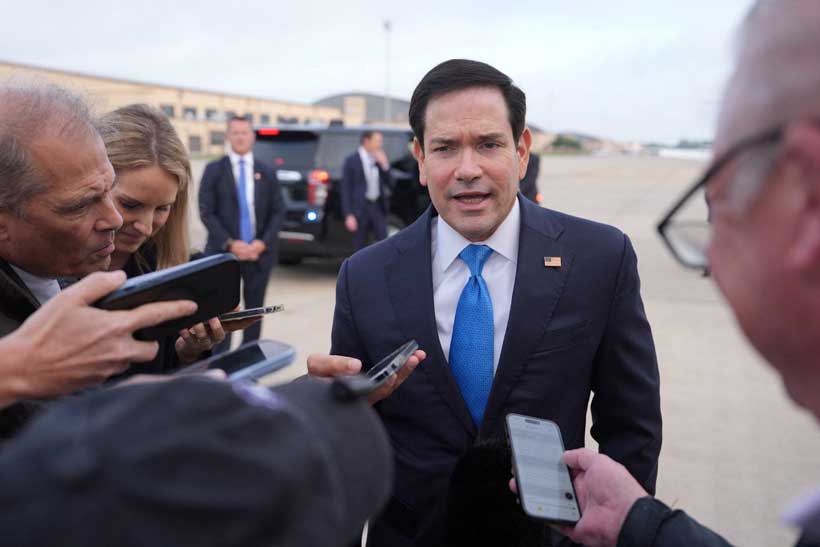
Secretary Marco Rubio will visit Samarkand, Uzbekistan, in “mid-October” to attend a C5+1 summit to engage the Central Asian region. He will also lead a “historic” delegation of “more than 100 American companies,” hoping to strengthen US business presence in this important region.
Increasing diplomatic engagement
The summit’s location matters, as the Uzbek government aims to increase engagement with the United States. A notable sign of growing US-Uzbek engagement is President Donald Trump’s invitation to President Shavkat Mirziyoyev, along with his Kazakhstani counterpart, President Kassym-Jomart Tokayev, to attend the G-20 summit in Miami this December.
On 2 September, the Uzbek embassy in the U.S. hosted an Independence Day reception in the famous Willard Intercontinental Hotel in downtown Washington, DC. During the ceremonial speeches, the speakers proposed that President Trump visit Tashkent, which would be the first time in history that a sitting U.S. president would visit the region.
Stay ahead of the geopolitical week.
MD Briefing delivers expert analysis across five global fronts — the Indo-Pacific, energy, geoeconomics, European security, and the Middle East — every Monday morning. Free.
Apart from Rubio’s upcoming visit, Representative Jason Smith, Chairman of the House Committee on Ways and Means, recently led a congressional delegation to Uzbekistan, Kazakhstan, and Mongolia, followed by a House Committee hearing on strategic partnerships to secure critical resources and supply chains.
Sapargli Shalgimbayev, president of CFive, a think tank in Astana, Kazakhstan, said, “For those of us who have been advocating for stronger U.S.–Central Asian economic relations for years, seeing these issues discussed at this level in Congress was particularly meaningful.” The U.S. President’s Special Envoy for South and Central Asia, Sergio Gor, also recently met with President Mirziyoyev in Tashkent.
Diplomatic engagement is also occurring in the U.S. as Saida Mirziyoyeva, head of the Administration of the President of Uzbekistan (and daughter of the current president), reportedly met with Donald Trump, according to a Telegram post. Neither government, however, has provided more information about the meeting.
Additionally, Uzbekistan is expanding its diplomatic footprint in the United States. In addition to the embassy in Washington and the consulate in New York, in early September, Uzbekistan also formally opened a new consulate in Seattle. This new diplomatic enclave opens as Tashkent and Washington expand their diplomatic and economic relations.
Trade and Economic Opportunities
Economic and trade relations are growing too. In June, the U.S. Trade Representative (USTR) Ambassador Jamieson Greer visited Tashkent and signed trade commitments to strengthen the bilateral economic and investment relationship.
Prospective new deals have also garnered hype. In 2025, Tashkent announced an $8.5 billion deal to buy up to 22 Boeing 787 Dreamliner aircraft to modernize the country’s commercial aviation industry. The aircraft will allow direct, long-distance flights to and from the United States, increasing connectivity and tourism.
Investment also goes both ways: the Uzbek company AFKA is building a manufacturing facility in Bowling Green, Kentucky. This facility will be the first-ever Uzbek manufacturing company in the U.S. In addition to creating over 300 jobs, the facility exemplifies growing trade and investment relations between the two governments and challenges stereotypes and assumptions that the U.S. is the only actor in U.S.-Central Asia relations that invests on the other side.
It remains to be seen whether the C5+1 summit in Samarkand and the delegation of US companies who will meet with their regional counterparts will result in new investment and trade contracts in the foreseeable future. It is easy to shake hands at a reception or working lunch, but negotiating a contract can be very time-intensive.
Keeping Expectations Realistic
Other areas of U.S.-Uzbek cooperation are more limited. Since 2012, the Mississippi National Guard has teamed up with the Uzbek military to increase the Central Asian nation’s military capabilities. However, military coordination with Central Asia has decreased due to the U.S. withdrawal from Afghanistan, the war in Ukraine, and U.S. military operations elsewhere in the world.
The potential for U.S.-Uzbek technological cooperation could be affected by additional competitors. Uzbekistan is a founding member of World Artificial Intelligence Cooperation (WAICO), a coalition created by China to promote cooperation among its members on artificial intelligence development. The problem is that Washington has created its own bloc, Pax Silica, and the U.S. does not want countries to belong to both. Kazakhstan is the only country that is a member of WAICO and Pax Silica, and Astana is currently under pressure from Washington to choose sides. Although Tashkent is unlikely to pursue a similar strategy, WAICO’s availability gives Washington less leverage over Uzbekistan’s technological alliances.
The two most high-profile demonstrations of U.S.-Uzbek engagement—a successful visit by Rubio to Tashkent for the C5+1 and the successful participation of President Mirziyoyev at the G-20—would set positive momentum for the next year of Washington-Tashkent relations and even wider Washington-Central Asia relations. This is a challenge in itself, as the current US administration is juggling many domestic and global issues simultaneously. The upcoming midterm elections, a renewed conflict in Iran, an expansion of the war between Russia and Ukraine, or higher domestic food and oil prices in the U.S. could take precedence over engaging Central Asia, limiting the impact of Rubio’s upcoming visit.
Ideally, Washington will seek meaningful projects to sustain engagement between the two countries after Rubio’s visit. Repealing the Jackson-Vanik Amendment is one alternative (though the likelihood is very slim). Similarly, direct flights between Tashkent and U.S. cities, thanks to the new fleet of Boeing aircraft, could increase tourism. Ideally, U.S.-Uzbek cooperation will evolve beyond Washington’s focus on energy and critical mineral resources, as other sectors of Tashkent’s industries and economy would welcome more development.
Of course, Washington-Tashkent relations do not occur in a geopolitical vacuum, as many actors are actively engaging Central Asia: in addition to the Global Powers, notable partners include Türkiye, India, Pakistan, South Korea, and Azerbaijan (Baku and Tashkent have a growing partnership). The Arab states were heavy investors in Central Asia before the war between Iran and the U.S./Israel. Unfortunately, the future of Arab investment and trade projects remains unclear because of the conflict’s heavy toll and the ongoing crisis in the Strait of Hormuz. Even Washington’s foreign policy priorities may shift because of ongoing global crises and events and the upcoming mid-term elections.
In other words, Washington needs constant, dynamic engagement to strengthen partnerships with Central Asia, as other (geographically closer) actors are active in the region. The Uzbek government would certainly welcome this development. Looking ahead, Washington-Tashkent relations could grow and strengthen, but they also need to diversify and keep evolving. The visit by a secretary of state and a “historic” business delegation to Uzbekistan and Central Asia is important, but what occurs the proverbial day after is arguably even more important, as that is when we will see the consequences of the meetings.
