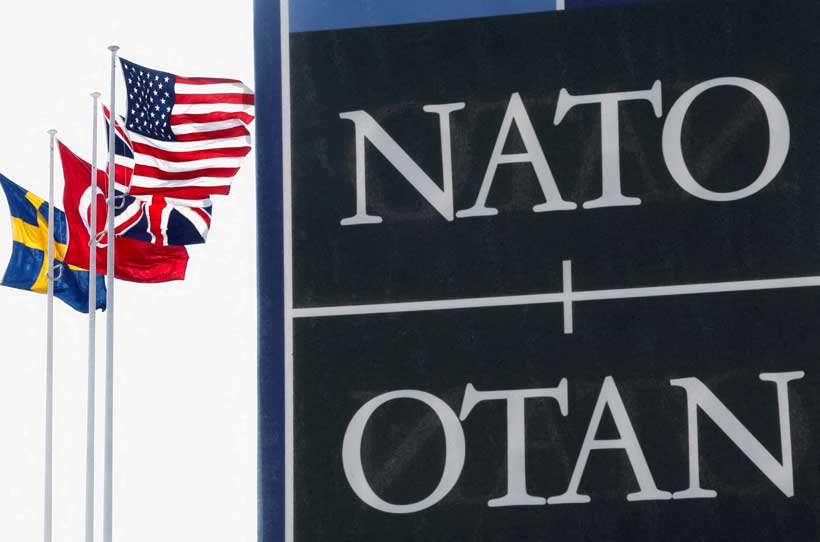
On 11 February, NATO launched Arctic Sentry — Swedish Gripen jets patrolling Greenlandic airspace, German Eurofighters overhead, nine flags behind a single new command. Officially, it answers Russian submarines in the GIUK gap. Unofficially, it arrived three weeks after Donald Trump stood in Davos and quietly abandoned a campaign that had included tariff threats against eight allies, AI-generated images of himself planting a flag on Greenlandic soil, and open talk of using force to take a NATO member’s territory. Arctic Sentry gave everyone something to point to instead of the question the crisis had just spent a month refusing to answer: what does the treaty that binds Denmark and the United States together actually say when the threat comes from inside the alliance?
Greenland has governed its own domestic affairs since 1979 and, since a 2009 referendum approved by 75.5% of voters, controls everything except defence, monetary policy and foreign relations, which remain with Copenhagen. A 1951 treaty gives the US its Pituffik Space Base on the island — and in that same treaty, Washington explicitly recognised Danish sovereignty over Greenland. None of that stopped Trump from calling US ownership “an absolute necessity” from late 2024 onward, then in January threatening tariffs of 10%, rising to 25%, on Denmark and seven other allies unless Copenhagen ceded the territory. Denmark answered by deploying Arctic-trained troops, committing 88 billion kroner ($13.7 billion) to Arctic defence, and — for the first time in its history — naming the United States a national security concern in its intelligence assessments. At Davos on 21 January, Trump reversed course, announcing a vague “framework” on Arctic security and minerals. Both governments immediately said sovereignty was never on the table.
Start with what the treaty actually says, because the answer is stranger than either side’s rhetoric suggested. Article 5 commits every member to treat an armed attack on another member’s territory “in Europe or North America” as an attack on all of them — and Greenland, legally, is Danish territory in North America. Legal scholars examining the crisis concluded that a US military seizure of Greenland would meet the treaty’s own definition of an armed attack, obligating every other ally, Denmark included, to assist — in theory, against the United States itself. Nothing in the text carves out an exception for the ally doing the attacking, because nobody who wrote the North Atlantic Treaty in 1949 imagined it would need one.
That obligation is real but almost worthless as a deterrent. Allies can satisfy it with overflight rights and intelligence-sharing rather than combat, so it guarantees solidarity in form more than substance. There is no expulsion clause anywhere in the treaty — the only available remedy is suspending a member for “material breach” under the general Vienna Convention on treaties, and that tool only exists after an attack has already happened. Worse, NATO’s North Atlantic Council runs on consensus, which means the United States holds an effective veto over any collective response aimed at itself. A guarantee that requires the aggressor’s sign-off to activate is not a guarantee; it is a formality that both sides can point to without either believing it changes their calculations.
Stay ahead of the geopolitical week.
MD Briefing delivers expert analysis across five global fronts — the Indo-Pacific, energy, geoeconomics, European security, and the Middle East — every Monday morning. Free.
Article 4, the consultation clause, exposes the same gap from a different angle. It has been invoked fewer than a dozen times in NATO’s history — after 9/11, by Turkey and Poland over Iraq and Syria, by the Baltic states over Russia — and every single instance addressed a threat from outside the alliance. Denmark never invoked it against Washington. Doing so would have been the first time in NATO’s history that a member asked the alliance to consult on a threat originating from within it, and Copenhagen chose quiet troop deployments and diplomacy instead, which tells you what Danish officials actually thought Article 4 was worth in this fight.
None of this is new, even if the scale is. The Cod Wars saw the UK and Iceland ram each other’s vessels over fishing rights for nearly two decades; that dispute was defused by Washington leaning on London to protect Iceland’s base value to NATO, not by any treaty mechanism. Turkey’s 1974 intervention in Cyprus pushed Greece to the edge of war with a fellow member and out of NATO’s integrated command entirely until 1980 — a unilateral walkout, not a legal resolution. Canada and Spain traded naval fire during the 1995 Turbot War; the EU mediated. Every prior near-war between allies was settled by something other than the treaty itself. Greenland is simply the first time the dominant member was the one applying the pressure, which is exactly the scenario the treaty’s authors never priced in.
The fair objection is that the system worked: Trump backed off, sovereignty held, Arctic Sentry now patrols the skies. True — but by the same off-ledger tools as every past case. Congress split against its own president, with the House speaker calling the threats “completely inappropriate” and a senior Republican senator dismissing annexation as “not realistic.” Three in four polled Americans opposed using force. France and Canada opened consulates in Nuuk in solidarity. None of that is written into Article 5. It is political cost, not treaty law, that actually constrained Washington, and political cost is not a rule — it depends on domestic opinion holding the next time, and the next.
Base case (roughly 55%): Arctic Sentry absorbs the dispute into routine multinational patrolling, and the Trump “framework” on minerals and security gets negotiated slowly through 2027 without ever revisiting sovereignty. Nobody invokes Article 4 or Article 5 because nobody wants to be the government that finds out what happens when they do.
Downside case: Talks over mineral licensing or expanded base access stall, domestic opposition in Washington fades once a different news cycle takes over, and Trump revives tariff or military threats. This time Denmark actually invokes Article 4 — the first inward-facing use in NATO’s history — forcing the North Atlantic Council to publicly debate a scenario its own treaty was never written for. Even if the Council manages only a bland statement, the act of debating it confirms to every smaller ally watching that consensus decision-making hands the dominant member an effective veto over any response aimed at itself. That confirmation, not anything Russia has done in the Arctic, becomes the more destabilising event for the alliance.
Upside case: The episode pushes European allies to formalise what has so far been improvised — a standing consultation mechanism for intra-alliance territorial pressure — while Denmark and Greenland accelerate genuine independence talks, on the logic that the crisis proved Greenland’s fate gets decided by outside powers precisely because its status is ambiguous. Removing that ambiguity removes the prize. This is underpriced because both Copenhagen and Greenland’s own mining and security interests currently benefit from keeping the arrangement exactly as unresolved as it is.
Arctic Sentry looks like an institutional answer. It is closer to an institutional non-answer, dressed in fighter jets, and every founding member has an interest in leaving it that way, because a tested guarantee that fails is worse for the alliance than an untested one everyone still gets to believe in. Watch whether Denmark or any other ally ever actually invokes Article 4 over pressure from inside the alliance rather than from Russia or a jihadist spillover — not Article 5, which nobody wants to test, but Article 4, the lower-stakes consultation clause that has never once been pointed inward. The day that happens will tell you more about whether collective defence law means anything among allies than every fighter jet NATO puts over Nuuk in the meantime.