


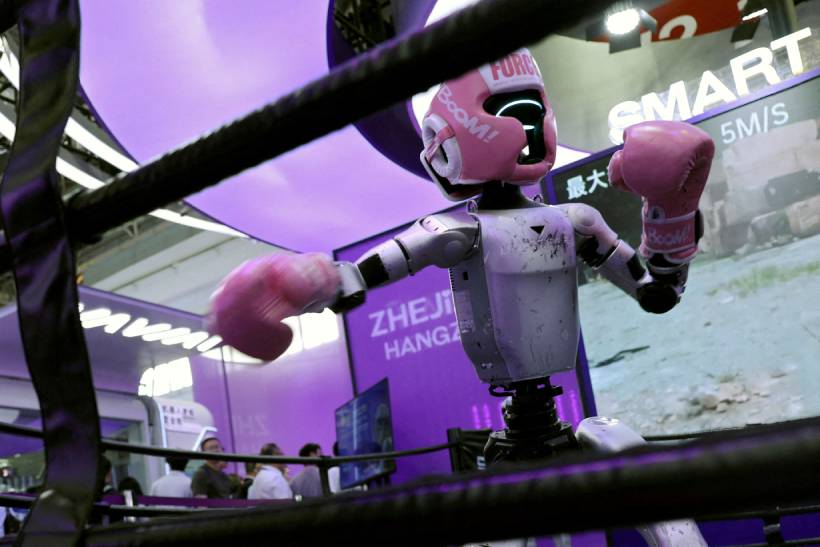
The second World Robot Games kicked off in Beijing, China, from August 22nd to 26th, 2026. 2,056 robots representing 666 teams from 16 countries competed in 51 diverse events within real-world, not simulated, environments. The five-day event was held at the National Oval Speed Skating Center in Beijing. The number of participating teams increased by a record 138% compared to the first edition. Approximately 1,000 robots showcased their agility at the opening ceremony. The competitions included athletic challenges such as running and agility drills. The tests moved from demonstration halls to realistic scenarios. Practical tasks were conducted in environments resembling factories, hotels, and model homes, as documented in live footage and covered by Chinese and international media outlets. The events include speed races for humanoid robots, such as breaking records in the 100-meter dash, weightlifting, tug-of-war, and autonomous tennis matches. The service and industrial challenges of these events take place in real workplaces rather than simulations, testing the embodied intelligence and the machines’ ability to solve everyday production problems.
Herein lies the potential benefit for the Global South from humanoid robot competitions and events in terms of learning from the Chinese model of technology transfer and localizing industry at competitive prices compared to expensive Western markets. This model also provides smart solutions for agriculture, logistics, and healthcare sectors tailored to the needs of developing countries and the Global South and promotes industrial cooperation and knowledge exchange through South-led initiatives, rather than complete dependence on traditional technology centers. In this context, humanoid robot competitions and events, such as the World Robot Games in Beijing, offer a pioneering Chinese model. Given the strategic opportunities these events offer for the Global South to transfer technology and localize industry at competitive prices, characterized by lower costs compared to Western and American markets, and to provide smart and practical solutions that meet the needs of developing countries and the Global South, contributing to building knowledge-based and independent cooperation, this facilitates technology transfer and industry localization at competitive prices. Furthermore, the reduced costs of components and integrated supply chains in China provide cost-effective alternatives to expensive Western technologies.
Therefore, China is focusing on transforming robots from mere showcases into practical, productive products that can be easily localized in emerging markets of the Global South. This is achieved by leveraging Chinese government incentives and support as a model for building local capabilities in the Global South, providing smart solutions for development sectors, and assisting in developing precise and practical robotic tasks (such as sorting, assembly, and handling real-world environments) to serve the logistics sector. The design of humanoid robots capable of operating in harsh environments also opens the door to smart applications serving the agricultural sector and rugged terrain. Here we find that China’s focus on producing service and social robots supports the healthcare and elderly care sectors at an affordable cost. It also promotes industrial cooperation and knowledge exchange, breaking the Western and American technological monopoly and encouraging the adoption of Global South initiatives for knowledge sharing, rather than complete dependence on traditional technology centers in Europe and the United States. This helps countries of the Global South to build (joint technological partnerships inspired by the efficiency of Chinese engineering and the rapid deployment of artificial intelligence applications). Furthermore, it motivates local engineering talent in the Global South by providing them with advanced manufacturing skills and industrial integration through learning from the Chinese experience and model of these humanoid robots.
These events, competitions, and races related to humanoid robots, hosted by the Chinese capital, Beijing, are linked to the technological rivalry between China and the United States. The event demonstrates China’s practical superiority in robot hardware and autonomous movement, a direct response to the ongoing US restrictions and bans on exporting chips used in technology manufacturing to China, as well as restrictions on dealings with Chinese technology companies. This transforms the technological race for humanoid robots from mere theoretical posturing into practical productivity, granting China geostrategic leverage in controlling global artificial intelligence supply chains. Here, the humanoid robot events in Beijing embody a (fierce technological and strategic struggle between China and the United States), where Beijing showcases practical superiority in manufacturing and movement that transcends US restrictions on chips, turning theoretical posturing into actual productivity that gives it influence in global supply chains. Herein lie the dimensions of the technological competition between China and the United States in the humanoid robot competitions in Beijing through the circumvention of restrictions. The efficiency of these humanoid robots reflects China’s ability to bypass the US ban on exporting advanced chips, which effectively signifies China’s shift to practical production, moving from theoretical models to field application and large-scale commercial production. This underscores the message of China’s geostrategic dominance of humanoid robot systems, artificial intelligence, and embodied intelligence in its confrontation with the United States by emphasizing China’s strengthening control over key aspects of the artificial intelligence industry and its global supply chains. The significance of Chinese superiority is further highlighted by the demonstrated resilience of the domestic smart device sector despite Western and American sanctions.
Stay ahead of the geopolitical week.
MD Briefing delivers expert analysis across five global fronts — the Indo-Pacific, energy, geoeconomics, European security, and the Middle East — every Monday morning. Free.
Accordingly, we understand the extent to which Beijing’s hosting of humanoid robot events and competitions can convey Chinese political messages to the Global South, the West, and the United States, emphasizing China’s ability to use field innovation in humanoid robotics as a tool for direct political and economic pressure. This is reshaping the balance of power in the advanced technology and artificial intelligence sector in China’s favor.
