


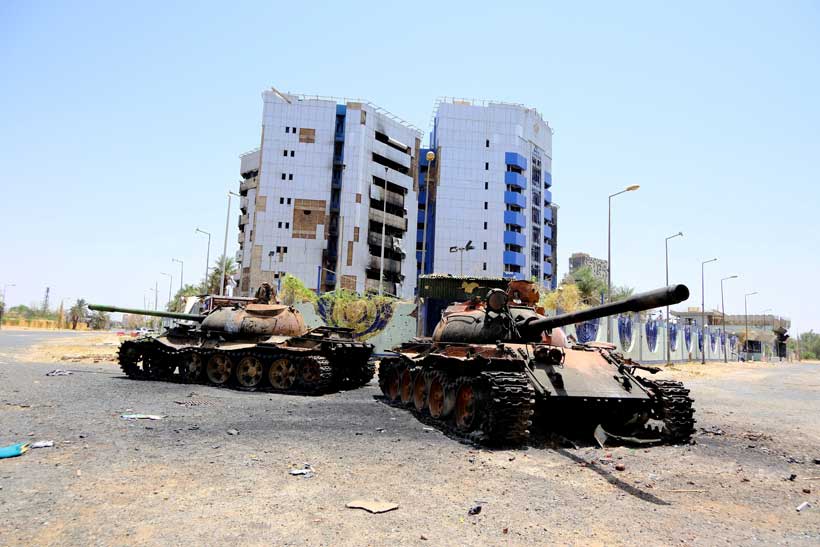
Sudan’s war has entered a more dangerous phase after fighting spilled across the country’s borders, raising fresh concerns about the conflict’s regional consequences.
The Chadian army accused the Sudanese Armed Forces (SAF) of carrying out an airstrike against a convoy inside Chadian territory. According to the Chadian General Staff, the attack occurred at about 8 p.m. on August 20 in the Mourdi department of Ennedi-Est province, near the Sudanese border. It said aircraft and drones believed to belong to the SAF or its allies pursued and struck the convoy more than 100 kilometres inside Chad. The convoy was reportedly carrying reinforcements for the Rapid Support Forces (RSF), which the Sudanese army regards as a rebel group.
The US has since condemned the airstrikes, calling for an end to external forces supporting the conflict. Massad Boulos, the US president’s senior adviser for Arab and African affairs, said the US government opposed the expansion of violence beyond Sudan’s borders and stressed that there is no military solution to the conflict.
“The parties must immediately accept a humanitarian truce, protect civilians, and allow unhindered humanitarian access,” he said.
Stay ahead of the geopolitical week.
MD Briefing delivers expert analysis across five global fronts — the Indo-Pacific, energy, geoeconomics, European security, and the Middle East — every Monday morning. Free.
Bolous also called for the expansion of the UN arms embargo, currently focused on Darfur, to cover the whole of Sudan, while accusing foreign powers of escalating the war.
“The UN Security Council must also act with urgency to ensure that the arms embargo and sanctions regime reflect the realities of the conflict today and hold those fueling and expanding this war accountable. External financial and military support to the warring parties must stop,” he said.
The US has also warned that external support was escalating the war, just as that the growing use of armed drones was obstructing the peace process.
The war began on April 15, 2023, when fighting erupted between the Sudanese Armed Forces (SAF) and the Rapid Support Forces (RSF) amid a deepening power struggle over Sudan’s political transition and the proposed integration of the RSF into the regular army. It has continued despite repeated ceasefire efforts and international initiatives to end the conflict.
The recent strike in Chad has now brought into sharper focus how far the war is spreading and how much the SAF’s expanding aerial capabilities depend on foreign support, especially with the presence and prominent use of Turkish drones.
French report highlights Turkey’s involvement
French newspaper, Le Monde reported that Turkey has emerged as the Sudanese army’s principal military supporter since the war began. The report said the Turkish government supplied Bayraktar TB2 and Akıncı drones and deployed instructors alongside them. It also reported that Saudi Arabia financed purchases of Turkish drones and Pakistani weapons for the SAF.
The report comes on the heels of Turkey’s deepening political relationship with Sudan’s military leadership. On August 7, Saudi Arabia, Turkey and Pakistan signed the Makkah Joint Defense Agreement, which provides that an armed attack against any one of the three countries would be regarded as an attack against all three.
According to Le Monde, cooperation among the three countries over Sudan predates the agreement, with Riyadh financing Turkish drones and Pakistani weapons for the SAF. The newspaper also reported a $1.5 billion Pakistani arms contract involving fighter jets, armoured vehicles and drones.
Since late 2024, Turkish-made Bayraktar TB2 and Akıncı drones have reportedly become part of the Sudanese army’s expanding aerial arsenal. The SAF has also used Iranian-made Mohajer-6 drones, while Chinese-made CH-95 and FH-95 systems have been deployed by the RSF, reflecting the growing role of foreign-supplied drone technology in Sudan’s war.
While there is no concrete evidence that a Bayraktar drone carried out the specific strike inside Chad, the presence of Turkish military technology in the Sudanese conflict is increasingly well documented.
In March 2025, The Washington Post reported that Turkish defence company Baykar had supplied the Sudanese army with at least $120 million worth of military equipment, including TB2 drones and hundreds of warheads. The investigation, based on contracts, correspondence, registries and visual material, also documented Baykar personnel providing technical support in Sudan.
In May 2026, Chatham House examined reports of Turkish drone supplies to the SAF while noting Ankara’s denial of direct deliveries. The relationship took on a clearer political dimension in June, when President Recep Tayyip Erdoğan met army chief Abdel Fattah al-Burhan in Ankara. The Turkish presidency said the two countries were seeking to expand cooperation in trade, agriculture, energy and defence.
This places Turkey’s role in Sudan beyond the question of individual drone deliveries. Turkey is deepening ties with the military leadership while presenting itself as a diplomatic actor in the conflict.
Beyond the current battlefield, Turkey’s relationship with Sudan dates back decades. But Erdoğan’s 2017 meeting with Omar al-Bashir and the agreement to redevelop Suakin underscored Ankara’s strategic interest in Sudan’s Red Sea coast.
The potential economic stakes here are also substantial. Sudan’s eventual reconstruction will require major investment in infrastructure, energy, agriculture and other sectors, while its Red Sea coastline and mineral resources offer significant strategic and commercial opportunities.
Foreign powers are therefore increasingly shaping not only how the war is fought but also the interests that will surround Sudan after the fighting ends. Turkey’s expanding relationship with the SAF is part of that wider contest, while the strike inside Chad shows how increasingly difficult it is to contain the war’s consequences within Sudan.
