


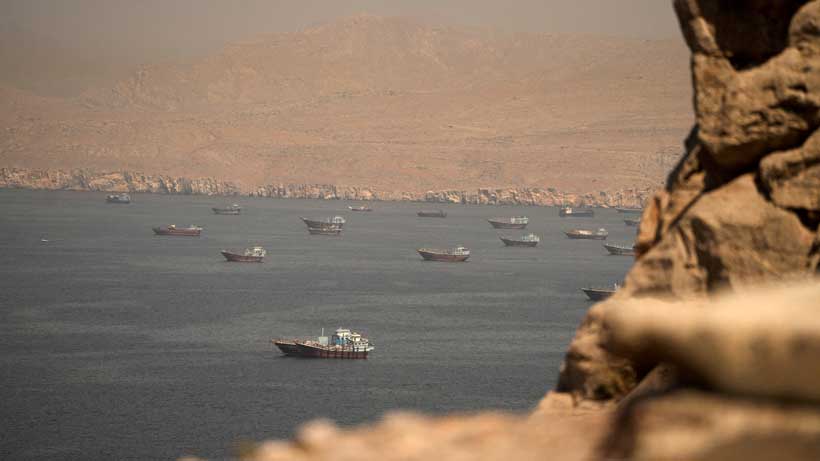
Six months into the war between the United States, Israel and Iran, the global oil market is facing a structural vulnerability that extends far beyond the disruption of supplies through the Strait of Hormuz. Almost half of the world’s oil production now originates in countries directly affected by armed conflict or major geopolitical confrontation, according to Reuters calculations, highlighting how deeply warfare has become embedded in the global energy system.
Countries affected by the conflicts in Iran, Russia, Ukraine, Libya and Venezuela produced around 45 million barrels per day in 2025, representing more than 43% of global oil supply, according to Reuters calculations based on International Energy Agency data. While not all of that production has been disrupted simultaneously, the sheer concentration of global supply in conflict-affected regions has transformed what might once have been considered isolated geopolitical shocks into a persistent systemic risk.
The significance goes beyond crude prices. The same conflicts are damaging refineries, disrupting shipping routes, forcing governments to restrict exports and drawing down emergency inventories. The result is a global energy market with less spare capacity, fewer reliable transport routes and increasingly limited protection against another major disruption.
A global oil system under pressure
The current crisis began with U.S. and Israeli attacks on Iran six months ago, which triggered severe disruption around the Strait of Hormuz, one of the world’s most important energy chokepoints.
Stay ahead of the geopolitical week.
MD Briefing delivers expert analysis across five global fronts — the Indo-Pacific, energy, geoeconomics, European security, and the Middle East — every Monday morning. Free.
The waterway normally handles a huge share of global oil flows. The conflict has dramatically reduced the amount of oil moving through it, although Saudi Arabia has diverted some exports toward the Red Sea while Gulf producers have increasingly relied on less transparent shipping arrangements.
Analysts estimate that the current disruption to Gulf oil flows stands at around 5 million to 7 million barrels per day.
That number is enormous, but it does not represent the full scale of the risk.
The problem is that alternative routes are themselves becoming vulnerable. Attacks in the Red Sea and near Egypt’s Suez Canal in July demonstrated that the crisis is no longer confined to the Persian Gulf.
The global oil trade therefore faces a network problem: when one route becomes dangerous, additional cargoes are redirected elsewhere, increasing congestion and exposure along alternative routes.
The Ukraine war adds another layer
The Russia-Ukraine war has created a separate source of instability.
Ukraine has increasingly targeted Russia’s refining infrastructure, striking facilities deep inside Russian territory. Some attacks have reached refineries thousands of kilometres from Ukrainian-held territory.
The effect is particularly important for refined products.
Russia has responded to domestic fuel shortages by restricting gasoline and diesel exports, removing additional supplies from international markets at a time when global refining capacity is already under pressure.
The conflicts in the Gulf and Ukraine have together reduced global refining capacity by roughly 10%.
This creates a dangerous distinction between the availability of crude oil and the availability of usable fuels. Even if enough crude remains available globally, shortages of refining capacity can prevent that oil from being converted into gasoline, diesel and jet fuel where it is needed.
Venezuela and Libya widen the geopolitical exposure
Iran and Russia are not the only sources of risk.
Libya’s prolonged political instability continues to threaten production, while U.S. restrictions on Venezuelan oil exports have added another layer of uncertainty to global supply.
The result is a remarkable concentration of energy production in politically unstable environments.
This does not mean that 43% of global oil production has disappeared. Much of the production in these countries continues to reach markets.
But the calculation demonstrates how vulnerable the global system has become to political and military disruptions.
Oil markets are increasingly having to price not just current production losses but the possibility that another major producer, export route or refinery could suddenly become unavailable.
America becomes the supplier of last resort
The United States has emerged as one of the most important stabilising forces in this environment.
The disruptions have increased the world’s reliance on U.S. crude and refined fuels. American producers and refiners have increased exports to compensate for shortages elsewhere.
But that dependence creates its own vulnerability.
U.S. energy infrastructure is not immune to disruption. Severe weather can temporarily affect production, refining and transportation, while American refineries are already operating at exceptionally high utilisation rates.
That means Washington is effectively being asked to compensate for disruptions occurring across several continents while its own energy system is operating under considerable pressure.
If a major hurricane or other disruption were to simultaneously remove significant U.S. refining capacity, the global consequences could be severe.
The refining bottleneck may be more dangerous than crude shortages
The most underestimated aspect of the current crisis may be the shortage of refining capacity.
Crude oil is only useful to consumers after it has been processed into products such as gasoline, diesel and jet fuel. When refineries are damaged or forced offline, crude supplies cannot easily compensate for the resulting shortage of finished fuels.
That is already becoming visible in fuel markets.
Russia’s export restrictions have tightened diesel markets, while U.S. diesel prices have reached record levels despite American refiners operating close to maximum capacity.
This creates a dangerous feedback loop.
High prices encourage refiners to maximise production. But prolonged operation at exceptionally high rates increases the risk of equipment failures and unplanned outages. If additional American refining capacity were lost while Middle Eastern and Russian facilities remain impaired, the global fuel market could move rapidly from tightness to outright shortage.
Emergency stockpiles are running out
Governments have attempted to cushion the shock by releasing emergency oil reserves.
The International Energy Agency has released record volumes from emergency stockpiles, helping compensate for some of the lost supply.
But those releases are now largely complete.
That matters because strategic reserves are designed to provide temporary protection, not permanently replace lost production.
At the same time, global inventories continue to decline.
This leaves the market with less of a buffer if another disruption occurs. The longer the wars continue, the more difficult it becomes to replenish those inventories while simultaneously satisfying current demand.
The market is therefore entering a more dangerous phase: emergency reserves are being depleted just as geopolitical risks remain elevated.
Oil is becoming an inflation problem
The consequences are no longer confined to energy traders.
Higher oil and fuel prices feed directly into transportation, manufacturing, agriculture and household expenses. Businesses pass higher fuel costs through supply chains, while consumers face higher prices for transportation and other goods.
That can keep inflation elevated even when other components of price growth are slowing.
Central banks then face a difficult choice. If they keep interest rates high to contain inflation, they risk weakening economic growth. If they cut rates while energy prices are accelerating, they risk allowing inflationary pressures to become entrenched.
The result can be higher borrowing costs for governments, businesses and households.
For heavily indebted governments, the combination of expensive energy, slower growth and higher interest rates is particularly uncomfortable. Higher fuel prices can increase government spending pressures while simultaneously weakening tax revenues through slower economic activity.
A new geography of energy risk
The most important development may therefore be structural rather than temporary.
For decades, globalisation encouraged the energy market to assume that crude could be moved from producing regions to consuming markets through an increasingly interconnected network of pipelines, ports, refineries and shipping lanes.
That system is now being tested by geopolitics.
The Strait of Hormuz is vulnerable to military confrontation. The Red Sea is exposed to attacks. The Suez Canal can become a secondary risk. Russian refineries are being targeted. Venezuelan exports remain subject to U.S. policy. Libyan production remains vulnerable to political instability.
The result is a global oil market in which geography and security have become inseparable.
The United States cannot carry the entire burden
America’s growing role as a supplier of last resort provides an important cushion, but it cannot completely insulate the world from a prolonged crisis.
U.S. production and refining capacity have limits. American refiners cannot indefinitely compensate for the simultaneous loss of millions of barrels per day elsewhere, particularly if they themselves experience maintenance problems, accidents or severe weather disruptions.
This is why the current situation differs from a conventional supply shock.
A conventional disruption can often be absorbed through spare production capacity, alternative suppliers or inventory releases.
The current crisis is occurring across multiple producers and transportation routes simultaneously.
There is therefore less redundancy in the system.
What happens if the wars continue?
The central question for energy markets is no longer simply when Iranian oil exports will recover.
It is whether the global oil system can continue functioning under prolonged geopolitical fragmentation.
If the Iran war continues, the Strait of Hormuz remains constrained, Russian refining capacity remains under attack and alternative shipping routes face additional risks, the world could enter a prolonged period of structurally higher energy prices.
That would have consequences far beyond oil.
Higher energy costs could reinforce inflation, delay interest-rate cuts, weaken economic growth and intensify fiscal pressures. Countries heavily dependent on energy imports would face particularly severe challenges, while producers outside conflict zones would gain greater strategic and economic importance.
The crisis could also accelerate investment in alternative energy sources, strategic reserves, domestic production and diversified supply chains. In that sense, today’s disruption could permanently reshape the global energy map.
But the immediate problem is much simpler: the world is running out of buffers.
With more than 43% of global oil production originating in conflict-affected countries, refining capacity under pressure, emergency stockpiles depleted and inventories declining, the international energy system has become unusually exposed to the next shock.
The defining question for the global oil market is no longer whether one war can disrupt energy supplies. It is whether the world can withstand several overlapping conflicts without turning a geopolitical crisis into a full-scale global energy emergency.
With information from Reuters.
