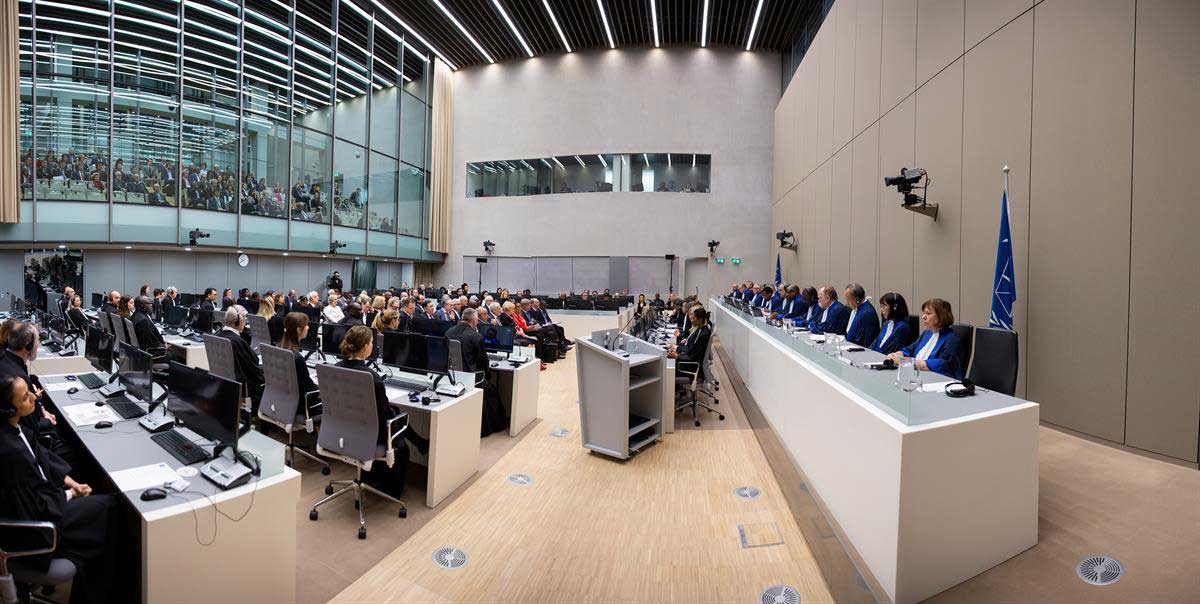
The United States’ recent confrontation with the International Criminal Court (ICC) raises a question about international law and geopolitics that needs urgent attention. Washington has historically been one of the main architects of the principles behind international criminal justice, from the Nuremberg trials to the development of modern international humanitarian and criminal law. Yet, the same country that helped establish the foundational idea that any individual in the world should be held accountable for war crimes, crimes against humanity, and genocide, has consistently resisted allowing an international court to exercise that same authority over its own citizens and the citizens of its allies.
It is undeniable that the ICC faces legitimate questions about global jurisdiction, accountability, efficiency and political legitimacy. But the problem is not necessarily that the ICC is beyond criticism or that the U.S. foreign policy seeks its dismantling, but that the ICC requires international legitimacy before superpowers to be able to exercise its authority over them more efficiently. Thus, the international community may indeed need to reform the ICC to improve the system. Weakening, isolating, or confronting it is not the answer.
What superpowers need to learn is that they could benefit from a strengthened subsidiary system of international justice, capable of pursuing and prosecuting international crimes more effectively through global coordination and cooperation, capabilities that no single state can replicate on its own. The deeper question is whether the world can build that kind of consensus over an international criminal justice system strong enough to prosecute the gravest crimes while legitimate enough for major powers to accept its authority.
The Contradiction: From Nuremberg to The Hague
Stay ahead of the geopolitical week.
MD Briefing delivers expert analysis across five global fronts — the Indo-Pacific, energy, geoeconomics, European security, and the Middle East — every Monday morning. Free.
The American role in creating this system is difficult to ignore. At Nuremberg, U.S. Supreme Court Justice Robert H. Jackson served as chief American prosecutor and helped establish the principle that individuals, including political and military leaders, could be held personally responsible for international crimes. The United States later played important roles in the creation of the tribunals for the former Yugoslavia and Rwanda. Even when negotiating the Rome Statute, Washington participated in defining the elements of international crimes and worked to establish safeguards around the ICC jurisdiction.
However, the apparent contradiction raised at the creation of the ICC itself. The United States voted against adopting the Rome Statute in 1998 while President Bill Clinton explicitly expressed support for international accountability and the prosecution of genocide, war crimes, and crimes against humanity. What was relevant is that the U.S. kept their seat at the table at that moment to shape ICC’s jurisdiction and procedures. The U.S. administration emphasized that the Court was designed to complement, rather than replace, federal judicial systems. They ultimately never ratified the treaty.
Washington’s subsequent policy went considerably further. During the George W. Bush administration, the United States formally notified the United Nations in 2002 that it did not intend to become a party to the Rome Statute and launched a global campaign to conclude bilateral “Article 98” or “non-surrender agreements”, under which a country waives its right to surrender U.S. nationals to the ICC.
With this precedent, a different analysis should be done: Although this history makes the current confrontation unsurprising, the fact that the U.S. and other major superpowers supports the foundational principles of international criminal justice while rejecting the ICC itself may suggest that the dispute is less about international law and more about who controls that authority and what checks exist over it.
The system has a Price, but a Benefit too
At first glance, it is understandable that no sovereign state wants an international prosecutor or judge to exercise authority over its citizens without its consent or without effective safeguards. This particular concern is not unique to the United States. Other countries, such as Russia, China, and Israel have raised similar objections. But beyond the obvious political interests of those states directly involved in conflicts where international crimes are alleged, if we want to preserve the ultimate goal of keeping international criminals accountable and strengthen the system, we must recognize and defend the benefits that such a system can provide, and make a stronger case for its value among democratic states, including the United States.
The ICC was designed around the principle of complementarity: national courts have primary responsibility, while the international court intervenes when a state is unwilling or genuinely unable to investigate or prosecute serious crimes. An international criminal court could potentially achieve things that no single state might be able to do on its own. First, war crimes and others often involve multiple jurisdictions, victims, perpetrators, and evidence across borders or nationalities, requiring a major level of coordination, information-sharing, and investigation capacities that no national justice system could potentially replicate. Second, relying only on the courts of a state directly involved in a conflict could raise serious questions of impartiality, particularly when the perpetrators are state officials or supporters. A subsidiary international system could therefore provide both that kind of global reach.
This is the unavoidable trade-off of international governance that the current global order requires. States must surrender some degree of absolute sovereignty if they want international institutions capable of addressing problems that transcend borders. Achieving this requires a dual strategy: first, building capacities over a robust Court around a shared consensus that serious international crimes should be subject to subsidiary international jurisdiction; and second, creating incentives and costs for states that neither meet minimum national standards of accountability nor allow legitimate international scrutiny. Over time, this combination could encourage even states outside the existing system to participate. But greater participation will eventually require a reformed (or new) Court that is also better adapted to the geopolitical realities of today. That’s a challenge that points directly to the need to reform the ICC itself.
Reforming the ICC Without Compromising It
If the problem is partly one of legitimacy and governance, a reform should address governance without compromising judicial independence. One possible model would be to strengthen the ICC’s political oversight through a representative governing body involving major powers, regional blocs, and other countries, while preserving a strict separation between political governance and judicial decisions. Such a model would require a Court with stronger investigative and prosecutorial capabilities, broader mechanisms for law-enforcement cooperation, rigorous legal procedures, and recurrent institutional accountability. Major powers could have a greater role in shaping ICC’s institutional rules, budget priorities, and checks, but they should have no veto power over any kind of investigation, prosecution, or judicial decision. Judges involved in specific cases need to remain fully independent and shall not participate in proceedings involving their own nationals or governments.
This distinction would be essential to prevent the ICC from becoming a second Security Council, where geopolitical power determines which affairs can move forward. Such a model would not be perfect and could still create risks of political pressure. But, like other global institutions, there may be value in designing a transitional architecture that better reflects the changing distribution of global power without sacrificing the independence that gives international criminal justice its legitimacy. The objective should not be to place the Court under the control of major powers, but to give those powers a legitimate stake in an institution whose judicial decisions remain beyond their control.
If a consensus could be made, the bigger the coalition defending international criminal justice, particularly when it includes major powers such as the United States, the greater the legitimacy and leverage to reform and strengthen the system. A more widely accepted framework could also make it easier to engage non-Western powers, including Russia and China, in adapting its rules and governance, rather than allowing international criminal justice to be perceived as a predominantly Western project.