


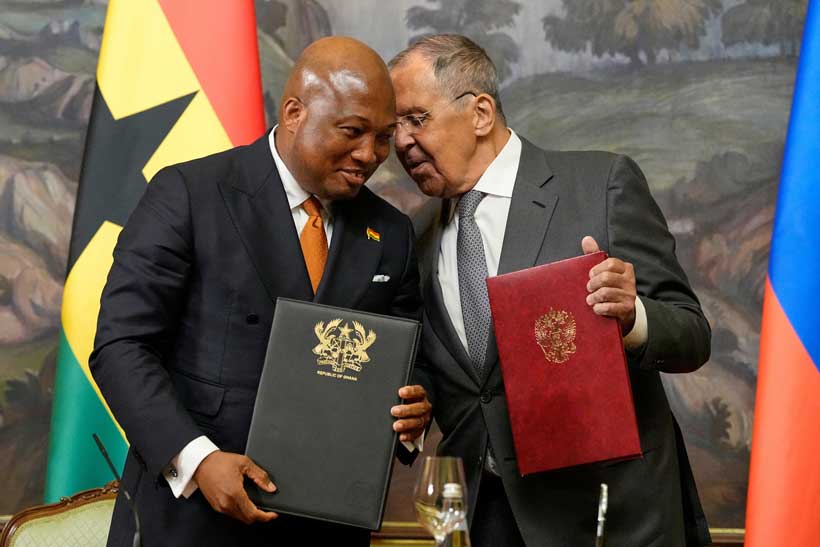
Russian Foreign Minister Sergey Lavrov and Ghana’s Foreign Minister Samuel O. Ablakwa, after an intensive strategic consultation aimed at raising bilateral relations from vision to commitment, have agreed on a pack of measures for normalizing relations between the Confederation of Sahel States (AES) and the Economic Community of West African States (ECOWAS). The three Francophone West African states have been facing serious security and development issues and desperately turned for military-technical assistance from Moscow after breaking with France and other Western allies.
In remarks at the joint media conference, it was underlined that it was necessary to ensure continuity with relations between the Confederation of Sahel States (AES) and the Economic Community of West African States (ECOWAS). On the understanding that Ghana is historically one of the most important players in West Africa. Undoubtedly, President John Mahama continues to promote a unifying agenda on the African continent, in the African Union, and also in world affairs. Critically assessing the current situation, especially in West Africa, a multitude of crises continue there in spite of the efforts of ECOWAS, the African Union, and the international community.
Regarding the regional issues, this, of course, borders on security and counterterrorism on the African continent, with a focus on the situation in the vast Sahara-Sahel region. This affects Ghana and other West African countries. “We are ready to provide necessary support to Africans, including in normalizing relations between members of ECOWAS and the three countries of the Alliance of Sahel States, which have withdrawn from ECOWAS but remain neighbors. We are interested in normalizing these relations, as well as the relations of the Sahel three within the framework of their participation in the African Union,” Lavrov said.
Notwithstanding the complexities, Moscow characterizes its collaboration with the Sahel states as a security partnership. Lavrov articulated, in comprehensive and candid terms, that West Africa should engage to reinforce its own collective security, primarily against terrorist threats. It is universally acknowledged that this endeavor necessitates the concerted efforts of all states within the region, encompassing both the existing members of ECOWAS and the countries comprising the Alliance of Sahel States, according to Lavrov.
Stay ahead of the geopolitical week.
MD Briefing delivers expert analysis across five global fronts — the Indo-Pacific, energy, geoeconomics, European security, and the Middle East — every Monday morning. Free.
Moreover, Russia’s stance is entirely aligned with this approach. During Lavrov’s working visit to Africa in mid-July—both in discussions with the leadership of the African Union and in talks with the foreign ministers of the Alliance of Sahel States—the officials advocated the imperative of overcoming difficulties that are, in many respects, artificially contrived and of establishing constructive and positive engagement around a mutually advantageous agenda. This encompasses all the countries, including Ghana, Côte d’Ivoire, Togo, and Benin, as well as the leadership of ECOWAS.
Incidentally, Russia will soon sign a memorandum on collaboration with ECOWAS, including in the sphere of security. There is a discernible interest in this matter. Therefore, it has become imperative to ensure the security of populations in West African countries—to build bridges and implement practical measures between ECOWAS and the Alliance of Sahel States. And Russia stands ready to facilitate this process in question.
Russia’s Leadership Messages
Beyond that, Russia has established comprehensive positions within the framework of bilateral cooperation to pursue AES in resolving conflicts; more importantly, crisis situations on the continent should be solved according to “the principle of African Solutions to African Problems.”
According to reports monitored during Lavrov’s mid-July trip to Africa, it primarily spotlights that principle and possibility to take an unwavering commitment in achieving the security and development goals set by Africans themselves. For academics who also unequivocally argued that the leaderships of both the African Union and ECOWAS have to pursue a policy of consolidation rather than division within the continent. This serves the interests of all African countries without exception. As a result, Russia only stands firmly for Africans to come to terms among themselves, with external actors merely facilitating the process by providing financial support for peacekeeping initiatives or encouraging the African countries to reach agreements among themselves.
Lavrov unreservedly underscored the primacy of political and diplomatic means of conflict resolution across the African continent, emphasizing that Africans themselves should play the leading role, with the support of the international community. Given the circumstances, Africa has to strengthen confidence-building measures for undertaking the main tasks in the contemporary world.
As notably seen, Russia has placed special emphasis on Africa, where pockets of instability persist, focusing primarily on the vast Sahara-Sahel region. Russia’s common view is that regional crises and the changes that are taking place in the countries of the region must be addressed by African states themselves, without attempts to impose external solutions on them. In this context, Russia firmly reiterated its support for any efforts to normalize relations between the Economic Community of West African States, on the one hand, and Guinea-Bissau, Mali, Niger, and Burkina Faso, on the other hand.
AES Experiencing Economic Difficulties
Basic research shows that besides instability, these three Sahel countries are engulfed in various socio-economic development problems, primarily due to their own poor and uncoordinated policies toward economic development. The UN Development Report ranks the three Sahel states in the lowest category in its index in the world. Perhaps AES remains symbolic but faces unprecedented obstacles in economic transformation and in building their collective security architecture. At least Russia has supported uprooting French domination and pledged tremendous partnership assistance to reshape their economy.
Analysts, however, interpreted Russia’s courtship as a larger push to raise and consolidate influence across Africa, leveraging anti-Western sentiments to build alliances and access strategic natural resources. The AES has battered its resources for military weapons and for necessary military-technical support and capacity-building in its armed forces as it moves towards strengthening diplomatic relations with Moscow. Following the Soviet collapse, Moscow presents itself as a reliable friend and a partner for ensuring Africa’s political and economic sovereignty.
The Confederation of Sahel States (Burkina Faso, Mali, and Niger) was created in September 2023 and formalized as a confederation in 2024, emerging after a string of military coups. Withdrawal from ECOWAS has sparked reactions and criticisms. The AES aims at forging integration and tackling existing diverse obstacles while navigating further for strategic external collaboration. Later, the Russian Ministry of Foreign Affairs launched what is referred to as “Russia-AES Ministerial Consultations” that focuses on regular annual political dialogue, reviews counterterrorism issues, and coordinates on bilateral investment plans in the Sahel region in West Africa. The AES security matters will be at the center of the deliberations at the forthcoming Russia-Africa Summit scheduled for late October 2026.
