


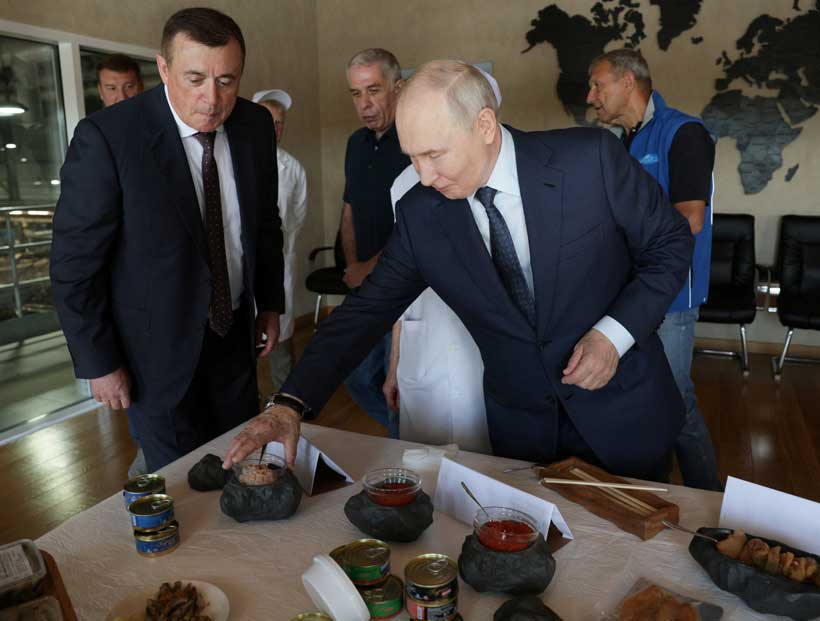
Russian President Vladimir Putin’s visit to Iturup in mid-August 2026 has sparked debates and generated fresh discussions on ownership of the territory between officials in Russia and Japan. Iturup is the largest and northernmost of the Kuril islands, ownership of which is still disputed between Russia and Japan.
Accompanied by the governor of the Sakhalin Region, Valery Limarenko, the president visited the Yasny fish processing complex, where he learned about the enterprise’s operations and had a conversation with the plant’s staff.
After that, the president toured the Kurilsk Central District Hospital. The healthcare facility offers round-the-clock inpatient and outpatient care, as well as emergency medical care and urgent treatment to residents of the Sakhalin Region’s Kurilsky District.
Why Putin visits Japanese islands
Stay ahead of the geopolitical week.
MD Briefing delivers expert analysis across five global fronts — the Indo-Pacific, energy, geoeconomics, European security, and the Middle East — every Monday morning. Free.
According to Russia’s media, Putin visited the Japan-claimed islands for the first time on a study trip to assess their geographical features. The visit was followed by Russian naval drills and the launching of a North Korean missile.
Ties between Moscow and Tokyo soured after Putin ordered the full-scale invasion of neighboring Ukraine in late February 2022. Japan joined other nations in condemning the military attack and imposing sanctions on Russia. Putin’s visit, more or less, coincided with Japan’s 81st anniversary since its surrender ended the Second World War and with North Korea’s missile fired into the sea ahead of major joint military exercises by Seoul and Washington.
Foreign Ministry’s Explanation
Foreign Ministry spokeswoman Maria Zakharova said, “Statements made by Japanese Prime Minister Sanae Takaichi and Foreign Minister Toshimitsu Motegi on August 13 regarding President Vladimir Putin’s visit to Iturup are utterly outrageous and completely unacceptable,” explaining further that Iturup, like all the Kuril Islands, is legally an integral part of Russia. High‑ranking Japanese officials have gone so far as to brazenly dictate to Moscow which regions of its own country its President may or may not visit.
The Japanese leadership’s current attacks against Russia are further evidence of the shortsightedness of official Tokyo, which has adopted an anti‑Russia stance bordering on hostility. Accordingly, official Tokyo, through its complicity in the Russophobic policies of the collective West, including the imposition of illegal restrictions, has violated all legal norms and has no business lecturing anyone on international law or the need to care for the future of Russian‑Japanese relations.
According to Zakharova, it can only be reiterated that, nearly 81 years after Japan signed the Instrument of Unconditional Surrender in September 1945, Tokyo is, once again, in the grip of revisionist narratives that whitewash its aggression in Asia and advance absurd claims against Russia. Clearly, such a short‑sighted policy runs counter to the efforts of most countries in the region to ensure peace, security, and cooperation and thus creates serious risks for the people of Japan.
Tokyo’s Reactions
Japan condemned Putin’s visit as ‘unacceptable,’ and Tokyo has maintained claims to them, making their return a condition for concluding a formal peace treaty that would unlock closer economic ties. Prime Minister Sanae said in a televised statement: “We hope that the Russian side will take the seriousness of this matter fully to heart.”
Geographical Description
The Kuril islands were formally claimed as Japanese territory in 1855. Near the end of the Second World War in 1945, the Soviet Union occupied these Kuril Islands and forcibly removed its Japanese residents. Notwithstanding that, Japan continues to claim the islands and considers the northern edge of the islands to be its own northernmost points.
It is located between Kunashir, approximately 20 km to its southwest, and Urup, 38 km to the northeast. Russia frequently referred to these islands as the Northern Territory, while Japan called them the Kuril Islands. Iturup is located between Kunashir, approximately 20 km to its southwest, and Urup, 38 km to the northeast. Russia frequently referred to these islands as the Northern Territory, while Japan called them the Kuril Islands.
