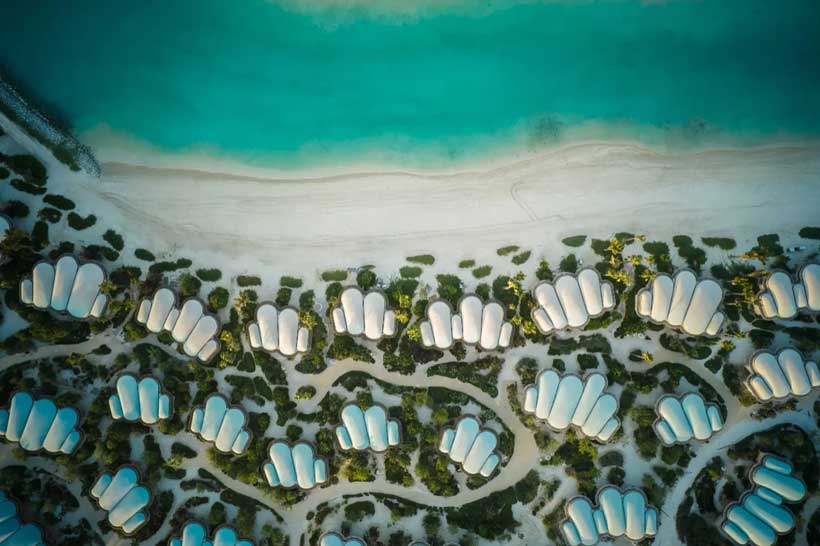
In late October, in a boardroom in Riyadh, executives from Red Sea Global and three Saudi lenders signed off on a SAR 6.5 billion ($1.73 billion) loan facility for AMAALA, the ultra-luxury wellness resort rising on the kingdom’s northern Red Sea coast. Riyad Bank underwrote the deal; the Saudi Investment Bank and Bank AlBilad came in as arrangers; the paperwork blended conventional and Islamic tranches under a green-loan framework. On paper, it read like routine project finance. For a company whose sole shareholder is the world’s fifth-largest sovereign wealth fund, the choice of lender said more than the number did.
The timing matters. Saudi Arabia’s Public Investment Fund, which owns Red Sea Global outright, has cut construction awards across its giga-project portfolio by roughly 60 per cent since 2024, from $71 billion to under $30 billion, and ordered spending reductions of 20 to 60 per cent depending on the project. Against that backdrop, a flagship resort turning to commercial banks rather than drawing further on its owner’s balance sheet isn’t a footnote. It’s the story.
Set beside NEOM, the contrast sharpens. The Line, once billed as a 170-kilometre linear city, has had its published scope narrowed to an initial stretch, its funding effectively ring-fenced inside PIF’s books to contain future write-downs, and openings at Trojena’s ski resort and Sindalah’s yacht island have both slipped. Diriyah, the historic-quarter redevelopment outside Riyadh, has leaned the other way, restructuring around public-private partnerships rather than pure sovereign equity. Red Sea Global, meanwhile, has kept shipping: eight resorts already trading, eight more due through 2026 — Six Senses, Rosewood, the Ritz-Carlton, a Four Seasons — doubling its portfolio to sixteen properties and roughly 3,000 keys, with a stated target of 300,000 visitors this year. The difference isn’t that Riyadh values hospitality over urbanism. It’s that Red Sea Global has paying guests already checking in, and NEOM, for the most part, still has renderings.
The fiscal arithmetic behind the shift is blunt. The kingdom’s break-even oil price sits above $90 a barrel by the IMF’s estimate; crude has traded closer to $60–65 for much of the past year. Saudi Aramco cut its dividend by roughly a third, to $84.5 billion, in 2025. PIF’s own cash reserves had fallen to around $15 billion by late last year, and the 2026 budget is projected to run a deficit near 3.3 per cent of GDP — about $44 billion. A fund that once bankrolled two dozen giga-projects at once is now rationing, and rationing means every remaining project has to make a better case for itself than “the crown prince announced it.”
Stay ahead of the geopolitical week.
MD Briefing delivers expert analysis across five global fronts — the Indo-Pacific, energy, geoeconomics, European security, and the Middle East — every Monday morning. Free.
Red Sea Global’s response has been to widen its funding base rather than simply absorb the squeeze. The AMAALA loan is one lever. Another is Laheq Island, the company’s first residential-led development, designed by Foster + Partners around an 800-metre ring of apartments and retail: rather than building purely to let, RSG is selling private residences outright, pulling buyer capital forward years before the doors open — much as Dubai’s developers learned to do a decade earlier. A third lever is the roster of hotel operators — Six Senses, Rosewood, Ritz-Carlton, Four Seasons — whose management contracts, and in some cases equity stakes, spread construction and operating risk that used to sit entirely with the sovereign fund.
The company’s own framing is unambiguous confidence. “We are one of the exemplar companies, we’ve delivered and we are delivering, so our funding is committed from the PIF,” chief executive John Pagano said this year, and the numbers he can point to are real: 11,000 staff, up from a skeleton team in 2017, and resorts that are open, priced and booking guests rather than existing as press renderings. But the more cautious reading is that even Red Sea Global has not been fully walled off from the reshuffle. Reporting this spring on PIF’s pivot toward AI infrastructure and away from tourism financing named the wider Red Sea Destination, not just NEOM, among the programmes absorbing cuts — a reminder that “exemplar” status is a ranking, not an exemption, and that the kingdom’s luxury-tourism bet now has to compete for capital against data centres as much as against Dubai or the Maldives.
The real test isn’t whether AMAALA’s villas fill this winter; early demand suggests they will. It’s whether Red Sea Global can keep borrowing at commercial rates once the assumption of unlimited sovereign backing looks less absolute than it did in 2017. A kingdom that used to fund ambition outright is now asking even its best-performing project to help fund itself — and watching closely to see whether it can.