Trump’s renewed talks with Tehran expose an uncomfortable reality: once war begins, foreign allies and their domestic networks can raise the political cost of ending it on American terms.
President Donald Trump said this week that the United States was having “very good discussions” with Iran, including negotiations that he said lasted an entire day. If those talks open a path out of the cycle of strikes, retaliation, and renewed escalation, Washington will again confront a question that has received far less attention than the decision to go to war: Who gets to determine the terms on which America’s war ends?
On paper, the answer is simple. The president should decide on the basis of American interests. In practice, war creates a new political environment. Groups that supported the initial operation, allies with broader objectives, media networks, political donors, and influence campaigns all acquire a stake in defining “victory.”
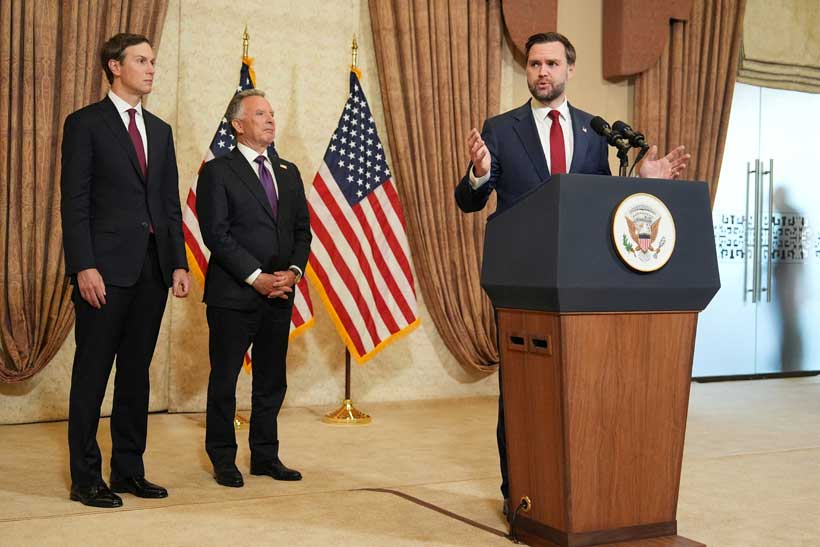
Vice President J.D. Vance’s recent remarks exposed that problem with unusual clarity. Vance said that certain individuals within the Israeli government had attempted to shape American public opinion against an agreement with Iran that could help end the war. He also acknowledged that friendly and hostile governments alike routinely try to influence Washington. The real danger, he suggested, begins when those efforts raise the political cost of independent American decision-making.
Stay ahead of the geopolitical week.
MD Briefing delivers expert analysis across five global fronts — the Indo-Pacific, energy, geoeconomics, European security, and the Middle East — every Monday morning. Free.
When the attacks began, part of the Republican coalition embraced the demonstration of American power. Preventing Iran from obtaining a nuclear weapon, restoring deterrence, and showing Washington’s resolve were presented as clear objectives. But once the administration moved toward limiting the conflict and reopening a diplomatic path, the vocabulary changed. Restraint could suddenly be called weakness, negotiation concession, and a limited outcome surrender.
This is where the difference between starting a war and ending one becomes clear. Beginning military operations requires a concentrated decision. The president gives the order, the military strikes, and allies rally behind the move. Ending a war requires deciding how much of the original objective has been achieved and how much more is worth the additional cost. That is when actors seeking to prolong the conflict can expand the definition of victory.
If the original objective is the nuclear program, missiles can be added next, then regional proxies or other regional concerns. A war that began with a limited purpose can gradually accumulate objectives that cannot all be satisfied at once.
Official filings under the Foreign Agents Registration Act show that Clock Tower X, led by former Trump campaign manager Brad Parscale, provided strategic communications and media services through Havas Media Germany on behalf of the State of Israel. The work included audience research, outreach to younger Americans, narrative development, influence mapping, and identifying high-impact voices and distribution channels. Subsequent filings describe millions of dollars in digital spending and an ambitious effort to reach American audiences at scale.
Parscale has rejected Vance’s characterization, saying Israel did not hire him to undermine negotiations with Iran. But that does not erase the larger issue. Modern political influence rarely works through direct orders. Its power lies in intermediaries.
When an embassy makes an argument, American audiences know they are hearing a foreign government’s position. When the same narrative is carried by an American political consultant, conservative broadcaster, MAGA-aligned influencer, or domestic organization, it can look like an organic expression of American opinion.
At that point, saying that “allies have a right to make their case” is no longer enough. Israel has the right to define its security interests. The United States has the same right. The problem arises when an ally’s preferences become so embedded in the American political arena that resisting them imposes a domestic political penalty on American officials.
That matters especially in the case of Iran because Washington and Jerusalem do not necessarily have identical interests at every stage. Israel may believe that continued military pressure offers the best way to reduce the threats it faces. The U.S. government must make a broader calculation: risks to American troops, energy prices, military readiness, economic costs, the danger of a wider regional war, and what another round of strikes is actually expected to achieve politically.
An alliance means little if it cannot tolerate disagreement. If every divergence from an ally’s preferred policy is portrayed as betrayal, weakness, or appeasement, the relationship has moved beyond consultation between two sovereign states. One side has begun to shape the domestic political cost of the other’s decisions.
This is where “America First” faces its real test. If the slogan means only that a president is free to use American military power, it offers a narrow definition of national independence. Strategic autonomy becomes harder when the president wants to say, “Enough.” Ending a war can require more political courage than beginning one because stopping means confronting those who can always produce one more objective and one more reason to keep fighting.
The United States cannot claim an independent foreign policy if foreign allies can use domestic networks to build support for continued war while raising the cost of ending it. That does not mean abandoning alliances or dismissing Israel’s security concerns. It means something more basic: decisions about an American war must ultimately be made in Washington according to American calculations.
That is why financial transparency surrounding foreign influence campaigns matters. Americans have a right to know which political messages emerged from domestic debate and which were amplified with the money and strategic planning of a foreign government.
Trump’s renewed talks with Iran have made the issue immediate. If an agreement becomes possible, hawks will argue that unresolved threats remain. They may be right. Almost no war ends with every threat removed. The relevant question is whether eliminating the remaining threats would cost the United States more than their elimination is worth.
A president who can start a war but must first satisfy foreign governments, media networks, political donors, and domestic pressure groups aligned with them before he can end it does not possess full strategic independence.
If Washington cannot stop a war when American interests require it, foreign influence will have achieved something more significant than changing a few headlines. It will have helped define the boundaries of the peace America is politically permitted to make.