


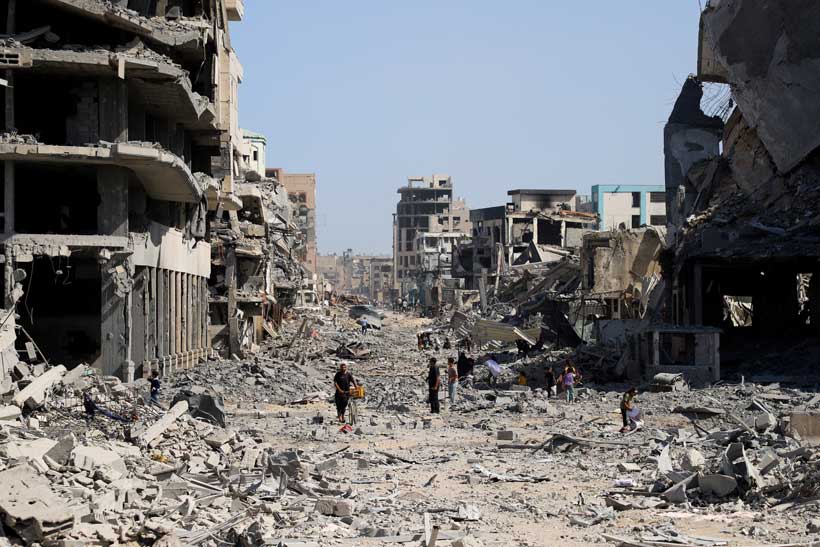
On July 30, Gaza’s parties signed a disarmament roadmap that Washington called a historic breakthrough, the latest turn in a sequencing fight this outlet has tracked closely for months. But a disarmed Gaza still cannot rebuild itself, and the deeper question sitting underneath every disarmament headline is where the rebuilding money actually goes once it arrives, and who gets to decide. Roughly seventeen billion dollars in pledges sits against a reconstruction bill the World Bank and United Nations put near seventy one billion dollars over a decade. As of this summer, congressional aides told reporters that almost none of the pledged money had reached the fund the Security Council actually authorized. Some of it, according to the Financial Times, appears to have gone somewhere else entirely.
The Board of Peace was established in January under a framework the Security Council endorsed through Resolution 2803, chaired by President Trump and staffed by a nine member Executive Board dominated by his own officials and associates, including Secretary of State Marco Rubio, envoy Steve Witkoff, son in law Jared Kushner, and former Prime Minister Tony Blair. Its mandate covers governance, security, and financing for Gaza’s reconstruction, overseeing a separate Palestinian technocratic body, the National Committee for the Administration of Gaza, led by Ali Shaath and based for now in Cairo. The board’s charter also grants Trump authority well beyond Gaza, describing a body meant to address conflicts globally, which is part of why most European governments have declined to join, and why the financing mechanism built underneath it deserves scrutiny on its own terms rather than as a footnote to the ceasefire. Notably absent from the design entirely is any Palestinian role in deciding how reconstruction funds are governed, only in receiving what the board eventually disburses.
The financing architecture built to support all this runs through a World Bank vehicle called the Gaza Reconstruction and Development Fund, known as GRAD, established at the Trump administration’s request following the Security Council resolution. GRAD is structured as a financial intermediary fund, a pass through mechanism that lets the Bank accept pooled donor money without its usual internal review process. Crucially, the Bank’s own documentation describes its role as a limited trustee, meaning it holds no fiduciary responsibility for how the money is spent once transferred to the Board of Peace. World Bank President Ajay Banga has said a financial controller was seconded to the board to help build appropriate oversight standards, and has promised donors transparency. But the design itself hands final control of disbursement to the board’s Executive Board, which the charter empowers to manage all budgets, financial accounts, and disbursements under Trump’s direction.
Membership in the board carries its own price. Countries that pledge one billion dollars within their first year secure permanent seats; those that decline participate on renewable terms without the same standing, a structure critics including the European Council on Foreign Relations and Carnegie Endowment for International Peace have described as pay to play. The United Arab Emirates, Qatar, Saudi Arabia, and Kuwait have each pledged at least one billion dollars, though Saudi Arabia and Kuwait indicated their contributions would be disbursed over several years rather than immediately. Canada’s invitation was reportedly withdrawn after Ottawa balked at the fee. Pakistan signed the founding charter in Davos in January, one of the earliest signatories, framing its participation around longstanding support for Palestinian statehood rather than the financing terms themselves.
Stay ahead of the geopolitical week.
MD Briefing delivers expert analysis across five global fronts — the Indo-Pacific, energy, geoeconomics, European security, and the Middle East — every Monday morning. Free.
The more consequential problem is where the money is actually sitting. By late May, the Financial Times reported that the World Bank administered GRAD account held zero dollars despite the seventeen billion in pledges, with donors instead directing funds toward an account the board established separately with JPMorgan Chase, outside the oversight structure the Security Council resolution envisioned. A Board of Peace spokesperson told the Financial Times that several channels exist to receive contributions and that donors had simply chosen alternatives to the World Bank fund. US Senator Jacky Rosen pressed Secretary Rubio in Congress over who controls that account and whether funds could benefit Trump or his associates; a separate Senate effort has sought to redirect a planned billion dollar State Department transfer to the board toward domestic energy assistance instead. None of this means money has been misused. It does mean the mechanism donors were promised is not the mechanism actually receiving their money, and no independent body currently confirms otherwise.
Into this gap has stepped private capital, most visibly DP World. The Dubai state owned port operator has held talks with Board of Peace representatives since late last year about managing Gaza’s supply chains, warehousing, cargo tracking, and security, according to a draft proposal the Financial Times reviewed, alongside the possibility of building a new port and free trade zone. Nothing has been signed, and DP World has not confirmed the discussions publicly. The company brings genuine capacity, it handles roughly one tenth of global trade, but also complications. Its longtime chairman resigned earlier this year amid scrutiny over ties to Jeffrey Epstein, and the company is simultaneously pursuing port contracts in Israel proper, including a joint bid for Haifa. A single operator holding commercial stakes on both sides of the same closed border is not necessarily disqualifying, but it raises a governance question that institutional readers will recognize immediately: whose interests does a neutral logistics operator actually serve once it depends on both parties for revenue.
Taken together, the picture is a reconstruction effort where the entity legally accountable for the money, the World Bank, has structurally opted out of responsibility for how it is spent, while the entity spending it answers to one chairman who also selects its Executive Board and can remove member states by a vote requiring a supermajority to overturn.
What Happens to the Money Now That Disarmament Has a Deal
The July roadmap explicitly ties reconstruction financing and timetables to supervision by the Board of Peace and the National Committee, which means the financing questions above are no longer background noise, they are the next test. Three paths look plausible over the coming months.
The most likely outcome is a continued muddle. Disarmament proceeds in the slow, partial way the July agreement already anticipates, heavy weapons surrendered over a window Board of Peace officials have described as lasting up to a year. Reconstruction financing follows a similar rhythm: pledges convert into actual transfers gradually, some through GRAD and some through the JPMorgan channel, DP World talks continue without a signed agreement through the rest of the year, and donor countries keep citing security conditions as their reason for withholding disbursement. This scenario does not resolve the transparency problem, it normalizes it.
A less likely but plausible scenario involves genuine pressure forcing consolidation. Continued congressional scrutiny in Washington, combined with donor discomfort, mainly among Gulf states now facing questions about where their own pledges actually sit, pushes the board to route contributions exclusively through the World Bank fund and to publish disbursement records. DP World, wary of further reputational exposure so soon after its chairman’s resignation, would likely wait for that clarity before signing anything substantial. This outcome is possible within the next two quarters but requires sustained pressure the story has not generated so far.
A third and less probable scenario is stall or reversal. The disarmament roadmap unwinds under the same strains that stalled phase two for most of this year, Israeli withdrawal slips, and donor governments treat that as license to delay further, leaving reconstruction financing frozen regardless of which account holds the money. Given how far the July agreement has already moved compared with the prior six months of deadlock, this outcome looks less likely than continued muddle, though it remains a real possibility given how many times this process has stalled before.
The Reconstruction Bill Nobody Has Actually Paid
Gaza’s disarmament sequencing was never the only obstacle standing between the current ceasefire and an actual rebuilt Gaza. Even a fully disarmed, fully secured Gaza cannot be rebuilt on pledges that sit in accounts nobody outside a small circle can audit, structured by a charter that gives one person the final word on where seventy billion dollars eventually goes. The clearest near term test is simple and falsifiable: watch whether the World Bank’s GRAD fund reports any nonzero balance in its next disclosure, and whether DP World converts its exploratory talks into a signed, published agreement before year end. If both remain empty, the money follows the same pattern as the ceasefire it is meant to fund, announced repeatedly, delivered rarely.
