


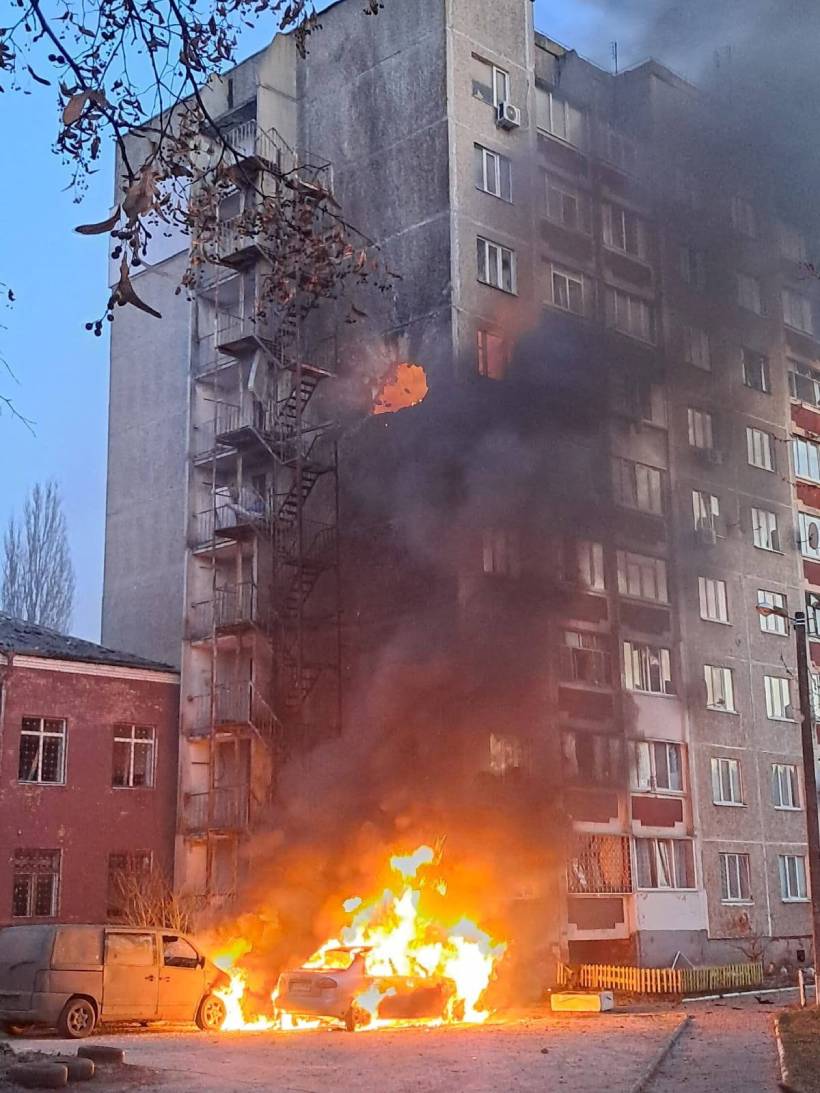
Russia has sharply intensified its aerial assault on Ukraine’s southeastern city of Zaporizhzhia, expanding the use of first person view drones and glide bombs in what Ukrainian officials describe as a deliberate campaign to terrorize civilians and disrupt daily life. As Moscow struggles to achieve major battlefield breakthroughs, the city has become the latest target of an air strategy aimed at increasing pressure on Ukraine’s population and critical infrastructure.
The escalation comes as Russia continues to claim the Zaporizhzhia region despite controlling only about three quarters of its territory.
Russia Expands Drone and Glide Bomb Attacks
Zaporizhzhia, located close to the frontline, has faced Russian missile and drone attacks since the beginning of the full scale invasion in 2022. However, residents say the intensity and nature of the strikes have changed significantly in recent weeks.
For the first time, Russian forces are regularly deploying first person view drones deep into the city, targeting vehicles, buses and groups of civilians in areas far from active combat.
Stay ahead of the geopolitical week.
MD Briefing delivers expert analysis across five global fronts — the Indo-Pacific, energy, geoeconomics, European security, and the Middle East — every Monday morning. Free.
Residents have begun referring to these attacks as “safari” strikes, a term previously associated with similar drone attacks in the southern city of Kherson, where drones hunt moving civilian targets.
Reuters journalists visiting a damaged seafood processing facility were forced to seek shelter after hearing the approach of one such drone.
Businesses and Civilian Life Under Pressure
One of the businesses hit was a seafood processing company owned by entrepreneur Kateryna Lahuta, whose facility was destroyed by Russian glide bombs.
She said the repeated attacks have driven customers away, made business planning nearly impossible and worsened labor shortages as many workers have joined Ukraine’s armed forces.
For many business owners, surviving the constant bombardment has become as difficult as operating under wartime economic conditions.
Ukrainian Officials Accuse Russia of Psychological Warfare
Zaporizhzhia Governor Ivan Fedorov said Russia’s objective extends beyond destroying infrastructure.
According to Ukrainian authorities, the growing use of FPV drones is intended to spread fear among civilians and force residents to abandon the city even as Russian ground forces remain unable to advance toward Zaporizhzhia.
Officials say Russian troops positioned south of the city have repeatedly failed to break Ukrainian defensive lines, prompting Moscow to increase pressure through aerial attacks instead.
Russia has denied deliberately targeting civilians.
Public Transport Becomes a Target
Public transportation has become increasingly vulnerable to drone attacks.
Several city buses and trams have been struck this year, prompting local authorities to introduce protective measures including drone detection monitors for drivers and stronger shatter resistant windows.
Roads in the southern Kosmos district are also being covered with protective drone netting to reduce the threat posed by low flying explosive drones.
Despite the danger, city officials say public transport services will continue operating.
Residents Adapt to Daily Danger
Despite frequent air raid alerts and repeated bombardments, many residents continue trying to maintain normal routines.
Children now attend underground schools and kindergartens built inside bomb shelters, while families increasingly organize their daily lives around expected attack times.
Many residents describe emotional exhaustion after years of war, saying they have become accustomed to living under constant threat.
Recent attacks have typically occurred around midday and early evening, creating a new pattern of uncertainty across the city.
Russia Broadens Pressure Across Frontline Cities
Ukrainian officials say similar tactics are now appearing in other frontline cities, including Kharkiv, where FPV drone attacks have also increased sharply.
The growing use of inexpensive but highly accurate drones reflects Russia’s broader effort to compensate for slow territorial gains by expanding pressure on Ukraine’s urban centers and civilian population.
At the same time, larger glide bombs continue striking residential neighborhoods, causing widespread destruction that Ukrainian air defenses struggle to intercept without additional advanced missile systems.
Analysis
The intensifying attacks on Zaporizhzhia illustrate how Russia’s military strategy is increasingly shifting from territorial advances to psychological and economic warfare. Unable to secure rapid breakthroughs on the battlefield, Moscow appears to be leveraging drones and glide bombs to erode civilian morale, disrupt economic activity and stretch Ukraine’s already limited air defense resources. The widespread use of FPV drones against civilian vehicles and public transport also signals an evolution in modern warfare, where inexpensive precision weapons are increasingly employed not only for tactical military gains but also to impose constant fear on frontline populations. As long as the ground front remains largely static, aerial intimidation is likely to remain a central component of Russia’s campaign against Ukraine.
With information from Reuters.
