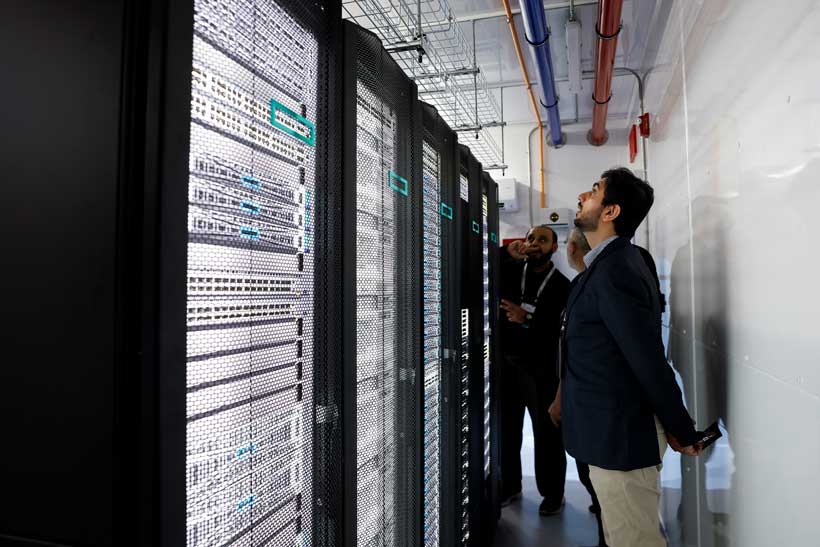
Malaysia’s data center boom offers a revealing piece of arithmetic. Between 2021 and June 2025, the government approved 143 projects. Within that total, 25 projects granted Malaysia Digital status represented RM144.4 billion in investment and were expected to create 1,429 jobs, according to the Ministry of Digital.
The comparison with manufacturing is difficult to ignore. In 2024, Malaysia approved RM120.5 billion in manufacturing investment across 1,108 projects, with 87,695 job opportunities. That works out to roughly RM101 million in approved data center investment for each projected job, compared with about RM1.37 million in manufacturing—around 74 times more capital per job.
The periods and sector boundaries are not identical, and neither figure captures temporary construction or wider supplier effects. Even so, the gap reveals an unusual development bargain: enormous capital inflows with narrow direct employment.
In February 2026, residents in Gelang Patah, Johor, staged Malaysia’s first protest of its kind against ZDATA’s planned data center complex, citing water pressure, dust, and the loss of green space. Selangor, meanwhile, began demanding stronger sustainability standards and 30 percent local content in areas such as integrated-circuit design and cooling systems. Malaysia had attracted global infrastructure, only to confront the harder question of what it would leave behind.
Stay ahead of the geopolitical week.
MD Briefing delivers expert analysis across five global fronts — the Indo-Pacific, energy, geoeconomics, European security, and the Middle East — every Monday morning. Free.
Malaysia’s experience may be an early warning.
The Enclave Behind the Boom
Data centers are becoming the factories of the AI economy, but they do not reproduce the industrialization model familiar to many developing countries. Manufacturing could absorb workers, build supplier networks, and transfer production capabilities. AI infrastructure is capital-intensive, dependent on electricity, land, connectivity, and often scarce water, yet lean in permanent employment.
The International Energy Agency expects global data center electricity consumption to rise from around 485 terawatt-hours in 2025 to approximately 950 TWh by 2030, while consumption by AI-focused facilities is projected to triple. This demand will grow while many developing economies are still expanding electricity access and managing climate pressure.
The result could be an enclave AI economy: a country hosts globally connected digital infrastructure and absorbs its resource costs while capturing limited employment, domestic capability, fiscal value, and control over the systems being built.
The enclave AI economy gives physical form to a wider double asymmetry. Infrastructure and environmental burdens are local, while intellectual property, high-value workloads, and strategic control may remain elsewhere. Servers may sit in Johor, Visakhapatnam, or Santiago, yet universities can still lack compute, start-ups remain customers, and domestic workers enter mainly through construction and maintenance.
Indonesia faces the same conversion problem. In April 2024, Microsoft announced a US$1.7 billion investment over four years in cloud and AI infrastructure, alongside AI-skilling opportunities for 840,000 people. The scale is significant, but headline figures reveal little about whether participants move into high-value roles, whether universities and start-ups gain access to compute, or whether domestic firms enter the infrastructure’s supply chains.
Investment totals can therefore conceal the more consequential question: what can the host economy convert that capital into?
Political Access Is Not Operational Certainty
For investors, the easiest route into a market often runs through political intermediaries who accelerate permits, consolidate land, connect companies to utilities, and provide protection. That route is faster than negotiating with communities, universities, workers, local governments, and environmental groups, but more fragile.
Chile offers a warning. Google had secured approval for a US$200 million data center in Santiago, but concerns grew over its impact on the stressed Central Santiago Aquifer. In February 2024, an environmental court partially reversed the permit and required the company to account for climate change. Seven months later, Google said it would redesign the project, replacing water-based cooling with air cooling.
Legal permission had been secured, yet the original design could not survive the conditions around it. For infrastructure expected to operate over decades, social license functions as operational risk insurance. Community resistance can delay construction, raise financing costs, and trigger redesign. Political access may secure entry under one administration; a deeper social bargain can survive drought, scrutiny, and political turnover.
The State Is Making a Larger Bet
Competition for AI infrastructure encourages governments to offer land, tax relief, power connections, water access, and accelerated approvals before the public return becomes visible.
Google’s planned AI hub in Visakhapatnam illustrates the scale of this contest. The company announced a US$15 billion investment over five years, including an initial one-gigawatt data center campus, fiber infrastructure, and a new international subsea gateway. The project is part of a wider rush to build gigawatt-scale capacity in Andhra Pradesh.
The political attraction is understandable. A large announcement signals modernization and a place in the AI race. Capability-building moves more slowly: training engineers, developing suppliers, and expanding clean power take years. Political brokerage can produce private value much sooner.
Enclave investment can therefore become a stable short-term equilibrium. Benefits concentrate among investors, landowners, contractors, and intermediaries; costs disperse across electricity systems, water basins, public finances, and future generations. By the time they become visible, assets are already taking shape.
Political risk emerges when opaque governance deepens fragilities that already exist. Once citizens see public resources allocated to private capital without a credible public return, the dispute moves beyond technology. The state begins to look less like a manager of development and more like a broker of access to national resources.
The ability to govern AI investment is therefore becoming part of state resilience.
That task is harder because AI investment no longer sits inside a simple bargain between governments and companies. Data centers operate within a multiplex digital ecosystem shaped by utilities, hyperscalers, financiers, local governments, universities, communities, and global clients. Governments may approve a project, but grid operators determine whether it can be powered. Lenders price social and environmental risk. Communities can contest resource use, while universities and firms influence whether infrastructure produces local capability.
Political intermediaries may accelerate entry but cannot permanently coordinate this ecosystem. The challenge is aligning actors whose incentives and time horizons rarely converge. Digital public infrastructure could provide shared rails for information, commitments, and accountability, although technology will not dissolve the power struggles involved.
DPI Can Also Be Captured
A government can build a public dashboard that discloses little. Employment targets can count temporary construction while obscuring permanent technical roles. Related companies can appear as local suppliers. Consultation can be digitized yet remain performative, while environmental reporting arrives after decisions become difficult to reverse.
Control is what matters: who sets the indicators, owns the data, and audits the figures; which communities are recognized as affected; and what consequences follow when investors miss their commitments.
DPI can serve as an infrastructure of accountability. Under captured institutions, the same system can become digital theater that gives an old political bargain a modern interface. Opacity is rarely just an information failure; it can protect actors who benefit from the arrangement. An effective system must therefore alter incentives and create consequences.
Turning AI Investment into Public Value
Chile’s National Data Centers Plan offers one of the clearest emerging architectures for DPI-enabled AI investment governance. Covering 2024–2030, it combines investment facilitation with environmental criteria, information on energy, land, and fiber; regional AI campuses; talent development; advanced computing access; and multi-stakeholder monitoring.
The plan is not itself a DPI. Its significance lies in combining functions that shared digital infrastructure could make interoperable, reusable, and actionable across projects. A DPI for AI investment governance would make three relationships visible: the public resources committed, the domestic capabilities created, and the consequences triggered when corporate commitments are missed.
Public contributions should include electricity, water, land, grid upgrades, and fiscal incentives. Where new demand requires additional generation, transmission, or water infrastructure, the investor’s contribution should be explicit.
Capability should be measured beyond training enrolments. Governments need to track apprenticeship completion, hiring, wages, local procurement, supplier upgrading, and movement into higher-value roles. Compute access should also form part of the bargain. Hosting advanced infrastructure means little if universities, start-ups, and public agencies cannot use it.
Consequences are equally important. Water use above agreed thresholds could pause expansion. Missed procurement or skills-transfer commitments could reduce incentives or redirect contributions into capability funds. Unresolved grievances should affect later permitting, while environmental and grid performance shape access to future capacity.
DPI-enabled investment governance matters only when shared information is connected to institutional action and credible consequences.
A Harder but More Durable Bargain
The Global South has strong reasons to welcome AI capital. Many countries need it to expand digital infrastructure, diversify their economies, and enter emerging value chains. Excessive or unpredictable restrictions could redirect projects elsewhere.
Yet a race built around cheap land, subsidized power, and political protection would reproduce an old extractive pattern in digital form.
Three futures are emerging. In an extractive enclave, investors and intermediaries secure rapid entry while public benefits remain thin. Managed legitimacy adds corporate social responsibility, compensation, and limited consultation, containing resistance temporarily. Embedded investment is harder because it connects resource allocation, domestic capability, public return, and accountability from the beginning.
The third model costs more upfront and demands greater state capacity. It also offers what the cheaper bargain cannot reliably provide: continuity for investors and durable legitimacy for governments.
Negotiating an AI investment deal between capital and political intermediaries is often the easy part. The real test begins when water becomes scarce, citizens ask what they received in return, or a new government inherits the agreement.
The countries that manage those pressures well will have built more than data centers. They will have found a way to turn foreign compute into domestic capability without hollowing out the social contract that makes long-term investment possible. That may prove to be the more important contest in the AI economy.