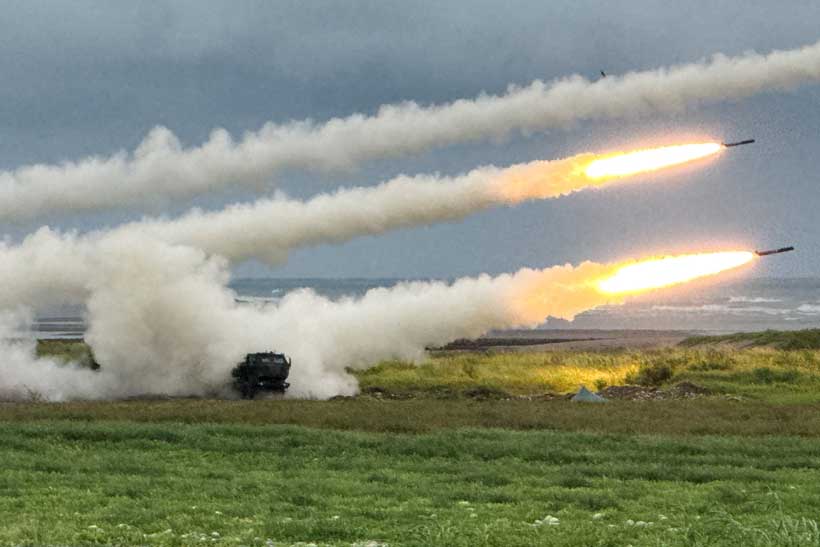
On June 21, 2026, Taiwan’s Ministry of National Defense announced that its armed forces would launch a five-day, four-night “Immediate Combat Readiness Exercise” from June 22 to June 26, intended to strengthen the ROC Armed Forces’ immediate response capabilities under a high state of readiness and validate the effectiveness of joint operations. The ministry described it as part of the armed forces’ annual joint operations training program, designed to train units at all levels during the deployment phase of combat readiness preparations and enhance rapid peacetime-to-wartime transition and priority deployment procedures. Notably, the announcement did not describe the drill as a response to a specific Chinese military action, even though it came against a backdrop of renewed PLA activity around the island.
This was not a standalone event. It was the first of a staged sequence: a one-week “joint defense exercise” was set to begin July 13 as a prelude to Han Kuang, with the main event, Han Kuang Exercise No. 42, scheduled to begin on August 5.
The Drill in Detail: Units, Equipment, Scenario
The exercise was carried out using actual troops, on actual terrain, in real time, using actual equipment, and through actual implementation. It was designed to evaluate how Taiwan’s military would respond if the Chinese People’s Liberation Army rapidly transformed a routine military exercise into an actual military attack. Its stated focus, per the Ministry of National Defense (MND), included rapid peacetime-to-wartime transition and priority deployment, with scenario-based prompts directing units through joint-operation subjects.
Stay ahead of the geopolitical week.
MD Briefing delivers expert analysis across five global fronts — the Indo-Pacific, energy, geoeconomics, European security, and the Middle East — every Monday morning. Free.
On the opening morning, combat units immediately began moving to designated defensive positions across the country in preparation for repelling invading enemy forces. In northern Taiwan, combat units from the 269th Mechanised Infantry Brigade took part, with CM32, CM33, and CM34 Clouded Leopard eight-wheeled armoured vehicles observed moving to defensive positions in Qingpu, Taoyuan. On-the-ground reporting added that a military Field Information Communications System (FICS) vehicle accompanied the armored column, indicating the drill also tested real-time battlefield communications and command-and-control linkages alongside maneuver units.
Central News Agency reporting indicated the drill focused specifically on early readiness measures by standing forces during a stage of attack in which Beijing has taken initial action but opposing forces have not yet launched, with contingency versions to be held if the Chinese Communist Party announces targeted military exercises or live-fire activity aimed at Taiwan. This format is not new: the Immediate Combat Readiness Exercise was first initiated in March 2025 by then-Minister of National Defence Wellington Koo, introduced in response to China’s grey-zone harassment. Coverage of the drill’s rollout also noted it unfolded the same week Taiwan received the first batch of two US-made MQ-9B drones, underscoring how the exercise coincided with a broader modernization push in Taiwan’s surveillance and strike-support capabilities.
The broader planning cycle has also changed shape this year. The military has revised its joint operational planning in response to the PLA’s growing use of aircraft and naval deployments alongside joint drills with the China Coast Guard. So Taiwan has now streamlined the previous three-stage structure into a two-phase framework. This includes a routine combat readiness period and a defense operations period. Under the combat readiness phase some new alert levels including combat preparation deployment, second-level enhanced readiness, and first-level heightened alert were also introduced.
Did China Run a Parallel Drill
At the time of Taiwan’s June 22–26 drill specifically, Beijing did not stage a matching named exercise. However, its activity stayed within the routine gray-zone baseline, with 21 Chinese military aircraft and multiple naval vessels detected operating near Taiwan the day before, under what Beijing described as a “combat readiness patrol,” including J-16 fighters, KJ-500 airborne early warning aircraft, and Y-20 refueling aircraft, 19 of which entered Taiwan’s southwestern ADIZ before continuing to the Western Pacific.
However, closer to the main Han Kuang exercise itself, China did conduct a formal live-fire drill. On July 23, 2026, China began two days of live-fire drills in some parts of the Taiwan Strait near the shores of its southeastern province of Fujian, with the activity running from 6 a.m. to 6 p.m. each day, covering an area bounded by five points in the waters east and south of Dongshan Island in Fujian’s Zhangzhou. Taiwan’s defense ministry reported that 21 Chinese military aircraft, six naval vessels, and two official ships were operating around the island until early Thursday. Notably, the drill came a day after talks between U.S. Secretary of State Marco Rubio and Chinese Foreign Minister Wang Yi on a range of issues including Taiwan, on the sidelines of the ASEAN foreign ministers’ summit in Manila, where Rubio told reporters the US “disagrees” with China sending its Coast Guard around Taiwan. Taiwan’s foreign ministry condemned China’s actions and called on Beijing to exercise “rational self-restraint” and “immediately cease its military provocations and gray-zone intrusions,” arguing China has disregarded the international community’s shared aspirations for regional security by unilaterally using military force to threaten the waters surrounding the Taiwan Strait.
Conclusion
Taiwan’s June 2026 Immediate Combat Readiness Exercise was a compact, five-day drill on paper, but it served as the opening rung of a longer ladder for July’s joint defense exercise and August’s Han Kuang No. 42 which is built around realism, faster wartime transition, and integrated communications testing. China’s posture across this period was two-tiered: routine combat-readiness patrols through most of the run-up, followed by a more pointed two-day live-fire exercise off Fujian just ahead of Han Kuang itself which may seem smaller than Beijing’s largest past shows of force, but timed closely enough to read as a deliberate signal rather than mere routine.