


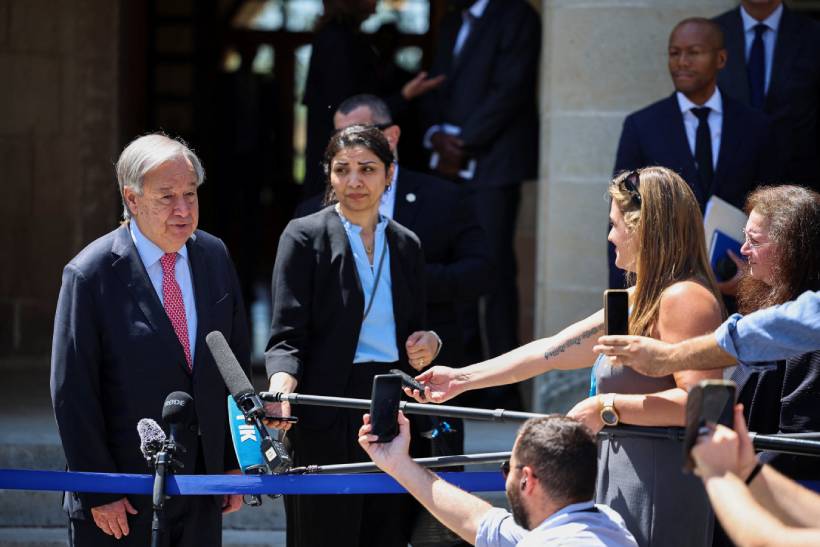
United Nations Secretary General Antonio Guterres has launched a renewed diplomatic effort to revive Cyprus peace negotiations, holding separate meetings with Greek Cypriot and Turkish Cypriot leaders before planned joint talks aimed at ending nearly a decade of political deadlock.
The initiative comes amid cautious optimism that both sides may be more willing to re engage, although significant disagreements over the framework for negotiations remain unresolved.
Guterres Begins New Mediation Effort
Guterres met Greek Cypriot President Nikos Christodoulides and Turkish Cypriot leader Tufan Erhurman separately on Tuesday. The three leaders are scheduled to hold joint discussions on Wednesday inside the United Nations controlled buffer zone that has divided the island for decades.
Speaking after meeting Christodoulides, Guterres emphasized that any breakthrough ultimately depends on the two communities.
Stay ahead of the geopolitical week.
MD Briefing delivers expert analysis across five global fronts — the Indo-Pacific, energy, geoeconomics, European security, and the Middle East — every Monday morning. Free.
“It depends obviously on the Cypriots themselves. I will do everything I can to support the Greek Cypriots and Turkish Cypriots in this very important moment,” he said.
Although Cypriot media reported that the United Nations had prepared proposals to bridge differences, UN officials denied that any finalized peace plan currently exists.
Negotiating Positions Still Differ
The two sides continue to disagree over both the format and starting point of future negotiations.
President Christodoulides supports resuming talks from where negotiations collapsed in 2017 under the long standing United Nations framework for a bizonal bicommunal federation.
Turkish Cypriot leader Tufan Erhurman, elected last year, has expressed greater openness to a federal solution than his predecessor, who advocated permanent partition through a two state model.
However, Erhurman insists that any negotiations must first establish political equality between the two communities and clearly define the rules governing future talks before formal discussions begin.
A Conflict Rooted in History
Cyprus has remained divided since 1974, when Turkey intervened militarily following a coup backed by Greece’s military government.
Since then, the island has been separated by a United Nations monitored buffer zone stretching approximately 180 kilometers.
The internationally recognized Republic of Cyprus governs the southern part of the island and represents Cyprus within the European Union. The northern part is administered by the Turkish Republic of Northern Cyprus, which is recognized only by Turkey.
Britain, Greece and Turkey remain guarantor powers under the 1960 Treaty of Guarantee, giving them specific responsibilities regarding the island’s constitutional order.
Turkey’s Role Remains a Major Obstacle
One of the most contentious issues continues to be Turkey’s future security role.
Greek Cypriots oppose any continued military or security guarantees from Ankara following a settlement, arguing that Cyprus should become a fully sovereign state free from external intervention.
Turkish Cypriots, however, view Turkey’s security presence as an essential safeguard for their political and physical security.
Turkey continues to publicly support a two state solution, while the United Nations, the European Union, Greece and the Greek Cypriot leadership continue backing a federal reunification model.
The renewed United Nations initiative reflects growing recognition that Cyprus remains one of Europe’s longest unresolved territorial and political disputes. While the election of Turkish Cypriot leader Tufan Erhurman has created a more favorable diplomatic atmosphere, fundamental disagreements over sovereignty, governance and security continue to limit the prospects for a comprehensive settlement.
For the European Union and NATO, progress on Cyprus would carry strategic significance beyond the island itself. The dispute has repeatedly complicated cooperation between NATO allies Greece and Turkey while remaining a persistent obstacle in Turkey’s relationship with the European Union. Any meaningful breakthrough could improve regional stability in the Eastern Mediterranean and facilitate broader security cooperation.
However, expectations should remain cautious. Previous negotiation rounds failed despite extensive international mediation, largely because neither community was prepared to compromise on core issues of political equality, territorial arrangements and security guarantees. Unless both sides demonstrate greater flexibility on these fundamental questions, the latest diplomatic effort risks joining a long list of unsuccessful peace initiatives despite the renewed political momentum.
With information from Reuters.
