


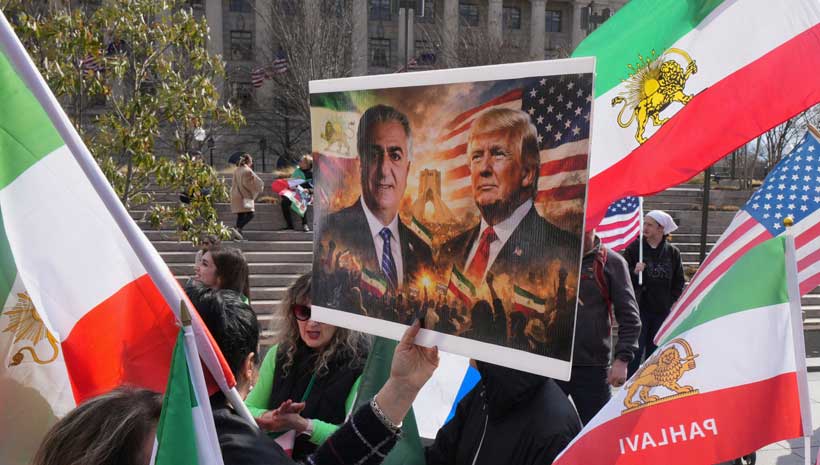
The prospect of regime change in Iran has once again entered international debate as exiled Crown Prince Reza Pahlavi intensifies his campaign to position himself as the face of a post Islamic Republic Iran. Speaking to Western governments, engaging with Iranian diaspora groups, and presenting himself as a democratic alternative, Pahlavi has sought to capitalize on mounting economic hardships, political repression, and regional instability that have placed unprecedented pressure on Tehran.
Yet despite increased media visibility and diplomatic outreach, Pahlavi’s campaign continues to face significant obstacles. He lacks an organized political movement inside Iran, struggles to unite the fragmented opposition abroad, and faces skepticism from many Iranians who associate the monarchy with authoritarian rule before the 1979 Islamic Revolution. As Iran confronts heightened confrontation with Israel and the United States alongside growing domestic unrest, the question remains whether Reza Pahlavi can transform symbolic leadership into a credible political alternative.
Reza Pahlavi’s Bid for Leadership
Reza Pahlavi, the eldest son of the late Shah Mohammad Reza Pahlavi, has spent decades in exile following the collapse of the monarchy during the 1979 revolution. Rather than advocating the immediate restoration of the monarchy, he has increasingly framed himself as a transitional figure committed to democracy, secular governance, and a referendum allowing Iranians to determine their future political system.
Since the nationwide protests following Mahsa Amini’s death in 2022, Pahlavi has significantly expanded his international engagement. He has met lawmakers in Europe and North America, called for stronger sanctions against Iran’s leadership, and urged Western governments to increase support for Iranian civil society. His message emphasizes peaceful political transition while portraying himself as a unifying national figure above partisan politics.
Stay ahead of the geopolitical week.
MD Briefing delivers expert analysis across five global fronts — the Indo-Pacific, energy, geoeconomics, European security, and the Middle East — every Monday morning. Free.
However, translating international recognition into domestic political influence remains his greatest challenge.
Fragmented Iranian Opposition
One of the principal obstacles to any leadership bid is the deeply divided nature of Iran’s opposition.
Exiled opposition groups range from constitutional monarchists and secular republicans to Kurdish organizations, leftist movements, ethnic minority groups, and the Mujahedin e Khalq. These organizations possess competing visions for Iran’s future and frequently disagree over leadership, strategy, and engagement with foreign governments.
Attempts to establish unified opposition coalitions have repeatedly collapsed due to ideological disputes and personal rivalries. Several prominent activists who initially cooperated with Pahlavi later withdrew support, highlighting the difficulty of building a broad based movement capable of presenting a credible alternative to the Islamic Republic.
Without a cohesive opposition, even widespread dissatisfaction inside Iran has not translated into an organized political force capable of challenging the existing system.
Limited Domestic Political Reach
While Reza Pahlavi enjoys support among segments of the Iranian diaspora, assessing his popularity inside Iran remains considerably more difficult.
The Islamic Republic strictly suppresses organized opposition, making independent polling nearly impossible. Public expressions of support for exiled political figures carry serious legal risks, while state controlled media portray Pahlavi as an agent of foreign governments.
Although slogans favoring the former monarchy have occasionally appeared during anti government protests, they have not emerged as the dominant political message. Most demonstrations since 2022 have focused primarily on economic hardship, political freedoms, women’s rights, and opposition to government repression rather than advocating the restoration of the monarchy.
Consequently, there is little publicly verifiable evidence that Pahlavi commands a nationwide political organization capable of mobilizing supporters inside Iran.
International Support and Strategic Calculations
Western governments continue to criticize Iran over its nuclear activities, human rights record, and regional military policies. However, they have generally avoided formally endorsing any individual opposition leader.
While Pahlavi has secured meetings with Western officials and legislators, these engagements have not translated into official recognition as Iran’s future leader. Many governments remain cautious about openly backing regime change given the historical experience of foreign intervention in the Middle East and uncertainty regarding what political order might follow the Islamic Republic.
Regional actors also maintain differing priorities. Some governments may welcome political change in Tehran but remain reluctant to publicly support one opposition figure without evidence of substantial domestic legitimacy.
The Challenge of Regime Change
History demonstrates that successful regime transitions typically require a combination of sustained domestic mobilization, elite defections, institutional fragmentation, and organized political leadership.
Although Iran faces persistent economic challenges, sanctions, inflation, and periodic public protests, its security institutions continue to demonstrate significant capacity to contain unrest. The Revolutionary Guards remain deeply integrated into Iran’s political, military, and economic structures, limiting the prospects for rapid political transformation.
Without substantial internal support networks or divisions within the ruling establishment, external advocacy alone is unlikely to produce meaningful political change.
Analysis
Reza Pahlavi has succeeded in raising his international profile and positioning himself as one of the most recognizable faces of Iran’s exiled opposition. His emphasis on democratic transition, secular governance, and national reconciliation has broadened his appeal beyond traditional monarchist circles. However, visibility should not be confused with political capability.
The greatest weakness of Pahlavi’s campaign remains its limited organizational presence inside Iran. Regime change is ultimately determined by internal political dynamics rather than international recognition, and there is little evidence that any opposition movement currently possesses the institutional strength necessary to challenge the Islamic Republic directly.
At the same time, Iran’s opposition remains deeply fragmented, preventing the emergence of a unified alternative capable of attracting broad domestic and international support. Unless opposition groups overcome ideological divisions and establish coordinated leadership within the country, dissatisfaction with the current government is unlikely to translate into a successful political transition.
Ultimately, Reza Pahlavi may continue serving as an influential international advocate for democratic change, but his ability to lead a genuine regime transition will depend less on diplomatic engagement abroad than on whether he can build legitimacy, organization, and broad based political support inside Iran itself.
With information from Reuters.
