


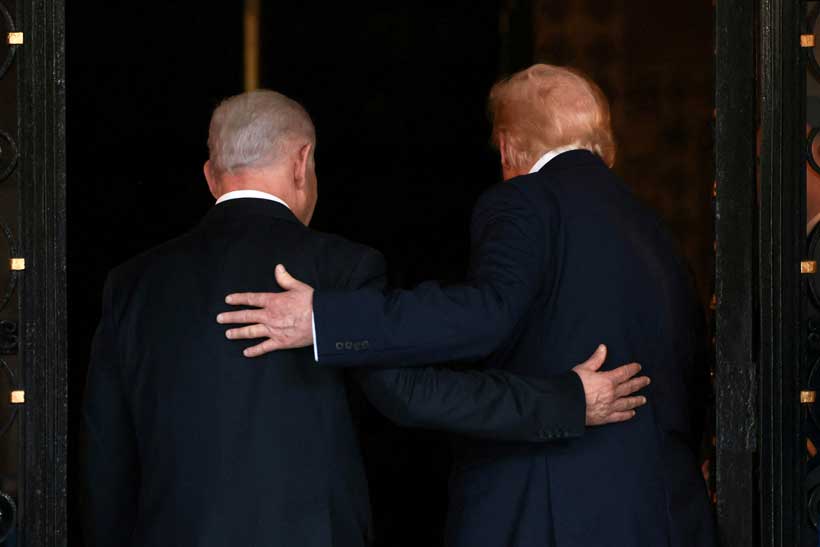
Chinese authorities are monitoring the demonstrations against US President Trump and Israeli Prime Minister Benjamin Netanyahu, viewing them as a reflection of the erosion of Western legitimacy, and are strategically exploiting them to fuel anti-American and anti-Israeli rhetoric. This is especially true given the growing popular calls in the United States and Israel for protests accusing Trump and Netanyahu of wasting budgets on futile wars, which they see as a sign of their military and political failure to achieve any semblance of victory. The Chinese strategic and political vision is to (capitalize on American and Israeli public discontent with their leaders). Beijing views these protests as an expression of the failure of the US-Israeli alliance to manage crises and wage wars lacking legal justification.
Here, official Chinese media and social media platforms focus on criticizing American and Israeli policies, holding them primarily responsible for Middle Eastern tensions and regional wars. They accuse the US administration of exacerbating crises and hindering diplomatic solutions through its unconditional support for Israel. Chinese media outlets directly blame US policy, linking Washington’s strategies in the Middle East to the escalation of conflicts, such as the Gaza war. They also employ satire and criticism against the policies of Washington and Tel Aviv. Official Chinese platforms utilize videos and modern techniques to mock the direct and indirect US and Israeli military involvement in the Gaza war, the Iran conflict, and other Middle Eastern conflicts. With Chinese media criticizing Israeli practices and irresponsible Israeli military actions, Israeli military operations are described in Chinese media and academic discourse as irrational and driven by religious fervor and extremism that hinders stability. This is coupled with China’s diplomatic rejection of these Israeli policies. Beijing regularly calls, in statements from its Ministry of Foreign Affairs, for a halt to the surge of Israeli operations and warns against the dangers of resorting to unconventional weapons or expanding the scope of the war in Gaza or during a war against Iran.
We find that Chinese intelligence agencies and circles are (attempting to solidify their diplomatic discourse in the face of Washington and Tel Aviv). Chinese diplomacy uses these protests within the US and Israel as concrete evidence to support its official positions calling for de-escalation and adherence to the UN Charter. For this reason, Chinese intelligence and military analysis monitors the military cost of these unjustified US and Israeli wars, particularly in the Middle East. Here, the Chinese military establishment is monitoring the drain on American and Israeli resources in regional conflicts and assessing their cost, as well as evaluating the geopolitical impact of these wars. Chinese assessment bodies believe that these wars provide Beijing with greater leeway to focus on its economic and Asian interests without direct involvement.
To this end, Chinese media and political institutions strategically exploit internal protests in the United States and Israel to highlight what they describe as the erosion of Western legitimacy and the weakening of liberal democracies. This Chinese geopolitical and media strategy is manifested through the exploitation of internal US and Israeli tensions in Chinese media discourse. This is particularly evident in the deliberate highlighting of protests against the policies of Donald Trump and Benjamin Netanyahu by Chinese state media outlets such as the (People’s Daily and the Global Times), presenting them as tangible evidence of sharp societal and political divisions within the Western system and its allies. Consequently, the United States and Israel accuse China of a media blockade. Netanyahu directly accused Beijing of leading organized propaganda campaigns on social media platforms like (TikTok) to undermine Israel’s political legitimacy and military positions, an accusation China vehemently denies.
Stay ahead of the geopolitical week.
MD Briefing delivers expert analysis across five global fronts — the Indo-Pacific, energy, geoeconomics, European security, and the Middle East — every Monday morning. Free.
Here, Chinese media focuses on the issue of the US and Israeli military budget wars. The parallel Chinese media narrative highlights the discontent of the American and Israeli public with the enormous military spending on wars deemed futile by protesters, and the diversion of these funds to domestic development rather than internal economic depletion. Therefore, China is using these internal American and Israeli disturbances to send several strategic messages to Beijing in the face of Western criticism. China is employing these popular protests within the US and Israel as a diplomatic pressure tactic. When Washington criticizes human rights records or demonstrations in Chinese regions like (Hong Kong or Xinjiang), Beijing responds by pointing to the use of force to suppress protests within the US and Israel, or to the existence of divisions within the US and Israel, to expose Western hypocrisy. With China’s introduction of what it calls an alternative model, it aims to bolster the integrity and stability of its own centralized leadership model by highlighting the political and military failures of its adversaries. This model presents China as a more reliable and stable alternative to the existing US-Israeli-led international order in the Middle East.
Here, Chinese state media outlets, such as the (People’s Daily, Xinhua News Agency, and the Global Times), have adopted a targeted and intensive media strategy to cover anti-war protests within the United States and Israel. Beijing’s objective in this coverage is to highlight the deep internal divisions within its adversaries, to cast doubt on the legitimacy and morality of Western military decisions, and to portray Washington as a destabilizing force in the world, thereby positioning itself as an alternative sponsor of peace. The features of this coverage and the tools used can be detailed through specific Chinese models and examples, to highlight the American and Israeli popular protests as a democratic crisis and Western hypocrisy. Here, the Chinese press focuses on portraying the dispersal of peaceful protests inside America as a manifestation of the suppression of expression and the impatience of Western politicians with the democracy they promote to China and the world.
There are numerous examples of the suppression of popular protests within the United States, which have been extensively covered and analyzed by Chinese state media and intelligence and military think tanks. For instance, student protests at American universities, such as (Columbia and Texas), received extensive print and broadcast coverage. An account called Jun Zhengping (affiliated with the People’s Liberation Army Information Center) posted candid comments asking, Can the indiscriminate violence used to suppress students quell domestic discontent?. Similarly, the People’s Daily published videos asserting that American students were fed up with the double standards of the United States. Therefore, the coverage of the Chinese press and media came to focus on (the depletion of the US and Israeli government budgets and the economic consequences of the wars on their people), and here Beijing employs the figures and banners raised by demonstrators in Washington and Tel Aviv to emphasize the idea of futile wars and the financial burden placed on the shoulders of the ordinary citizen for the benefit of the military-industrial complex.
Chinese media outlets also provide diverse examples of their coverage of domestic protests in the US and Israel. For instance, the Chinese newspaper Global Times published several regular reports highlighting marches in Washington, D.C., focusing their reporting on the demands of American taxpayers to end unlimited military funding. Here, the Chinese coverage portrays the Trump administration as sacrificing domestic economic security for continuous foreign military adventures. Similarly, Chinese media deliberately portrays Israeli public anger and division regarding its leadership, intentionally separating the public sentiment in Israel from the political direction of Netanyahu’s government. They exploit protests by hostage families and anti-war movements in Gaza, for example, to demonstrate the leadership’s incompetence and erosion of its legitimacy. For example, the (Chinese Xinhua News Agency), through its news platforms, focuses on conveying images of the massive demonstrations in Tel Aviv demanding the departure of Netanyahu, and highlights the demonstrators’ accusations against him of prolonging wars and continuing military escalation, such as (the recent exchange of strikes with Iran) for personal political purposes and to avoid prosecution, without regard for the lives of Israelis or hostages. In addition to the Chinese digital recruitment mechanism via (TikTok algorithms) and what are known as spamouflage campaigns. These are coordinated digital propaganda and disinformation campaigns that use networks of fake accounts on social media platforms to disseminate targeted content, deepen social divisions, and discredit opponents.
Besides official Chinese media, Western intelligence and analytical reports have revealed that Beijing employs parallel tools to amplify the scale and impact of these demonstrations within the United States and Israel. Chinese digital examples of this are diverse. Several American, Israeli, and Western technical investigations have identified networks of fake accounts or (Spamouflage) supported by China on platforms such as Twitter (formerly known as ‘X) and others. These accounts operate automatically and systematically to repost and amplify videos showing the burning of the Israeli flag in America or police clashes with anti-war protesters. The goal here is to create the impression that the Western public completely rejects the idea of Israeli flag burning. The policies of its leaders are reinforcing the international political isolation of Washington and Tel Aviv.
Accordingly, we can understand the focus of official Chinese media and social media platforms on criticizing American and Israeli policies, holding them primarily responsible for Middle East tensions and regional wars, such as (criticizing the unconditional American support for Israel), which deepens crises and obstructs diplomatic solutions.
