


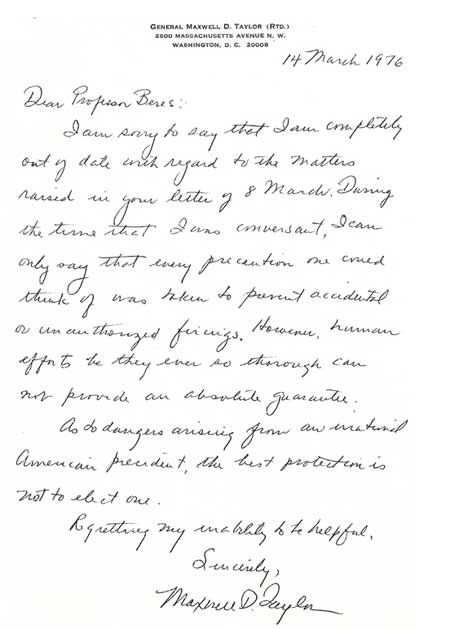
“As to [nuclear war] dangers arising from an American president, the best protection is not to elect one.”-General Maxwell D. Taylor (ret.), 14 March 1976.[1]
More than fifty years ago, retired USA four-star general Maxwell D. Taylor sent me a handwritten letter (copy attached hereto) concerning US presidential irrationality and nuclear war. At that time, General Taylor, a former Chairman of the Joint Chiefs of Staff, was helping me answer certain nuclear decision-making questions pertinent to a forthcoming book.[2] Now, during the dissembling Trump era, these early questions have become much more than narrowly academic or generic queries.
But how should these questions be answered? Among other things, such vital queries ought no longer be confined to the esoteric communications of generals and professors. For conspicuous reasons, it is no longer rational for Americans to speak of presidential irrationality only in whispers. More precisely, at this point in the Trump era, sotto voce utterances are no longer excusable.
There will be multiple particulars. On urgent questions of nuclear war, virtually anything is now possible. In Washington, it is plausible that President Trump would at some point direct openly nuclear threats toward Iran or another state adversary. Because a nuclear war would represent a unique historical event (i.e., it would be sui generis), there could be no science-based way to determine meaningful probabilities.
Stay ahead of the geopolitical week.
MD Briefing delivers expert analysis across five global fronts — the Indo-Pacific, energy, geoeconomics, European security, and the Middle East — every Monday morning. Free.
All things considered, General Taylor’s1976 letter to me has become markedly timely and worrisome. To avoid “the dangers arising from an irrational American president,” warned Taylor many years ago, “the best protection is not to elect one.” But aren’t we already too late to heed such advice?
On April 7, 2026, after launching his original war against Iran,[3] Donald Trump thundered: “A whole civilization could die tonight.” Under authoritative international law, this declaration and various subsequent threats (e.g., “We will bomb you back to the Stone Age”) displayed “criminal intent” (mens rea). Jurisprudentially, leaving aside their evident strategic shallowness, this declaration and following threats were expressly genocidal.[4] As another matter of law, they wrongly conflated wars of preemption with wars of prevention.
Under binding international law, only the former could be permissible. All associated military actions would need to meet multiple legal standards of “anticipatory self-defense.” And these standards would require enemy threats that were “imminent in point of time.”[5] As a correlative problem, there would exist no objective criteria of “imminence.”
Though not understood by this president or his legal advisors, international law remains an integral part of United States law.[6] In consequence of Trump’s continuously acrimonious and visceral threats,[7] the United States is already facing expanding risks of a nuclear war.[8] Such risks could manifest incrementally or all at once. And they could concern an intentional nuclear war or a nuclear war that is inadvertent.
There is more. President Trump’s witting indifference to science-based reasoning will have assorted and unwanted consequences. In the parlance of formal logic, Trump’s “reasoning” vis-à-vis Iran displays the argumentum ad baculum fallacy (“illegitimate appeal to force”). Among other erroneous objectives, this reasoning is intended to recruit political supporters by falsely simplifying complex strategic problems.[9]
In dealing with nuclear war scenarios, US national security policy will need to exhibit not “just” herculean intellectual skills, but also variously discernible levels of courage. President Donald Trump’s re-named “Department of War” – a change signifying much more than nomenclature – will encourage needlessly rancorous policies drawn from stunningly barren clichés. Though Trump’s “peace through strength” mantra might be appropriate for grammar-school recitations,[10] it offers nothing of mature analytic value.
World peace requires enforceable world law. But in announcing a Department of Defense name-change to the “Department of War” on September 5, 2025, Pete Hegseth, now America’s “Secretary of War,” promised “maximum lethality, not tepid legality.” Trump’s messaging was clear: Better an invigorating hot war than a disappointingly lukewarm peace.
Could there have been any dignified and decent justification for such a blatantly lawless message? Though modern international legal rules were codified at the Treaty of Westphalia in 1648, seventeenth-century anarchy is now morphing into something far more ominous. In large part, this transformation into “chaos” owes to the increasing complexity of strategic decision-making in world politics (especially risks of miscalculation, computer malfunction, hacking, artificial intelligence manipulation and accident) and to reciprocal national policies of contrived simplification. As a dynamic process, the steady emergence of global chaos can be understood and controlled only by systematic applications of courageous thought.
The 2025 movie, “A House of Dynamite” offers a scenario in which the nuclear aggressor is not readily identifiable. In the “real world,” this fearful scenario is increasingly credible. To wit, as the number of nuclear powers increases, the plausibility of an “anonymous attacker scenario” will also increase. Even without a verifiable expansion of nuclear weapon states (i.e., “horizontal proliferation”), therefore, Trump-initiated arms race accelerations (i.e., “vertical proliferation”) will open a Pandora’s Box of prospectively irremediable harms.
Still, the US president’s July 2026 announced plan offering nuclear enrichment opportunities to Saudi Arabia points toward further horizontal proliferation, not just by that wealthy kingdom, but also by regional states worried by such new Saudi opportunities.
Since the 17th century, global stability has depended on a presumed “balance of power.” In reality, however, this “balance” has never been anything more than a falsely-reassuring fiction. Sigmund Freud would have explained this as an existential example of “wish fulfilment.”
There is more. In today’s world of approaching chaos, longstanding security deficits are being exacerbated. Accordingly, still-capable and courageous American leaders will need to (1) devise alternate strategies of nuclear war-avoidance and counter-nuclear terrorism, and (2) guard against grievous potential harms of presidential irrationality. Among other cautionary issues, such stabilizing and law-enforcing strategies could never benefit from an American president who prefers stream-of-consciousness reasoning to logic-based analyses. In essence, these strategies will require strenuous intellectual thought and corresponding acts of “will.”[11]
Antagonistic to intellect, Donald Trump’s national security policies now cling tenaciously to crumbling architectures of Westphalian anarchy. As timely geographic examples, certain transitional forms of chaotic disintegration are already being boosted by US presidential actions in the Middle East, a region where Trump’s recurrently-declared cease-fires and peace settlements remain little more than caricature. Here and in assorted other places, the residually-rational threat mechanisms of Westphalian anarchy are being sacrificed to the irrational expectations of belligerent nationalism. Two clear examples are Trump’s proposed sale of fifth-generation F-35 aircraft to Turkey and his proud ties to Ahmed al-Sharaa, former al-Qaeda jihadist and now president of Syria.
In world politics, metaphor can be convincing, but analogy is never truth. Overall, there is no longer any defensible pretext for states to seek a regional or global “balance of power.” Because of “normal” nuclear weapons proliferation, many usually core calculations of world system equilibrium are being rendered futile. Everywhere in this Trump-disordered world legal order, states are unable to gain tangible security advantages via “equilibrium.”
Even amid such steeply-perplexing matters, some strategic assumptions remain valid. Under no conceivable circumstances, for example, could shrill presidential threats of vengeance and reciprocity help the United States or its Israeli ally. Following Donald Trump’s unhidden indifference to refined analytic thought (e.g., “I love the poorly educated.”), unmanageable nuclear spread is now virtually assured. In some fashion, this proliferation could include sub-state terror organizations in the Middle East, a unique development that would impact US ally Israel in particular.[12]
Quo Vadis? During periods of competitive risk-taking, which are now more-or-less inevitable, once “unthinkable” weapons could become “thinkable.” Most worrisome will be new nuclear powers that operate with deficient systems of command and control and/or already-nuclear powers led by unstable or irrational decision-makers.
During his ritualized rants, US President Donald Trump has mused openly about nuclear weapons serving as operationally-appropriate instruments of war. But the only rational use of nuclear weapons in world affairs could be deterrence ex ante, not revenge ex post. Portentously, Russian president Vladimir Putin has occasionally voiced similarly dangerous nuclear sentiments. At some point, dissembling Trump-Putin musings could tangibly intersect. What then?
In significant measure, it is from certain indecipherable interactions between Trump and Putin decision-making processes that unprecedented existential harms could emerge. Presumptively, some of these interactions would be “synergistic.” By definition, this means that cumulative outcomes would be more injurious than the sum of constituent parts.
Precisely how much “more injurious” is not logically or scientifically determinable. Ultimately, however, these synergistic interactions would enlarge the risks and consequences ofchaos. “Where there were great military actions,” foresaw French Poet Saint-John Perse (1887-1975), “there lies whitening now the jawbone of an ass.”
Any chaos will be dense or opaque. A likely aspect of the upcoming chaos would be acts of irrationality.[13] If the United States should have to face a non-nuclear jihadiststate adversary with access to nuclear weapons (e.g., Iran backed by North Korea or Pakistan), both countries’ balance-centered deterrence postures could be undermined. A similar scenario could sometime confront Israel.
Such challenges to American military power would signal unacceptable threats of nuclear terrorism and/or nuclear war. These threats would be enlarged by Trump’s illogical plans for resumed nuclear testing of both warheads and delivery vehicles. Russian fears would be heightened by any US deployments of a “golden dome,” a politics-shaped plan for “total” missile defense. This plan would compel Moscow to more aggressively seek an “assuredly destructive” nuclear arsenal – an incentive that would continuously raise the odds of nuclear confrontation and nuclear war.
Issues of adversarial irrationality and madness will need science-based scrutiny in Washington. In world politics, irrationality is never the same as madness.[14] By definition, an irrational adversary is one that could at some (still indeterminable) point value certain goals more highly than national self-preservation.
For the United States, a mad adversary could be worse than an irrational one, much worse. A mad enemy would display no calculable preference ordering and would not be subject to any credible threats of American military deterrence. Here, the incumbent president’s limited understanding of nuclear risk could lead the United States farther and farther away from required policy revaluations.
A prudent response to such multiplying challenges ought never to be expected from Donald Trump’s “Department of War.” What America needs going forward is not testosterone screenings for “warriors,” but a coherent 21st century plan to enlist the country’s most gifted strategic thinkers.
For Washington, no choice between mad and irrational adversaries will be made available. Moreover, whether the United States would do better to confront irrationality, madness or both will not be Donald Trump’s decision to make. On this predictable disqualification, Washington’s only sensible imperative will be to base high-consequence conflict decisions (especially ones concerning nuclear war avoidance) on solidly intellectual foundations.
All things considered, what should now reasonably be expected about expanding risks of presidential irrationality and nuclear war? Foreseeably, in the United States, no viable solutions will be uncovered or championed by any designated political authority.[15] Recalling US General Maxwell D. Taylor’s letter to this author of 14 March 1976 (attached), the “best protection” against an irrational American president is “not to elect one.”
[1] See General Taylor’s letter to the author (Professor Louis René Beres) at the end of this article.
[2] See Louis René Beres, Apocalypse: Nuclear Catastrophe in World Politics (The University of Chicago Press, Chicago and London, 1980).
[3] Under international law, the question of whether or not a condition of war exists between states is often unclear. Traditionally, a “formal” war was said to exist only after a state had issued a formal declaration of war. The Hague Convention III codified this position in 1907. This Convention provided that hostilities must not commence without “previous and explicit warning” in the form of a declaration of war or an ultimatum. See Hague Convention III on the Opening of Hostilities, Oct. 18, 1907, art. 1, 36 Stat. 2277, 205 Consol. T.S. 263. Presently, a declaration of war could be tantamount to a declaration of criminality because international law prohibits “aggression.” See Treaty Providing for the Renunciation of War as an Instrument of National Policy, Aug. 27, 1948, art. 1, 46 Stat. 2343, 94 L.N.T.S. 57 (also called Pact of Paris or Kellogg-Briand Pact); Nuremberg Judgment, 1 I.M.T. Trial of the Major War Criminals 171 (1947), portions reprinted in Burns H. Weston, et. al., INTERNATIONAL LAW AND WORLD ORDER 148, 159 (1980); U.N. Charter, art. 2(4). A state may compromise its own legal position by announcing formal declarations of war. It follows that a state of belligerency may exist without formal declarations, but only if there exists an armed conflict between two or more states and/or at least one of these states considers itself “at war.”
[4]On the crime of genocide under international law, see: See Convention on the Prevention and Punishment of the Crime of Genocide, opened for signature, December 9, 1948, entered into force, January 12, 1951, 78 U.N.T.S. 277. Although the criminalizing aspect of international law that proscribes genocide-like conduct may derive from sources other than the Genocide Convention (i.e., it may emerge from customary international law and also be included in different international conventions), such conduct is always an egregious crime under international law. Even where the conduct in question does not affect the interests of more than one state, a traditional canon of international legal validity, it becomes an international crime ipso facto whenever it constitutes an offense against the world community “delicto jus gentium.”
[5] The customary right of anticipatory self-defense, which is the legal expression of preemption, has its modern origins in the Caroline Incident. This was part of the unsuccessful rebellion of 1837 in Upper Canada against British rule. (See: Beth Polebau, “National Self-Defense in International Law: An Emerging Standard for a Nuclear Age,” 59 N.Y.U. L. REV. 187, 190-191 (noting that the Caroline Incident transformed the right of self-defense from an excuse for armed intervention into a customary legal doctrine). Following the Caroline, even the threat of an armed attack has generally been accepted as justification for a militarily defensive action. In an exchange of diplomatic notes between the governments of the United States and Great Britain, then-U.S. Secretary of State Daniel Webster outlined a framework for self-defense that does not actually require a prior armed attack. (See Polebau, op. cit., citing to Jennings, “The Caroline and McLeod Cases,” 32 AM. J. INT’L L., 82, 90 (1938).) Here, a defensive military response to a threat was judged permissible as long as the danger posed was “instant, overwhelming, leaving no choice of means and no moment for deliberation.”
[6] Recalling the precise words of Mr. Justice Gray, in delivering the judgment of the US Supreme Court in Paquete Habana (1900): “International law is part of our law, and must be ascertained and administered by the courts of justice of appropriate jurisdiction….” (175 U.S. 677(1900)) See also: Opinion in Tel-Oren vs. Libyan Arab Republic (726 F. 2d 774 (1984)).The specific incorporation of treaty law into US municipal law is codified at Art. 6 of the US Constitution, the so-called “Supremacy Clause.” It is manifest that Donald J. Trump has no awareness of these facts or simply doesn’t care about them.
[7] One may think here of Swiss Nobel Literature laureate Hermann Hesse’s generic description of a perilous national leader: “The dull-witted brute, blindly trampling around in the flower gardens of intellect and culture.” (See The Glass Bead Game, 1943).
[8] On probable consequences of a nuclear war by this author, see: Louis René Beres, Surviving Amid Chaos: Israel’s Nuclear Strategy (Rowman & Littlefield, 2016; 2nd. ed., 2018); Louis René Beres, Apocalypse: Nuclear Catastrophe in World Politics (Chicago: University of Chicago Press, 1980); Louis René Beres, Mimicking Sisyphus: America’s Countervailing Nuclear Strategy (Lexington MA: Lexington Books, 1983); Louis René Beres, Reason and Realpolitik: US Foreign Policy and World Order (Lexington MA; Lexington Books, 1984); and Louis René Beres, ed., Security or Armageddon: Israel’s Nuclear Strategy (Lexington MA: Lexington Books, 1986).
[9] See, in this connection, philosopher Ludwig Wittgenstein’s generic comment on analytic simplification as deception: “Remember that one is sometimes convinced of the correctness of a view by its simplicity or symmetry…. “(On Certainty, 1969).
[10] Intermittently, this mantra focuses on assorted agreements for “cease fire.” In law, a cease fire or armistice represents an intra-war convention, an agreement concluded between belligerents. Such an agreement, it follows, does not terminate a “state of war.” The 1907 Hague Convention IV Respecting the Laws and Customs of War on Land, stipulates, at the Annex to the Convention, that “An armistice suspends military operations by mutual agreement between the belligerent parties.” (Emphasis added): See CONVENTION NO. IV RESPECTING THE LAWS AND CUSTOMS OF WAR ON LAND, WITH ANNEX OF REGULATIONS. Done at The Hague, Oct. 18, 1907. Entered into force, Jan. 26, 1910. 36 Stat. 2277, T.S. No. 539, 1 Bevans 631, at Chapter V, Art. 36.) The courts of individual states have also affirmed the principle that an armistice does not end a war (See, for example, Kahn v. Anderson, Warden, United States, Supreme Court, 1921, 255, U.S. 1). Throughout history, cease fires and armistices have envisaged a resumption of hostilities.
[11] Modern philosophy origins of “will” lie in writings of Arthur Schopenhauer, especially The World as Will and Idea (1818). For his own inspiration, Schopenhauer drew freely upon Johann Wolfgang von Goethe. Later, Nietzsche drew just as freely (and perhaps more importantly) on Schopenhauer. Goethe was also a core intellectual source for Spanish existentialist Jose Ortega y’Gasset, author of the singularly prophetic twentieth-century work, The Revolt of the Masses (Le Rebelion de las Masas (1930). See, accordingly, Ortega’s very grand essay, “In Search of Goethe from Within” (1932), written for Die Neue Rundschau of Berlin on the occasion of the centenary of Goethe’s death. It is reprinted in Ortega’s anthology, The Dehumanization of Art (1948) and is available from Princeton University Press (1968).
[12] Regarding Israel’s never-ending war with Palestinian insurgent forces, history deserves pride of place. Relentless Palestinian hostility to Israel has decipherable doctrinal foundations in the PLO’s “Phased Plan” of June 9, 1974. In its 12th Session, the PLO’s highest deliberative body, the Palestinian National Council, reiterated the PLO aim as being “to achieve their rights to return, and to self-determination on the whole of their homeland.” All prospective Palestinian terror would have still-earlier roots in the Palestinian National Covenant. Calling officially for sustained Arab violence against Israel, this document was adopted in 1964, three years before the 1967 Six Day War. This means that the PLO’s core guidance on terror was first published – together with its explicit references to the annihilation of Israel – three years before there were any “occupied territories,” For the Palestinian Authority, which until October, 2015, had still officially agreed to accept a “Two-State Solution,” the underlying position of protracted war was part of a broader strategy of incorporating Israel into “Palestine.” This irredentist incorporation was already codified on all PA maps. The most unambiguous Palestinian call for the removal of Israel remains the PLO’s “Phased Plan” of June 9, 1974. Under the authoritative laws of war, this Plan represents an unhidden commitment to carry out certifiable crimes against humanity.
[13] Says Karl Jaspers: “The rational is not thinkable without its other, the non-rational, and it never appears in reality without it.” (Reason and Existence; 1935).
[14] “We are mad,” says Seneca (Letters, 95), “not only as individuals, but as nations also. We restrain manslaughter and isolated murders, but what of war and the so-called glory of killing whole peoples?”
[15] In the words of Spanish existentialist philosopher Jose Ortega y’ Gasset, a political authority who acts as “mass man” [in this article context, US President Donald J. Trump] “has no attention to spare for reasoning. He thinks only in his own flesh.” See Ortega’s clarifying classic, The Revolt of the Masses (1930).
