


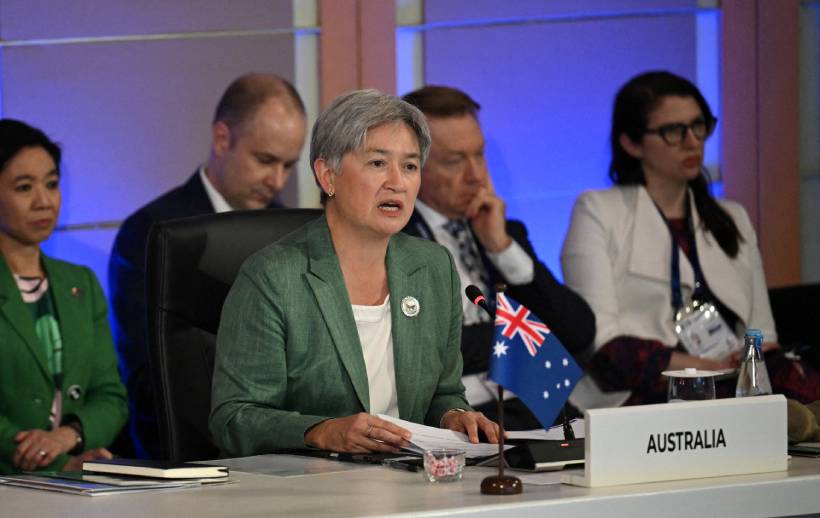
Canada has called for an immediate de-escalation and a permanent ceasefire in the Middle East, warning that the humanitarian situation has become increasingly grave, while also expressing concern over rising tensions between China and the Philippines in the South China Sea.
Speaking on the sidelines of the Association of Southeast Asian Nations (ASEAN) foreign ministers’ meeting in Manila on Wednesday, Canadian Foreign Minister Anita Anand urged all parties involved in the Middle East conflict to return to diplomacy and protect civilians.
“The situation is quite grave, and we very much hope that parties will come to the table and ensure that the permanent ceasefire is negotiated and held,” Anand said.
She stressed that hospitals, schools and other civilian infrastructure must be protected, adding that Canada would “always call for de-escalation, a ceasefire, and respect for humanitarian considerations and human life.”
Stay ahead of the geopolitical week.
MD Briefing delivers expert analysis across five global fronts — the Indo-Pacific, energy, geoeconomics, European security, and the Middle East — every Monday morning. Free.
Canada Raises Concerns Over South China Sea Incident
Anand also addressed the latest confrontation between Philippine and Chinese vessels in the disputed South China Sea, describing the incident as “troubling.”
“Without question, the incident is troubling, and we are concerned,” she said. “We do not agree with intimidation as a means of addressing disputes.”
Canada reaffirmed its support for resolving maritime disputes under the United Nations Convention on the Law of the Sea (UNCLOS) and reiterated its commitment to a free and open Indo-Pacific.
“Whether we’re talking about the Indo-Pacific, the Strait of Hormuz, or waterways generally, there is a need to remember that the structure of freely navigable waters and international law is a guidepost that we can gravitate towards,” Anand said.
China Meeting Focuses on Regional Security
Asked about her meeting with Chinese Foreign Minister Wang Yi on Tuesday, Anand said discussions covered bilateral relations and regional security issues.
“In terms of the broader geopolitical situation, we did spend some time on the Indo-Pacific, and I raised my concerns,” she said, without providing further details.
The meeting comes amid heightened regional tensions over competing territorial claims in the South China Sea, where recent confrontations between Chinese and Philippine vessels have drawn international attention.
Trade Remains a Key Priority
Beyond security concerns, Anand said Canada is seeking to strengthen economic ties with Southeast Asia by advancing negotiations on a free trade agreement with ASEAN.
“Making sure that there’s unanimity towards concluding the FTA between ASEAN and Canada, that’s our top priority here at this summit,” she said.
The proposed agreement forms part of Canada’s broader strategy to diversify its trade relationships beyond the United States while expanding its economic presence in the Indo-Pacific region.
With information from Reuters.
