


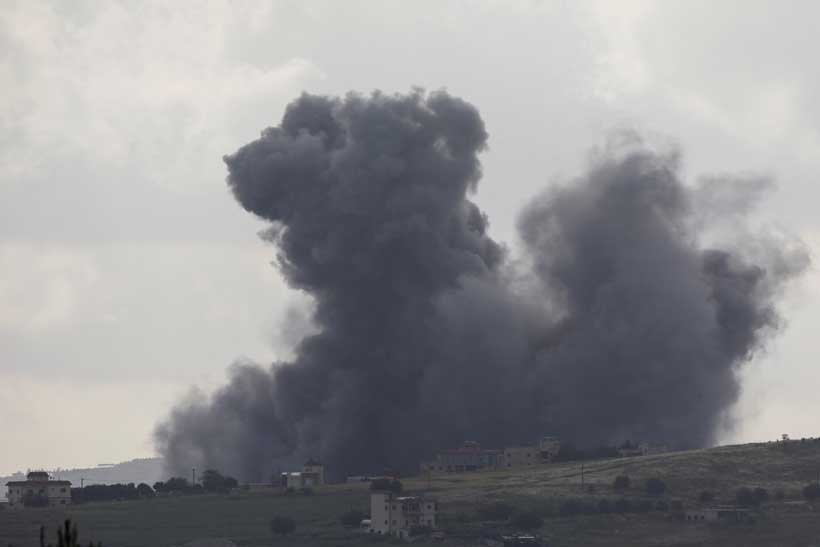
Lebanese army troops began deploying in the southern town of Zawtar al Gharbiyeh on Tuesday after Israeli forces withdrew from the area, marking the first implementation of a U.S.-brokered security plan aimed at stabilizing southern Lebanon and reducing Hezbollah’s military presence.
The deployment represents the first practical test of an agreement that could reshape the security landscape along the Israel-Lebanon border following months of renewed conflict.
Lebanese Army Takes Control
According to a senior Lebanese security official, the Lebanese Armed Forces entered the town after Israeli troops completed their withdrawal, allowing Beirut to begin restoring state authority in an area that has long been contested.
The Lebanese army confirmed that its units had deployed in the Nabatieh region and urged residents to delay returning until security conditions improve.
Stay ahead of the geopolitical week.
MD Briefing delivers expert analysis across five global fronts — the Indo-Pacific, energy, geoeconomics, European security, and the Middle East — every Monday morning. Free.
Military officials also advised civilians to follow the instructions of deployed troops to ensure their safety as stabilization operations continue.
First Test of the US Brokered Security Plan
The withdrawal is part of what Israeli officials describe as the “pilot zone programme,” a phased security arrangement brokered by the United States.
Under the agreement, the Lebanese army will gradually assume responsibility for security in parts of southern Lebanon while confiscating weapons held by the Iran-backed Hezbollah movement. In return, Israeli forces are expected to conduct phased withdrawals from occupied areas.
Israeli military officials described the initiative as a test of whether the Lebanese state can establish itself as the sole legitimate armed authority in southern Lebanon.
Israel has repeatedly questioned Lebanon’s ability to disarm Hezbollah but views the arrangement as an important step toward reducing cross-border tensions.
Region Devastated by Conflict
The territory being transferred has suffered extensive destruction during recent fighting.
Dozens of villages have been heavily damaged or completely destroyed, while hospitals, electricity infrastructure and water facilities have been severely affected.
Tens of thousands of displaced residents have remained unable to return home as military operations continued along the border.
Restoring security is considered essential before reconstruction efforts and civilian resettlement can begin.
Conflict Linked to Wider Regional War
The latest confrontation between Israel and Hezbollah erupted in early March, shortly after the United States and Israel launched strikes against Iran.
Hezbollah said its attacks on Israel were intended as support for Tehran, opening another front in the broader regional conflict involving Iran and its allies.
The escalation further intensified instability across the Middle East, linking Lebanon’s security situation directly to the wider U.S.-Iran confrontation.
Diplomatic Momentum Builds
The military developments come as Lebanese President Joseph Aoun travels to Washington for talks with U.S. President Donald Trump.
The meeting is expected to focus on implementing the security agreement, strengthening Lebanon’s armed forces and discussing broader efforts to prevent renewed conflict along the Israeli-Lebanese border.
Analysis: A Small Step That Could Shape Regional Stability
The deployment in Zawtar al Gharbiyeh is far more significant than a routine military redeployment. It is the first real test of whether the Lebanese state can gradually replace Hezbollah as the dominant security actor in southern Lebanon—a longstanding objective for both Israel and the United States.
Success could encourage additional Israeli withdrawals and strengthen Lebanon’s sovereignty over its southern territory. Failure, however, would reinforce Israeli skepticism about Beirut’s ability to control Hezbollah and could trigger another cycle of military confrontation.
For now, the operation represents a cautious but potentially important step toward stabilizing one of the Middle East’s most volatile frontiers.
With information from Reuters.
