


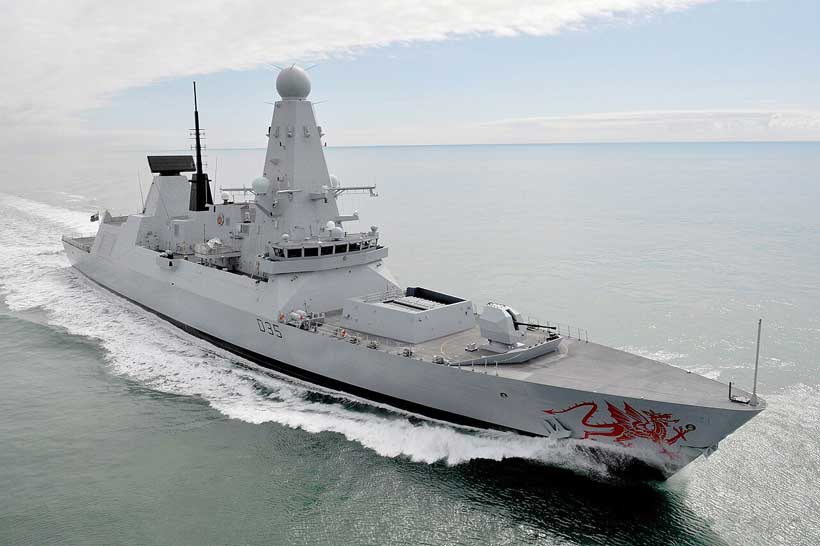
The rocky deployment of the HMS Dragon exposed a British military in decline, adding urgency to London’s long-range strike strategy. That strategy has now taken shape in the Defence Investment Plan (DIP), published on 30 June after months of delay, but its £15bn headline has landed to a mixed reception, welcomed by industry yet questioned by economists and MPs over how much of it is genuinely new money.
Whilst teams worked tirelessly to ready the HMS Dragon, then-Defense Secretary John Healey said he was “not happy with the situation we have with British warships,” while Navy Lookout argued, “The real scandal is the 30 years of underfunding and decline that have left the navy with a lack of vessels, people, munitions and spares…” Unfortunately, the RN is not alone in this dilemma, as land and air forces face similar circumstances, and the scandal surrounding the deployment of the HMS Dragon was just the latest in a long series of alerts.
British military prowess at sea, on land and in air used to be feared and revered across the world but, as with many European neighbors, defense capabilities declined during post-Cold War peace. This is alarming for the UK, and Europe as a whole, as global conflicts intensify and military generals warn of a potential attack on a NATO member by 2029.
Rupert Pearce, National Armaments Director, told the House of Commons Defence Committee last December that “warfighting readiness is not where we need them to be” and that investments are needed to “fill the gaps that have emerged in our Armed Forces capabilities as a result of years of underinvestment, naturally through a peace dividend but also through emptying our warehouses” to supply Ukraine.
Stay ahead of the geopolitical week.
MD Briefing delivers expert analysis across five global fronts — the Indo-Pacific, energy, geoeconomics, European security, and the Middle East — every Monday morning. Free.
Limits on British Defense
This is particularly worrying following Prime Minister Keir Starmer’s pledge to send British troops to Ukraine as part of a multinational peacekeeping mission (only France has made a similar commitment) if a peace agreement is signed. Furthermore, General Roland Walker, Chief of the General Staff, said it would only take 6-12 months to decimate the regular British army in an all-out war with Russia, which is why he argues, “We cannot wait for a perfect army in 2035—we must transform the army we have now.”
That requires investments, and Air Chief Marshal Richard Knighton, Chief of the Defense Staff, told the PM that the Ministry of Defense was short £28bn to fund programs needed to get Britain “battle ready.” A “tug-of-war” over funding between the MoD and the Treasury delayed publication of the Defence Investment Plan (DIP), a standoff serious enough that then-Defense Secretary John Healey resigned in June, weeks before the plan’s publication. Even then, £4.8bn, roughly a third, was left unfunded.
As might be expected, the plan was met with a lukewarm response from the Defence Committee. Last November, the Committee’s Chair, Tanmanjeet Singh Dhesi, argued, “Accelerating the speed of industrial change is essential, and readiness must be at the top of this Government’s agenda.” Since the DIP’s publication, Dhesi has struck a more measured but still critical note, saying the plan contains “significantly less detail” than previous plans, and calling it disappointing that there is still no clear timeline for reaching 3% of GDP.
Change of Strategy: Strike Further
In the pursuit of ‘readiness’, leaders must contend with two key hurdles: British forces are comprised of merely 70,000 soldiers with little hope for that increasing much; and, even with the DIP’s pledge to lift core spending towards 3% of GDP, the government’s own figures leave little headroom to address ageing equipment. Given this reality and having witnessed what has given advantages in Ukraine and Iran, military leaders are changing tactics to be able to do more with less in the event of conflict with Russia by focusing on long-range missiles with heavy payloads that can cause significant damage.
The army’s website says, “To fight future wars, the British Army and its NATO Allies must be able to see further and strike further.” British officials and military leaders now consider long-range deep precision strike (DPS) conventional weapons and targeting technology that guides strikes as vital for avoiding drawn-out combat and for deterrence, as Russia would know any attack could be met with equal destruction.
Alistair Carns, Minister for the Armed Forces, explains, “The character of conflict has changed… We need an equitable mix of mass-produced drones coupled with high-end sophisticated weapons systems across all domains. We need an industrial base that can scale and sustain the demand and scale of modern warfare.” British defense contractors are working on these needs, often in collaboration with European partners, although the DIP’s confirmation of government funding is now expected to accelerate development and production.
This is the case for the STRATUS program being developed with France and Italy to ultimately replace Storm Shadow/SCALP missiles as well as Harpoon and Exocet anti-ship missiles. After a 2017 launch, the program entered the development phase in March for two complementary air and sea-launched missiles: STRATUS LO which is long-range and stealth and STRATUS RS, a highly supersonic and maneuverable cruise missile. Both will perform SEAD/DEAD missions: a capability Europe currently relies on American technology for. The UK announced plans to purchase LO missiles with Luke Pollard, Minister of State for Defense Readiness and Industry, saying it fills “a requirement called the Future Offensive Surface Weapon (FoSUW) which will provide a long-range anti-ship strike weapon with land attack capabilities, compatible with the Mk 41 Vertical Launch System.” The DIP has since confirmed £1.4bn in funding for Stratus, built on the Lancaster House agreement with France, and orders for the RS could add momentum.
The DIP also confirms the phased retirement of Storm Shadow, with no relaunch of UK production announced, a decision consistent with Stratus’s intended role as its successor. Yet Storm Shadow remains the only proven high-end European air-launched cruise missile, not least in Ukraine, whose government is separately negotiating a license to build the French SCALP-EG variant domestically. With Stratus not due before the early 2030s, and generals warning of a possible clash with Russia before the decade is out, any reassessment of the gap could draw on France’s own move to increase SCALP and MdCN deliveries by up to 85%, set out in its newly revised military programming law.
Government has also confirmed a £770m initial investment over four years for a deep precision strike missile program with Germany under the Trinity House Agreement, with a range of over 2,000km. It therefore appears to be an early stage of the project, leaving little hope of it entering service before the mid-2030s.
As for ground-launched capabilities, the Land Precision Strike (LPS) missile aims to create ‘one launcher, many payloads’ from an upgraded MLRS. The DIP has since confirmed UK participation in the American Precision Strike Missile (PrSM) program, at a cost of £190m for a roughly 500km-range weapon, but doubts remain over whether American orders, after US forces used a third of their PrSM stocks in Iran, will take priority.
British military leaders across domains are looking to increase long-range DPS strike capabilities to give what General Sir Gwyn Jenkins, First Sea Lord, says the “advantage that if an aggressor is foolish enough to strike us, they will know we can strike back”. And Britain is not alone: a UK-led initiative at July’s NATO Ankara summit commits 12 European allies to over $50bn in deep strike spending over the next decade. As Ukraine has experienced, being able to defend one’s country is important, but striking back equally is the only way to make a difference or to deter potential aggressors.
