


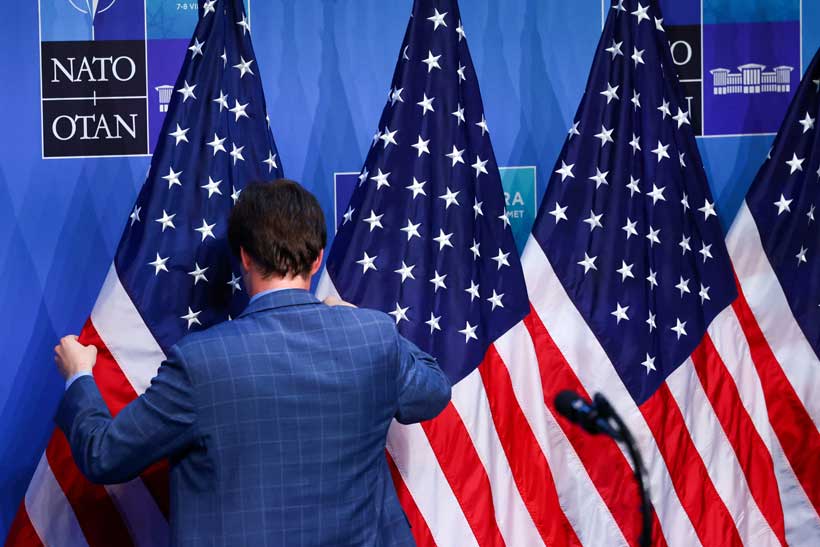
As the NATO summit took place July 7th through 8th in Ankara, American pressure on European leaders to meet increased defense spending benchmarks took center stage, set against the United States’ recent threats to withdraw from the alliance. During the 2025 NATO summit, European leaders were urged to increase their military spending to 5 percent of GDP by 2035, more than doubling the previous target of 2 percent. This pressure stems from growing American discontent with the cost of the alliance and its perceived lack of return on investment, a sentiment enhanced by the unenthusiastic European response to the recent American strikes on Iran. This complaint isn’t new; American officials have long argued that NATO is one-sided, accusing European nations of free-riding on U.S. military commitments. But that rhetoric has grown noticeably more aggressive in recent years. Still, the benefits of NATO membership are not as one-sided as many assume, and the United States is far more dependent on the alliance than it tends to acknowledge. Proponents of withdrawing from NATO in favor of a domestic-focused foreign policy frame the move as a cost-saving measure. But a closer look at the economic and strategic tradeoffs suggests the opposite may be true, raising the question of whether neo-isolationism is a policy the U.S. can actually afford.
If the United States exited NATO, it would lose access to the global infrastructure it currently relies on to project power abroad, including the shared network of air, ground, and naval bases in allied countries that allow American forces to operate far from home. Losing that access wouldn’t just mean losing shared bases; every future military operation on foreign soil, allied or not, would require negotiating an individual Status of Forces Agreement (SOFA) with that nation, often involving payments and lengthy legal negotiations. To maintain its current level of global reach and military power, the U.S. would have to pay to rebuild the infrastructure it currently shares with its allies.
Beyond hard security costs, NATO functions as more than a military alliance. It builds trust between member states that translates into deeper economic ties. Long-term data shows that NATO membership increases bilateral trade between member nations by 12–27 percent, and that effect grows as the alliance expands. The more countries that join NATO, the more trade flows between all members involved. That’s the upside of membership, so what’s the cost of leaving?
The clearest economic hit would land on bilateral trade. Leaving NATO is projected to shrink U.S. exports by 16.1 percent, a loss of roughly $240 billion annually. RAND research modeling a 50 percent reduction in U.S. foreign security commitments found it could shrink American GDP by as much as $490 billion per year. Altogether, the potential economic losses from scaling back security commitments are expected to be more than three times higher than any gains.
Stay ahead of the geopolitical week.
MD Briefing delivers expert analysis across five global fronts — the Indo-Pacific, energy, geoeconomics, European security, and the Middle East — every Monday morning. Free.
While the direct costs of leaving NATO would be largely trade-related, it’s worth weighing the long-term consequences of the power vacuum such a withdrawal would create. A United States with diminished global influence wouldn’t just be ceding ground; it would be handing that ground directly to Russia and China. European nations might attempt to ramp up their own defense spending in response, but the question remains of if it possesses the capability of increasing spending fast enough to deter Russian expansion into Ukraine. Meanwhile, China has spent years deepening economic and diplomatic ties in regions where U.S. influence is already thin, such as Africa. Without an American counterweight through NATO, that expansion would likely accelerate, putting U.S. security interests further out of reach.
The case for leaving NATO rests on a simple premise: that the U.S. is paying too much for too little in return. But the numbers tell a different story. Exiting the alliance wouldn’t free up money for domestic priorities so much as it would trade one set of costs for a far steeper one. Hundreds of billions in lost trade, the price of rebuilding military infrastructure that the U.S. currently has, and a strategic vacuum that Russia and China are already positioned to fill. Cost might be a popular argument for walking away from NATO, but cost is also the strongest argument for staying. The U.S. isn’t paying for an alliance it no longer needs, but for leverage, access, and stability that would be extraordinarily expensive, if not impossible, to rebuild alone.
