


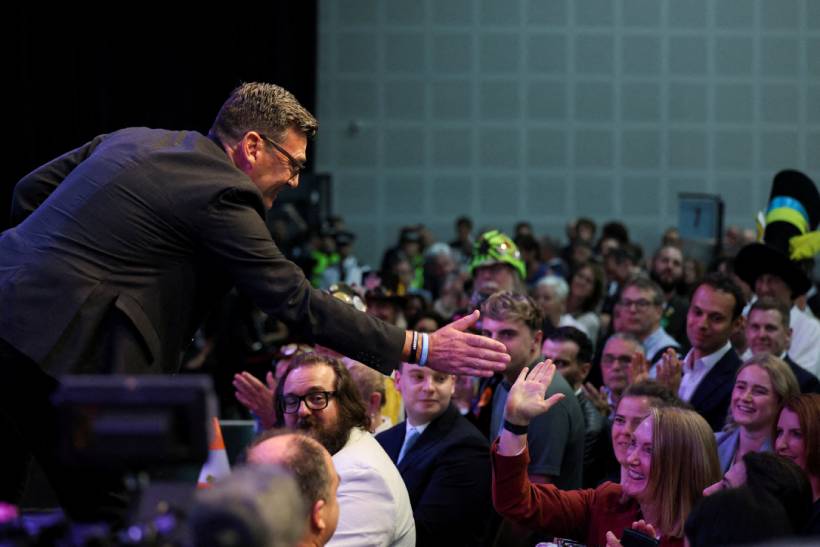
Andy Burnham is set to become leader of Britain’s governing Labour Party on Friday, clearing the final hurdle before taking office as prime minister on Monday.
The 56-year-old former mayor of Greater Manchester secured overwhelming backing from Labour lawmakers after a rapid leadership transition triggered by the collapse of support for outgoing Prime Minister Keir Starmer.
Burnham’s elevation would make him Britain’s seventh prime minister in a decade and place one of Labour’s most prominent regional figures at the centre of national politics at a time of mounting economic pressures and the growing popularity of Nigel Farage’s Reform UK.
From Greater Manchester to Downing Street
Burnham earned the nickname “King of the North” during his tenure as mayor of Greater Manchester, where he became known for forcefully defending regional interests against decisions made in London.
Stay ahead of the geopolitical week.
MD Briefing delivers expert analysis across five global fronts — the Indo-Pacific, energy, geoeconomics, European security, and the Middle East — every Monday morning. Free.
His reputation was built on campaigns for greater transport investment, devolved powers and economic support for northern England, particularly during the COVID pandemic when he publicly challenged the Conservative government over funding for Greater Manchester.
After returning to parliament last month by winning the seat of Makerfield, Burnham moved quickly into contention for the Labour leadership as lawmakers sought a figure capable of reconnecting the party with disillusioned voters.
The leadership transition
Friday’s special Labour conference is expected to formally confirm Burnham as party leader, with the transition to prime minister scheduled for Monday.
The speed of the handover reflects the urgency felt within Labour after months of weak polling and internal concern that the party was losing support to Reform UK, which has topped several national opinion polls.
Burnham’s promise to confront Reform’s rise proved decisive in winning over many Labour MPs who fear losing their seats at the next general election, which must be held by 2029.
Burnham’s economic vision
In extracts released ahead of his leadership speech, Burnham is expected to present a government that is “authentically Labour” and focused on economic renewal, reindustrialisation and greater public control over key services.
Central to his agenda is what he calls the “biggest rebalancing of power” from London to Britain’s regions.
He argues that decades of economic centralisation have deepened inequality and fuelled resentment in communities that feel left behind by national policymakers.
Burnham’s approach draws heavily on his experience in Greater Manchester, where he advocated for devolved decision-making and locally tailored economic strategies rather than policies designed primarily around London and the South East.
Why Reform UK changed Labour’s calculations
The rise of Reform UK has become the defining political challenge facing both Labour and the Conservatives.
Farage’s party has attracted significant support in former Labour heartlands by combining anti-establishment rhetoric with concerns about immigration, economic stagnation and declining public services.
Labour MPs increasingly concluded that Burnham was better positioned than Starmer to compete for those voters because of his stronger regional credentials and more interventionist economic message.
Recent controversy surrounding Farage’s acceptance of funding from wealthy donors may provide Burnham with an opportunity to argue that Reform is less anti-establishment than it claims.
What we still do not know
Despite the excitement surrounding his arrival, many questions about Burnham’s premiership remain unanswered.
He has given only one major speech since re-entering parliament, and details of his cabinet, fiscal strategy and approach to issues such as taxation, defence spending and relations with Europe have yet to be unveiled.
Investors, businesses and international partners will be watching closely for signals about whether his government will pursue significant departures from recent Labour economic policy.
The challenge of governing quickly
Burnham faces a difficult timetable.
With a general election likely within the next three years, he has limited time to demonstrate tangible progress on wages, investment, housing and regional inequality.
Many of his ideas, particularly those involving devolution and industrial strategy, are long-term projects whose benefits may not be immediately visible to voters.
Nigel Wilcock of the Institute of Economic Development said Burnham had spent years arguing for a different model of economic growth, but the real test would be translating that vision into practical results.
Why it matters
Burnham’s arrival could mark a significant ideological shift within Labour away from the more cautious, centrist approach associated with Starmer and toward a stronger emphasis on regional empowerment, industrial policy and state involvement in economic development.
His premiership would also be an important test of whether a politics rooted in English regional identity can successfully counter the appeal of right-wing populism.
Future outlook
The first 100 days of Burnham’s government are likely to focus on announcing a new cabinet, setting out a regional investment strategy and delivering early measures aimed at demonstrating that power is genuinely being shifted away from Westminster.
The broader question is whether Burnham can convert his popularity in northern England into a nationwide governing coalition. If he succeeds, Labour may regain momentum ahead of the next election. If he fails to produce visible economic improvements quickly, Reform UK could continue consolidating support among voters who feel abandoned by both major parties.
Ultimately, Burnham’s premiership may become a referendum on whether Britain’s political centre of gravity can move away from London and whether a more decentralised model of economic development can address the frustrations that have reshaped British politics since Brexit.
With information from Reuters.
