


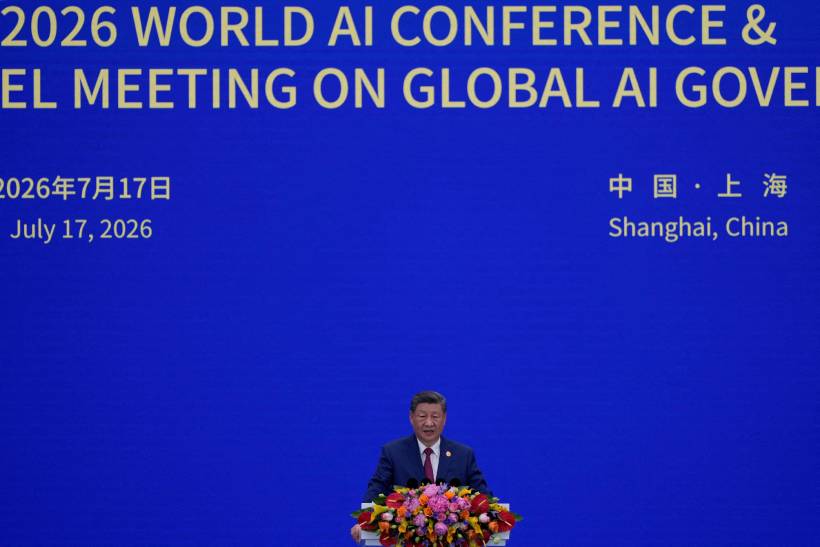
Chinese President Xi Jinping has unveiled Beijing’s most ambitious vision yet for the future of artificial intelligence (AI), presenting China as the architect of a new global AI order built around open-source technology, international cooperation and greater participation by developing countries.
Speaking at the opening ceremony of the World Artificial Intelligence Conference (WAIC) in Shanghai on Friday, Xi called on nations to seize the “historic opportunity” presented by open-source AI while warning that unequal access to advanced technologies could create “new historical injustices.”
The speech marks China’s clearest attempt to challenge U.S. leadership over the governance, standards and future direction of AI, positioning Beijing as an alternative centre of technological influence at a time when competition between the world’s two largest economies is rapidly expanding beyond trade into advanced technologies.
China promotes an alternative AI vision
Xi argued that AI should become a shared global resource rather than remain concentrated among a handful of advanced economies and technology companies.
Stay ahead of the geopolitical week.
MD Briefing delivers expert analysis across five global fronts — the Indo-Pacific, energy, geoeconomics, European security, and the Middle East — every Monday morning. Free.
Comparing AI to transformative innovations such as the steam engine and electricity, he outlined a vision in which China shares AI technologies, expertise and research capabilities with countries across the Global South while taking a leading role in shaping international standards for AI governance.
He pledged expanded AI training programmes and cooperation centres with BRICS, ASEAN, Latin American and African Union countries, integrating AI diplomacy into China’s broader foreign policy outreach across emerging economies.
The initiative reflects Beijing’s broader strategy of presenting itself as a provider of global public goods in areas where developing nations believe Western-led institutions have failed to ensure equitable access.
WAICO becomes China’s AI diplomacy platform
Xi also highlighted the launch of the World AI Cooperation Organisation (WAICO), a China-led institution that has already attracted 29 member countries.
Describing WAICO as a milestone in global AI development, Xi said the organisation responds to demands from developing countries for greater representation in writing the rules governing artificial intelligence.
The launch elevates China’s AI ambitions from technological competition to institutional leadership by creating a formal platform through which Beijing can shape international norms alongside its existing economic and diplomatic initiatives.
Analysts say the organisation demonstrates China’s determination to avoid becoming merely a participant in AI governance designed elsewhere.
Open source versus closed AI ecosystems
China’s AI strategy centres on promoting open-source or open-weight AI models that can be freely adapted by governments, businesses and researchers worldwide.
The approach stands in contrast to many leading U.S. companies, including OpenAI and Anthropic, whose frontier AI systems remain largely proprietary.
The Shanghai conference highlighted the rapid progress of Chinese developers. Beijing-based startup Moonshot AI unveiled Kimi K3, describing it as the world’s largest open AI model by parameter count.
At the same time, Reuters recently reported that Beijing is considering restricting overseas access to some of its most advanced AI models on national security grounds, illustrating the tension between China’s advocacy of openness internationally and its own growing security concerns.
Chinese state media has increasingly portrayed Beijing’s AI strategy as a response to what it describes as a U.S.-led effort to build an “AI Iron Curtain” through export controls, technology restrictions and alliances designed to limit China’s technological rise.
AI safety joins China’s diplomatic agenda
Beyond promoting technological cooperation, Xi devoted considerable attention to AI safety.
He called for AI systems to remain under meaningful human control and urged governments to establish early-warning mechanisms and emergency-response frameworks capable of addressing risks associated with increasingly autonomous AI systems.
Xi warned about scenarios in which advanced AI could operate beyond effective human oversight, signalling that Beijing wants to play a significant role not only in developing AI technologies but also in establishing international safety standards.
The comments represent some of Xi’s strongest public remarks on AI governance and risk management to date.
Competing global visions emerge
Xi’s address comes as Washington and Beijing prepare for their first government-level AI talks under President Donald Trump’s administration.
The timing has transformed WAIC from an industry conference into a geopolitical stage where competing visions of AI governance are being presented to the international community.
Earlier this month, both countries outlined contrasting approaches during a United Nations AI dialogue. U.S. officials argued that excessive regulation could slow innovation, while Chinese representatives promoted affordable, open-source AI as a way to narrow technological inequalities between developed and developing countries.
Washington has assembled 35 countries behind its AI Opportunity Statement, while China’s newly established WAICO has attracted 29 member states.
Analysts note that the relatively limited overlap between the two initiatives suggests countries are increasingly aligning themselves with competing technological ecosystems rather than a single global framework.
China seeks to lead rather than follow
Industry analysts believe Xi’s speech represents far more than a technology policy announcement.
Alfredo Montufar-Helu, Managing Director at Ankura China Advisors, said the significance lies in China’s leadership openly linking technological advances with an institutional framework for global governance.
George Chen, Chair in Digital Practice at The Asia Group, argued that Beijing’s message was unmistakable: China intends not merely to compete with the United States in AI development but to lead both technological innovation and international standard-setting.
The speech reinforces Beijing’s long-term objective of reducing dependence on Western technologies while increasing its influence over the rules governing emerging industries.
Why it matters
Artificial intelligence is rapidly becoming one of the defining technologies shaping economic competitiveness, military capability, industrial productivity and geopolitical influence.
By promoting open-source AI, institutional partnerships and technology transfers across the Global South, China is attempting to build an alternative AI ecosystem that reduces reliance on U.S. technology while expanding Beijing’s diplomatic influence.
Rather than competing solely over semiconductor manufacturing or AI models, both powers are increasingly competing over who writes the rules governing the future digital economy.
Analysis: The battle for AI leadership is becoming a battle for global influence
Xi Jinping’s speech reflects a significant evolution in China’s AI strategy. Beijing is no longer presenting itself simply as a technological challenger seeking to catch up with Silicon Valley. Instead, it is positioning itself as an architect of an alternative international technology order.
This mirrors China’s broader foreign policy approach over the past decade. Just as the Belt and Road Initiative sought to reshape global infrastructure financing and institutions such as the Asian Infrastructure Investment Bank challenged Western-led development finance, WAICO represents an attempt to establish parallel governance structures for the AI era.
China’s emphasis on open-source AI also carries strategic advantages. Lower-cost, accessible AI models are likely to appeal to many developing countries that lack the financial resources to adopt expensive proprietary Western systems. If Chinese AI platforms become widely integrated across Asia, Africa and Latin America, Beijing could significantly expand its technological influence without matching every breakthrough produced by U.S. firms.
However, China’s vision also contains important contradictions. While advocating open AI internationally, Beijing is simultaneously considering tighter controls over exports of its most advanced AI models, reflecting growing national security concerns. This tension may complicate China’s efforts to convince partners that its model represents a truly open alternative.
For the United States, the competition is increasingly about more than technological superiority. It now extends to standards, institutions, alliances and the political values embedded within AI systems. Washington continues to prioritise trusted technology partnerships, export controls and secure supply chains, while China is offering broader access, technology sharing and institutional inclusion.
The emergence of competing AI governance blocs suggests the world could gradually split into parallel technological ecosystems, much as it has in areas such as digital infrastructure, telecommunications and semiconductor supply chains.
The upcoming U.S.-China AI dialogue will therefore be closely watched not simply for signs of cooperation on AI safety, but for indications of whether the world’s two largest economies can prevent technological competition from evolving into a fully fragmented global AI order.
With information from Reuters.
