


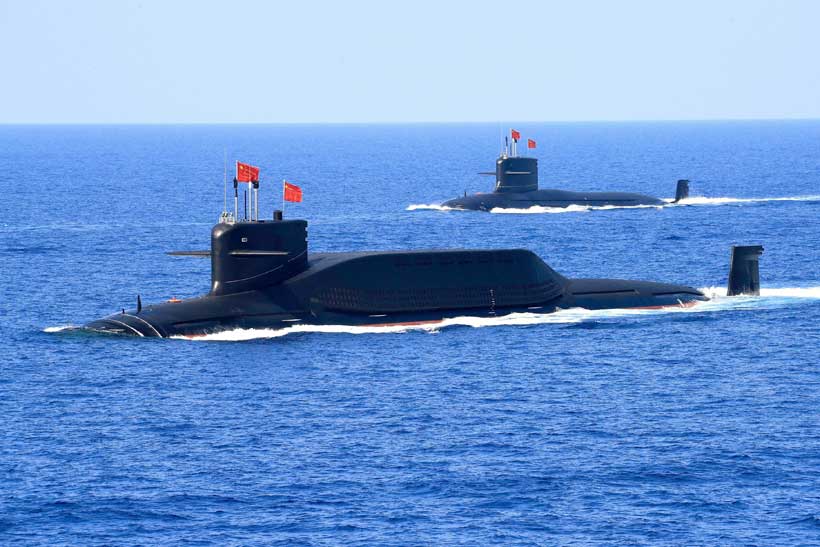
On July 6, at 12:01pm Beijing time, a Chinese nuclear-powered submarine launched a ballistic missile from beneath the South China Sea. The missile came to rest some 300km east of Tonga, in the South Pacific Nuclear Free Zone which China had pledged to respect in the Treaty of Rarotonga, which it signed in 1987. Beijing has described it as an “annual training session”, but the U.S., Japan, Australia and New Zealand found it destabilizing. Both characterizations miss the more consequential story.
The July 6 test was not primarily about the missile or where it landed. It was about what China chose to demonstrate, to whom, when, and simultaneously with what else. It was about a country publicly signaling that its sea-based nuclear deterrent has crossed a credibility threshold, and doing so in a way carefully calibrated to send different messages to different audiences simultaneously. Understanding those messages, and what they mean for the Pacific security architecture, requires going considerably further than the technical details of the launch itself.
Not Routine, But A Campaign
China’s state media described the launch as routine annual training. The operational record tells a different story. The July 6 SLBM test was the second time China has launched a ballistic missile into international open Pacific waters since 1980; the first being the September 2024 test of a land-based DF-31B ICBM. Two tests in two years, each publicly announced, each generating significant regional reaction, each followed by Chinese diplomatic messaging about transparency and restraint. This is not a testing program. It is a demonstration campaign.
The pattern matters because it reveals deliberate intent. Nuclear-armed states test their missiles regularly: the US Navy conducted four Trident tests off Florida last September alone, and Russia test-launched an SLBM last October. What distinguishes China’s approach is the deliberate public theatricality of tests conducted in international waters rather than over Chinese territory, and the precise calibration of timing around other events. The September 2024 ICBM test came during heightened Taiwan Strait tensions. The July 2026 SLBM test came two days after America’s 250th Independence Day, on the opening day of the China-Russia Joint Sea 2026 naval exercise, and hours after Australia and Fiji announced a new mutual defense pact. China had two launch corridor options available — one from the Bohai Sea, one from the South China Sea. It chose the South China Sea, which sent the missile over parts of the Philippines and into the Pacific, maximizing the geographic footprint of the demonstration. These are not coincidences. They are choices.
Stay ahead of the geopolitical week.
MD Briefing delivers expert analysis across five global fronts — the Indo-Pacific, energy, geoeconomics, European security, and the Middle East — every Monday morning. Free.
The Bastion Logic and What It Changes
To understand why the July 6 test represents a qualitative shift rather than an incremental development, it helps to understand what the bastion strategy means and why it matters now in a way it did not a decade ago.
The Soviet Union during the Cold War operated a bastion strategy for its ballistic missile submarines — concentrating them in heavily defended home waters like the Barents Sea and Sea of Okhotsk, where Soviet air and naval forces could protect them from US anti-submarine warfare operations. This allowed Soviet submarines to remain survivable without venturing into open ocean where American hunter-killer submarines could track and potentially target them. The US strategy in response focused on keeping Soviet submarines bottled up in those bastions, denying them access to open water where they could threaten the American homeland from close range.
China appears to be developing a similar concept, built around the South China Sea and Bohai Sea as its primary operating areas for ballistic missile submarines. The strategic logic is straightforward: if the JL-3 can reach most of the continental United States from those heavily defended home waters, Chinese submarines never need to expose themselves to American anti-submarine warfare by venturing into the open Pacific. The entire US strategy of forward-deploying hunter-killer submarines and maritime patrol aircraft to detect and track Chinese SSBNs becomes considerably less relevant if Chinese submarines can hold American cities at risk without leaving waters where American forces struggle to operate freely.
The July 6 test demonstrated that this capability is real. A missile launched from somewhere in the South China Sea traveled 7,200 kilometers. With the JL-3’s estimated maximum range of 10,000 to 12,000 kilometers, a submarine in those same waters could reach the American east coast. The mathematics of the bastion strategy now work for China in a way they did not when the JL-2, with its more limited range, required submarines to venture further east to threaten the continental United States.
How China’s Sea-Based Deterrent Compares to the World’s
Context matters here and is rarely provided in coverage that focuses exclusively on Chinese capabilities in isolation.
The United States operates 14 Ohio-class submarines, each carrying up to 20 Trident II D5 missiles with multiple independently targetable warheads and a range of approximately 12,000 kilometers. The UK maintains four Vanguard-class submarines, keeping one on continuous patrol at all times. France operates four Triomphant-class submarines on a similar pattern. Russia maintains a large but aging SSBN fleet across its Northern and Pacific fleets. All four of these forces have decades of operational experience, established patrol patterns, hardened command and control architecture, and submarines assessed as significantly quieter than China’s current Type 094 Jin-class boats.
China has six Type 094s. To be able to be on patrol at sea all the time through the maintenance cycle, transit times, and crew rotation, at least five boats have to be operational at all times. China is at six, and counting. It’s unclear if the submarines in service are now patrolling continuously or not, though a number of U.S. officials believe they are, and the Bulletin of Atomic Scientists said China’s warheads are typically kept away from launchers, making quick deployment more difficult. The Type 094 is also considered to be much more audible than its American and Russian counterparts, reducing its survivability in open ocean warfare where acoustics is still the most important means of tracking.
The next generation Type 096, which is being built at Bohai shipyard in Huludao, should solve both issues. Open-source estimates suggest a pressure-hull diameter of roughly 12 meters, capacity for 16 to 24 missile tubes, and an acoustic signature significantly reduced from the Type 094. With the Type-096, China will command, for the first time, a sea-based deterrent that is not just close to but equal in survivability to that of the US and Russian counterparts, if it enters service before the end of the decade.
India tested its own SLBM from the INS Arighat submarine in December 2025, its second operational SSBN. That test was quiet, domestically focused, and generated minimal international reaction. The contrast with China’s Pacific demonstration is itself informative — India is building a sea-based deterrent primarily for regional strategic balance, focused on survivable second-strike capability against Pakistan and China. China is building something with global reach and announcing it to the world.
Claiming Transparency While Practicing Opacity
Beijing claimed transparency. Japan’s Coast Guard was notified a day in advance that a hazard area had been designated, for what was described as falling space debris. It was not until 90 minutes before launch that China’s Defense Ministry clarified the activity involved a ballistic missile test. The Hague Code of Conduct against Ballistic Missile Proliferation, which China has been pressed to join since 2009, sets out standard pre-launch notification procedures. China notified relevant countries in its own formulation while declining to follow those procedures. At the current NPT Review Conference, Chinese diplomats have cited their 2024 advance notice as evidence of transparency. The 2026 test follows the same pattern.
The transparency claim is doing specific diplomatic work. It allows China to present itself as a responsible nuclear power engaged in legitimate military modernization, while maintaining maximum ambiguity about the details that would allow outside analysts to accurately assess its capabilities. China did not disclose the missile type, the submarine’s launch position, or the precise flight path. The photographs released by Chinese state media showed both the JL-2 and JL-3 without confirming which was tested, a deliberate choice that preserved uncertainty about whether China has validated the JL-3’s full range capability, while ensuring the association with the more capable system dominated international coverage.
The broader arms control implication is serious. The US State Department called on China to engage in meaningful arms control discussions. China’s warhead stockpile has grown from roughly 290 in 2019 to over 600 today, on a trajectory toward 1,000 by 2030. A country expanding its arsenal at that pace while declining to join the HCOC or engage substantively in bilateral nuclear risk reduction talks is not a country whose transparency claims should be taken at face value. The opacity is the strategy.
The Russia Dimension and What It Means for US Pacific Planning
The launch’s coincidence with the opening of China-Russia Joint Sea 2026 was not lost on anyone paying attention. Russian naval vessels arrived in Qingdao on July 6, the same day as the missile test. After the exercise, elements of both navies will conduct a joint patrol in the Pacific. Last year’s iteration was the first to include submarines, and this year’s will likely expand on that precedent.
China and Russia have now conducted joint bomber patrols over the Sea of Japan and western Pacific, joint naval patrols approaching Alaskan waters, and coordinated submarine exercises. The July 6 SLBM test, conducted on the day the Russian ships arrived, while RIMPAC 2026 involving 29 US-allied nations was underway in Hawaiian waters, was a specific kind of message about the military dimension of Sino-Russian alignment. For US Pacific Fleet commanders managing both RIMPAC and the Chinese demonstration simultaneously, the resource and attention demand of the dual scenario were not theoretical.
The Regional Cascade: Japan, Australia and the Pacific Islands
For Japan, the implications go beyond where any single missile landed. Chinese submarines operating regularly in Pacific patrol areas change Japan’s anti-submarine warfare requirements, its maritime domain awareness posture, and its crisis-response planning for any Taiwan contingency. The debate Japan has historically treated as taboo, whether to acquire nuclear-powered submarines for conventional missions, is now unavoidable. Not because anyone proposes Japanese nuclear weapons, but because nuclear propulsion provides the endurance and stealth required to track Chinese submarines across the distances now involved. A conventional submarine, however capable, cannot maintain the submerged endurance needed to shadow a Chinese SSBN across thousands of kilometers of Pacific Ocean.
For Australia, the test reinforces the strategic logic behind AUKUS and accelerates the urgency of its nuclear-powered submarine acquisition. The Australia-Fiji defense pact announced on the same day reflects a broader pattern of Pacific states recalibrating their security arrangements in response to a changing undersea reality. For Pacific Island nations, the landing of a Chinese ballistic missile inside the South Pacific Nuclear Free Zone, whatever China’s technical compliance with Treaty of Rarotonga protocols, represents a normalization of nuclear activities in waters those nations designated as nuclear-free nearly four decades ago. New Zealand’s Winston Peters warned explicitly against allowing such tests to become routine. The trajectory of China’s demonstration campaign suggests that is precisely what Beijing intends.
Our Take: Nothing About This Was Routine
The July 6 test adds one more data point to a pattern that is now unmistakable. China is conducting a deliberate, sequenced campaign to normalize its strategic missile demonstrations in international waters: building the operational record, the crew experience, the command and control verification, and the international perception management that a globally credible sea-based deterrent requires. The 2024 ICBM test validated the land-based leg publicly. The 2026 SLBM test has validated the sea-based leg publicly. Both were timed for symbolic and strategic effect. Both were followed by claims of transparency that did not meet international standards. Both generated exactly the international reaction Beijing needed to demonstrate that it can absorb diplomatic criticism while continuing its program on its own timeline.
The Pacific security environment on July 7 is meaningfully different from what it was on July 5. Not because China suddenly has capabilities it lacked before, but because it has chosen to demonstrate those capabilities publicly, in international waters, in a way designed to make them impossible to dismiss as theoretical. Whether Washington responds with arms control engagement or accelerated investment in undersea warfare is a policy question. What is not a question is that the undersea nuclear competition in the Pacific has entered a new phase, and China has decided the world should know it.
