


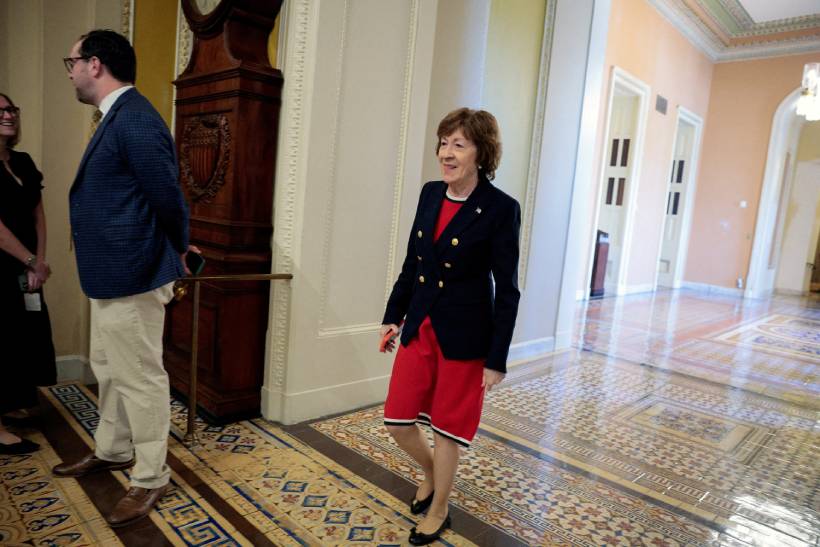
Republican Senator Susan Collins faces renewed political pressure in Maine after a fatal Immigration and Customs Enforcement (ICE) traffic stop shifted attention away from Democratic turmoil and back onto one of the state’s most divisive issues.
The incident occurred in Biddeford, where ICE officers fatally shot a man during a traffic stop, sparking public outrage and placing Collins in a difficult position as she seeks another term in the U.S. Senate.
Collins Calls for Pause on ICE Traffic Stops
In response to the shooting, Collins urged Homeland Security Secretary Markwayne Mullin to suspend non-urgent ICE traffic stops while investigations are conducted.
Mullin initially appeared receptive to the request. However, President Donald Trump publicly rejected the idea, arguing that traffic stops remain a critical law enforcement tool.
Stay ahead of the geopolitical week.
MD Briefing delivers expert analysis across five global fronts — the Indo-Pacific, energy, geoeconomics, European security, and the Middle East — every Monday morning. Free.
In a post on Truth Social, Trump said ICE should not abandon one of its “most important and effective crime-fighting tools,” warning that doing so would benefit criminals.
Collins later reiterated that traffic stops should be halted until the investigation is completed, but political analysts say Trump’s intervention weakened her effort to distance herself from the administration’s immigration policies.
Election Dynamics Shift
Before the shooting, Collins appeared to benefit from turmoil within the Maine Democratic Party.
Her leading challenger, Democrat Graham Platner, withdrew from the race after sexual assault allegations emerged. Platner has denied the accusations, but his departure forced Democrats into a rushed search for a replacement nominee, creating uncertainty just months before the election.
The controversy had dominated political discussion in Maine and diverted attention from Collins’ record.
That changed when the ICE shooting became the state’s biggest political issue.
“It was all Platner and Platner fallout,” University of Maine political scientist Mark Brewer said. “Then all of a sudden ICE becomes the story.”
Questions Over Collins’ Influence
The episode has also revived questions about Collins’ influence within the Republican Party.
For years, Collins has cultivated an image as an independent Republican willing to challenge her party when necessary. Political observers say Trump’s public contradiction of her position may undermine that message.
Ron Schmidt, a political science professor at the University of Southern Maine, said the dispute could make it harder for Collins to argue that she can effectively protect Maine’s interests within the Republican Party.
Democrats See Opportunity
Despite Democratic disarray following Platner’s withdrawal, analysts believe Maine remains one of the most competitive Senate races in the country.
Republicans currently hold a 53-47 Senate majority, making Maine a key target for Democrats hoping to regain control of the chamber.
Potential Democratic candidates include Secretary of State Shenna Bellows, former Maine Senate President Troy Jackson, former Maine CDC Director Nirav Shah, former congressional aide Jordan Wood, and social worker Paige Loud.
Collins Still Holds Advantages
Collins enters the race with significant strengths. She has represented Maine in the Senate since 1997 and has repeatedly won difficult re-election campaigns.
Her campaign raised more than $4 million between April and June and began July with approximately $11 million in cash on hand.
In 2020, Collins won re-election by nearly nine percentage points despite Democrat Joe Biden carrying Maine by a similar margin in the presidential race.
Why It Matters
The Maine Senate race is one of the most closely watched contests of the 2026 midterm elections. The ICE shooting has transformed the political conversation in the state, forcing Collins to navigate tensions between her moderate image and President Trump’s immigration agenda.
What Comes Next
Democrats must quickly unite behind a new nominee after Platner’s exit, while Collins faces pressure to demonstrate her independence on immigration and public safety issues. How voters respond to the ICE controversy could play a significant role in determining control of the Senate next year.
With information from Reuters.
