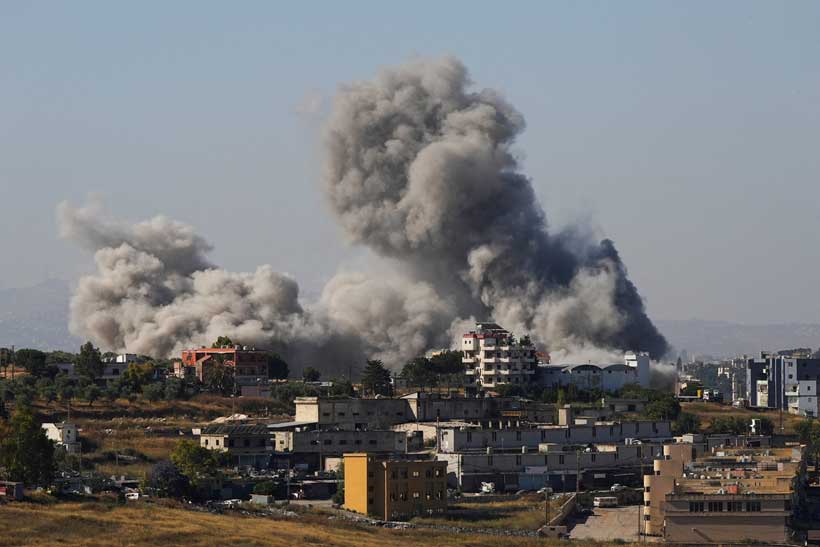
Israel’s battles in the Middle East show no signs of stopping as we move into the second half of the year. Bombs continue to fall on Palestine, and the new barrage of attacks on Lebanon appears to only just be getting started. The region seems plagued with conflict and Israel seems surrounded by leagues of perceived enemies. The USA’s “FUTURES” Act prepares the superpower to militarily integrate even closer with its transatlantic ally, AI is playing an increasingly central role in targeting and weapons systems, and the long-held global norms of sovereignty, non-intervention and territorial integrity may be more threatened now than any time in recent geopolitical history. Israel’s strategic doctrine and military ambitions are reflective of these important changes.
Background
The November 2024 ceasefire agreement between Lebanon and Israel was violated frequently prior to Israeli withdrawal, yet some still thought it to be a definitive cessation of hostilities. Israel and the USA’s joint assassination of Supreme Leader Ayatollah Ali Khamenei in February 2026 prompted Hezbollah’s immediate retaliatory attack. Israel’s brutal response now means Lebanon is drawn into the wider, ongoing regional conflict. This is Israel’s seventh occupation of Lebanon since 1948, and the most violent in terms of deaths per day – 54.4, the highest daily casualty rate since the Lebanese civil war ended in 1990 (AOAV, 2026). Deploying a ground invasion, airstrikes and the catastrophic destruction of civilian infrastructure, this onslaught has now displaced over 1 million people in Lebanon – 35% of whom are children (UNHCR, 2026). These people lack basic access to food, water and shelter, and face increasingly intense, unpredictable and far-reaching bomb strikes. Humanitarian aid groups are unable to keep up with the numbers of citizens devastated by the attack. On the 24th March 2026, Israeli Defence Minister Israel Katz declared that Israel would destroy Lebanese border villages and permanently occupy territory in Lebanon as far as the Litani river. These plans sound far closer to the language of occupation and annexation than to any sort of neutral buffer zone.
The most recent bombing campaign has been the most destructive, with Majdal Zoun “cut in two” after Israel blew up a 200-meter-long underground tunnel leaving behind a “chasm” of unknown depth and dimensions (L’Orient, 2026). The tunnel extended through the most densely populated area of the town, spanning the public square, the mosque, and many homes. The explosions were so powerful that, before the detonation, the residents of nearby many villages were able to feel its tremors. The Israeli army claimed it had successfully destroyed a tunnel with hundreds of Hezbollah’s weapons. Since then, Lebanon’s National News Agency has confirmed the murder of a school principal, her mother, and two foreign workers. An Israeli drone targeted their car, despite the truce agreed upon only two weeks ago which Hezbollah maintains that it has been adhering to. Lebanese authorities say that 4,300 people have been killed in Israeli attacks since March, and President Joseph Aoun reminded that the occupation both undermines Lebanon’s legitimacy as a state, and inhibits the Lebanese army from properly deploying in the south of the country (France24, 2026).
Stay ahead of the geopolitical week.
MD Briefing delivers expert analysis across five global fronts — the Indo-Pacific, energy, geoeconomics, European security, and the Middle East — every Monday morning. Free.
Competing Doctrines and Parallel Tactics
Hezbollah is a Lebanese Shia Islamic political party, of relatively large size and significance. The party was inspired by the governing style of Iran following the 1979 revolution led by Supreme Leader Ayatollah Ruhollah Khomeini, and as such recognises Iran’s leader as their supreme authority. Their central mission is to curtail US influence in the Middle East, and supports the implementation of an Islamic state in Lebanon. In line with their dislike for the US, they also use armed resistance to oppose Israel’s actions in the region – functioning, in the eyes of some, as the USA’s transatlantic arm. Following the proposed integration of the American and Israeli militaries under the FUTURES Act, this proposition does not seem overly unreasonable; analysis from the Quincy Institute for Responsible Statecraft suggests the initiative would do more to intertwine the two nation’s militaries than the cumulative $200 billion in military aid which Israel has received from the US since its founding.
Hezbollah opposes both Western and Israeli influence alike, seeing the two, perhaps understandably, as inextricably linked. In its 1985 manifesto, Hezbollah also called for an Islamic state in Lebanon. Despite this, it has largely accepted Lebanon’s pluralistic political system since the 1990s, serving in coalitions and participating in elections. The party has shifted toward valuing popular consent over revolutionary imposition, but still sees opposition to the West and Israel as a primary goal. Popular sentiment, however, is divided in Lebanon because Hezbollah is seen by some as the reason for Israel’s decimation of the country.
Importantly, Hezbollah is not simply a proxy for Iran or another group simply pushing for fundamentalist Islamist reform. It functions as a political party, an armed militia, a welfare provider, a social movement and a key Iranian ally at the same time. Treating Hezbollah solely as an Iranian puppet ignores the important and varied socio-political functions which have allowed the group to retain loyal support within many parts of Lebanese society.
Israel’s political doctrine is similarly conservative, but importantly grounded in Zionism. Traditional Zionism sees the Kingdom of Israel (the Promised Land) as located in varyingly expansive places in the Middle East, depending on the individual Zionist, from the desert to the sea, from the Nile to the Euphrates, encompassing Palestine, Jordan and parts of Lebanon, Egypt, Syria and even Saudi Arabia. Israel’s ruling party, Likud, owes its roots to the revisionist Zionist movement, and explicitly confirmed the party’s quest for ‘Eretz Yisrael Ha-Shlema’ (literally, ‘the Whole Land of Israel’) when they first came to power in 1977. Even after the Oslo Accords in the 1990s, which signified international support for the two-state solution, the plan for Greater Israel continued to be developed and advanced. Since the Accords, more than 200 Israeli colonies and nearly 500,000 Israeli settlers have joined the country (UN, 2024). Despite being nominally committed to cultivating co-habitation, “a permanent war orientation runs deep in Israel’s political class, government and opposition, security establishment, new-right elite and media” (Levy, 2026a). In 2024, Israeli Finance Minister Smotrich suggested that Israel would eventually grow to encompass not only the entirety of Palestine, but also areas of Jordan, Lebanon, Egypt, Syria, Iraq and Saudi Arabia – asserting that Jerusalem’s future expansion to Damascus is “written” (Middle East Eye, 2024). Similarly, in a 2025 interview, Prime Minister Netanyahu said he felt “very much” connected to the idea of Greater Israel.
Undoubtedly, there are varying levels of support within Israel’s political elite and conservative zeitgeist for the Greater Israel vision; it would be unfair to posit the vision’s implementation as Netanyahu’s sole mission, but it would also be folly to suggest the project is entirely absent from his regional agenda. Recent actions in Lebanon, destruction of civilian infrastructure, annihilation of villages and so on, can be interpreted as both Israel’s rational response to the Hezbollah threat, perceived as existential, and as a play to catalyse (or continue) the Greater Israel project simultaneously. Certainly, recent online declarations from Israel’s national security minister, Itamar Ben-Gvir, asserting that “all of Lebanon must burn” and “for every tear of an Israeli mother, a thousand Lebanese mothers must weep” leave little room for interpretation of Israeli intentions – evoking images of brutal collective punishment, rather than self-defense. Levy, writing for the Guardian, suggests that Israel’s taking out of Iran as a regional power and weakening the security positions of Gulf Cooperation Council States was a deliberate move to make said states more dependent on Israel for security. Just days before the beginning of the initial war on Iran, during a visit with Indian Prime Minister Modi, Netanyahu shared his vision of a “hexagon of alliances around or within the Middle East […] Israel would be the key nodal point of this alliance” (Levy, 2026b).
Former senior IDF officers, Brigadier General Dr. Eyal Pecht and Lieutenant Colonel Dr. Itai Jimenis, released a recent paper for the IDF’s designated strategy institute, in which they outlined a shift in Israel’s military doctrine (IDF, 2026). Drawing heavily on the work of Henry Kissinger, seen by many as a prolific war criminal, the paper rests on his theory of international order requiring sustained military coercion. Kissinger’s own track record includes misdeeds such as the secret bombing of Cambodia and backing of the 1973 Chile coup – both of which produced the ‘order’ of US hegemony, and incurred mass civilian harm. The IDF’s publication advocates for prolonged Israeli military presence beyond its borders, expanded occupations, greater operational freedom, industrial mobilisation, and a larger army able to fight simultaneous multi-front wars. The publication claims, rather dubiously considering the explicitly Zionist terms of Likud’s initial ascension to power, that Israel was primarily a defensive actor up until Hamas’ surprise attack on October 7th 2023, but that, following the attack, Israel should begin to actively reshape surrounding states. The paper suggests regime change, resistance extermination and long-term whole-region control, and explicitly and frequently mentions Lebanon as a target for these efforts.The paper asserts that “the idea of operational control over territories from which a security threat arose, in Gaza, Lebanon and Syria” has been “re-adopted” by the State of Israel. Simultaneous and subsequently to regional hegemony’s ideological re-adoption, “the IDF succeeded in achieving operational control even in arenas far from Israel’s borders, without occupying and holding territory.”
Throughout both the initial Israeli attacks on Iran and the newer bombing campaign on Lebanon, the brutal apartheid in Palestine has not ceased. Airstrikes in Gaza are frequent, ground forces remain present in significant numbers and there have been multiple deaths (added to the estimated 70,000 murdered since October 7th) despite an ongoing ceasefire framework. As the multifront war escalates, Israel’s justifications have not multiplied; rather, on the new Lebanese front, the aggressor’s rhetoric remains eerily familiar. The IDF maintains that they are aiming for Hezbollah, but that, like Hamas, the group has deliberately embedded military assets in densely populated civilian areas, thus civil society and infrastructure are seen as legitimate military targets by the IDF. Some international commentators have suggested this rhetoric, of civilian/militia inseparability, is an excuse to carry out terror campaigns on civilians with the goal of scaring them out of supporting resistance groups. While Israel maintains that it gives warnings (calls, texts etc) for civilians to evacuate before bombings, having one’s home, livelihood, and community annihilated and left with only one’s physical body is not necessarily a show of admirable mercy on the attacker’s part.
International Legality
A significant claim made against Israel regards its violations of sovereignty and territorial integrity; widely respected norms of the international order codified in multiple international judicial documents. The Peace of Westphalia (1648) is thought by many international relations scholars to be the basis of these norms against conquest, ending European religious wars with the notion of ‘whose realm, his religion’, and thus sovereign territorial authority. This norm of international non-intervention and self-determination, enshrined in the UN’s Charter, is being eroded all over the world: by Israel in Palestine and Lebanon, by their American patron in Venezuela, by Russia in Ukraine, by Turkey in Northern Syria. It goes without saying, one would hope, that conquest, domination, annexation, occupation, imperial control and neo-imperial ‘interventions’ are, almost unfailingly, dark forces in the geopolitical sphere, and forces which many would think consigned to the more Hobbesian past.
Claire Vergerio (2021), however, suggests that the system of Westphalian sovereignty is, in fact, a myth. She suggests that European historians wanted to portray the continent as a mutually-respectful, orderly pantheon of sovereign states before Napoleon’s tyranny. The mythologised 1648 document contained no explicit mention of principles of territorial sovereignty, nor the phrase ‘whose realm, his religion’ – which actually came from the earlier Peace of Augsburg (1555). Europe itself didn’t begin to properly respect territorial integrity until 1945.
Both versions of the origins of territorial sovereignty have a role to play when assessing contemporary international affairs. While the Peace of Westphalia itself may not be the founding pillar of civilised global politics, the substantive outputs of Westphalia’s mythologisation are significant: the tenets of independence and self-determination drove Wilsonian liberal institutional thought (and, as such, the founding of the UN), mid-century decolonial movements, the bases of international law, and the Non-Aligned Movement. Myth or norm or neither, Westphalianism still has a real role to play in international peace because its core idea is the fundamental unacceptability of dominion and conquest. The litany of current violations of this doctrine may signal a regressive shift toward the pre-1945 state of global affairs; a world of violent realism, occupation and conquest in which the lives of states are ‘solitary, poor, nasty, brutish, and short’. Ceasefires violated with abandon, Presidents kidnapped by foreign aggressors, borders malleable and populations exterminable. With a UN independent commission of inquiry again affirming that Israel is committing genocide in Gaza (UN News, 2026), one worries that eroded norms and hawkish political elites could culminate in a second, “burn[ing]” genocidal front appearing in Lebanon. When a nation’s sovereignty becomes contingent on its willingness and ability to eliminate perceived security threats, then sovereignty itself becomes an extension and product of military power – not an equally applied legal principle as Westphalianism, the UN Charter and international judicial sentiment suggest.
AI, Weapons Systems and Conflicting Interests
If operational control without physical occupation is Israel’s doctrinal goal, as outlined by Pecht and Jimenis, then the automated systems “Hunter,” “Lavender” and “Hasbora” are the infrastructure that allow the goal’s realisation. Israel’s largest domestic arms supplier is Elbit Systems, a military technology company based in Israel which manufactures a wide range of defense equipment, including drones, munitions, combat vehicles, and digital command-and-control systems. Last week, the Royal United Services Institute held a land warfare conference organised by Miki Edelstein, who serves as both Vice President of Elbit Systems and reservist major general for the IDF.
Elbit Systems supplies the IDF’s digital army programme, Hunter, which is a command software for mapping military friends and foes. Elbit recently won a contract to develop the capabilities of Hunter further, using artificial intelligence. At the conference, Elbit claimed that Hunter has now successfully found a total of 850,000 legitimate military targets for the IDF. A former US military officer says, “definitively”, that there is no conceivable way for each of the 1,000 targets per day (“let alone 850,000 targets in aggregate”) to be properly and thoroughly assessed in terms of collateral damage and civilian risk – “even characterising 50 a day is hard enough”. Sophia Goodfriend, specialist warfare research fellow at Cambridge University, raised concerns about “accountability” and “human oversight” in the target vetting process. With Elbit’s expansive automation of the IDF’s targeting, one may worry that a possible two-fronted genocide will be executed largely by computer systems. One Israeli intelligence officer said that Lavender’s flagged targets were assessed by a human for only twenty seconds at a time, and that the system was permitted to kill 15 or 20 civilians during air strikes on low-ranking militants in the early stages of the Palestinian apartheid (Sabbagh, 2026).
Aside from the staggering potential for civilian death and injury in Lebanon, an increasingly pressing threat, the integration of AI into military targeting also raises questions of market ethics for the arms industry. Industrialising targeting – removing it from human monitoring and delegating it to computer systems – risks making civilian death profitable. If companies like Elbit are attending warfare conferences with ‘850,000 found targets’ being used as sales taglines to attract investors, then system coders and creators are incentivised to give those systems minimalist criteria to qualify targets. Thus, systems themselves may begin to look beyond traditional militia involvement to family ties, political leanings, internet history and so on to decide on legitimate targets. As these systems’ accumulation of vast amounts of potential targets functions as a signal to the markets of its being a smart investment, the baseline for ‘security threat’ will logically move closer and closer toward any opposition, not just armed opposition, being valid grounds for execution. Death risks becoming monetised, more than it already is in weapons markets, when we outsource war to computer systems. Further, individuals like Miki Edelstein, who have both financial stakes in Israel’s weapons market and personal influence within the IDF, are incentivised to lower security threat thresholds to line their own pockets and pursue the IDF’s hardline military ideology.
Looking to the Future
Israel is looking to continue peace talks with Lebanon in Rome in the coming weeks, following initial negotiations in Washington previously. Some sources however, such as The New Arab, suggest that Lebanon has “rejected” these talks as they were not properly notified of them. Instead, the Lebanese delegation wants talks to continue in Washington. Lebanon stands firm in its desire for the expulsion of Israeli troops, in order for their own to be properly deployed, while Hezbollah says the initial Washington framework was a relinquishing of sovereign rights – especially as Israeli withdrawal appears firmly tied to Hezbollah’s total disarmament.
The success of such talks, should they go ahead, is also uncertain. The prior talks’ ceasefire framework was undermined consistently by both sides, as was the 2024 truce. Moreover, the Islamabad Memorandum (mediated by Pakistan) between Iran and the USA, which mandated a ceasefire on all fronts (including Lebanon), has done nothing to prevent Israeli forces from committing daily violations of the agreement. Since Israel was not officially a party to the agreement, the state argues it “reserves the right” to continue strikes in Lebanon on Hezbollah. With this murky track record, it is doubtful that a more substantively impactful agreement will somehow be reached in Rome; international agreements, codes of conduct and acceptability standards appear increasingly malleable. Mr Netanyahu has made clear his prioritising of Israel’s ‘freedom of action’ – a freedom which few other states in the world seem to be able to exercise so fully.
In the Israeli political sphere, Mr Smotrich opposes the notion of an agreement with Iran, positing it as “bad for Israel and the entire free world. Period.” (Kahn, 2026). Given that many in Israel’s military elite see Hezbollah simply as an extension of the Iranian Islamic State, it is not unreasonable to think that the far-right sphere will oppose compromise on the Lebanon deal, too, preferring to see the nation “burn”. Mr Katz, Israel’s Defense Minister, said that Israel’s three main enemies (Hamas, Hezbollah and Iran) could persuasively argue that they had succeeded in their conflicts with Israel. This is because “victory for them was always about survival […] all three still have military capabilities” (Halbfinger and Bergman, 2026). This kind of rhetoric has a dark, tacit underbelly, as it indicates that victory for Israel with these groups is constituted only in either total extermination or complete disarmament – both war outcomes which have been increasingly unacceptable on the global stage since 1945.
If Israel increasingly reserves freedom of action beyond its borders, and other powers increasingly invoke similar claims, what do we have left of sovereign equality as the organising principle of the international liberal order? What remains of the notions of defeat, surrender, negotiation and diplomacy and a political theatre increasingly centred on annihilation, erasure and absolutism? The answer appears to be rather bleak, for both Lebanon and the rest of the world.