



There are works of literature that ask to be read, and there are works that demand to be survived. Abigail George‘s latest prose poem sequence belongs firmly, unflinchingly, to the second category. What arrives disguised as a short story is in truth something far more ambitious and far more dangerous: a sustained act of psychological excavation, a reckoning with love, loss, mental illness, family, and the ongoing catastrophe of Gaza, all braided together by a voice so distinctively George’s that it reads less like prose and more like a nervous system laid open on the page.
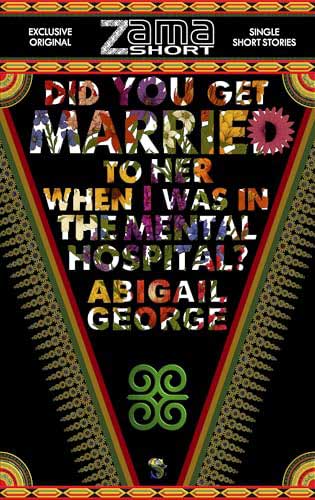
ZamaShort #12, 2026
The work is structured as a series of titled vignettes — “Night has Taken you Away from Me for the Last Time,” “A New Love,” “Gaza is not Dead,” “This is My Convent” — and this architecture is itself meaningful. George does not offer the reader a single sustained narrative because a single sustained narrative would be a lie. The mind under the pressure of bipolar disorder, grief, and abandonment does not move in straight lines. It spirals. It doubles back. It loses a thread and picks up a different one three rooms away. George honours this truth structurally, and the result is a work that feels formally brave precisely because it refuses the comfort of conventional cohesion.
The central emotional engine of the piece is the haunting, unnamed you — a lost love whose departure left wounds that George renders with terrifying precision. She is not sentimental about this loss. She is instead ferocious, turning the grief over in her hands like an object she is trying to identify, examining it from every angle: bitterness, longing, acceptance, rage, dark humour, and finally a kind of hard-won peace that never quite solidifies into resolution. This is honest writing. George does not give us healing because she has not finished being hurt, and she is too serious a writer to pretend otherwise.
What elevates the work beyond personal memoir into genuine literary art is the way George weaves the personal and the political into a single fabric. Palestine enters this text not as a political statement bolted onto private grief, but as a genuine emotional parallel — another site of devastation, another wound that the world refuses to take seriously, another body that is told its suffering is too much, too loud, too inconvenient. The juxtaposition is startling at first, then, as the work accumulates, entirely inevitable. George has lived on the margins of her own family, on the margins of a society that pathologised and stigmatised her illness; she recognises the grammar of dispossession when she sees it, wherever it appears.
Stay ahead of the geopolitical week.
MD Briefing delivers expert analysis across five global fronts — the Indo-Pacific, energy, geoeconomics, European security, and the Middle East — every Monday morning. Free.
The prose itself is extraordinary in its density and its strangeness. George writes in a mode that is neither straightforward fiction nor conventional poetry, but something in between — a form that allows her to compress enormous emotional weight into single sentences, to shift without warning from the intimate to the cosmic, from the breakfast table to the refugee camp, from a childhood typewriter to the poetry of Rumi and Khalil Gibran. Some readers may find this disorienting. Those readers would be right to feel disoriented, because disorientation is the accurate emotional register for a life lived with this kind of interior turbulence.
The literary forebears George invokes — Sylvia Plath, Virginia Woolf, Anne Sexton, Bessie Head, Ingrid Jonker — are not dropped as name-checks but genuinely inhabited. When she writes about these women, she is writing about her own survival strategies, her own attempts to locate herself in a lineage of women who made art out of conditions that might otherwise have destroyed them. This is one of the most moving dimensions of the work: its insistence that George is not an isolated case but part of a long, difficult, brilliant tradition of writers for whom the wound and the gift are the same thing.
The title itself is a masterstroke. It arrives in the text not as a metaphor but as an actual question — raw, direct, almost unbearable in its specificity. That a man she loved would have married someone else while she was hospitalised, that life continued without her, that the world does not pause for the mentally ill — this is the quiet devastation at the heart of everything George writes here. And yet the question is also darkly, painfully funny. George knows this. She is not a writer without humour, even when the humour is the kind that catches in your throat.
“Did You Get Married to Her When I Was in the Mental Hospital?” is not an easy work. It should not be. It is the work of a writer who has paid an enormous price for her art and who offers that art back to the reader not as a gift wrapped in comfort, but as an act of absolute honesty. In a literary landscape that sometimes rewards the carefully managed and the strategically palatable, this book is a necessary corrective. It is wild, it is wounded, it is luminously intelligent, and it is unmistakably alive.
Abigail George has written something that will stay with the reader long after the last page — not because it resolves, but because it refuses to.
Kabedoopong Piddo p’ Odoki, author of A Wreath for Flies
