


The coverage and analyses by the Chinese press and official media, as well as Chinese intelligence, military, defense, and security think tanks and their experts, regarding the Octagon headquarters (the strategic command complex of the Egyptian Armed Forces in the New Administrative Capital), considered it to be a supreme security and sovereign umbrella protecting foreign investments, especially logistics projects and the Chinese Belt and Road Initiative in Egypt. Its location near the Suez Canal Economic Zone and the axis of the Chinese TEDA projects in the economic zone in northwest Suez Canal and Ain Sokhna reflects a strategic guarantee for the stability of global supply chains, which is of great significance and importance to the Chinese. Chinese academic and intelligence analyses have focused on the fact that the massive and modern construction of the Octagon military facility sends a reassuring message to Chinese investors about the existence of specialized Egyptian defense and intelligence capabilities capable of protecting the Suez Canal Economic Zone and the Chinese industrial park (TEDA). This is due to its ability to secure the logistical arteries for Chinese projects. The strategic location of the Octagon headquarters, from China’s perspective, guarantees the Egyptian state’s ability to intervene rapidly to secure global trade and the Suez Canal, thus providing a safe environment for the massive projects that Beijing relies on in Egypt, the Middle East, and Africa. The new headquarters of the Egyptian Ministry of Defense, the Octagon, represents a deepening of the concept of centralized command for Beijing. It also represents a radical shift towards digitalization and centralized control in managing strategic operations and securing borders and waterways in Egypt and the region for China and its projects and investments within the framework of the Belt and Road Initiative.
For this reason, the intelligence and military circles in China were interested in analyzing the relationship between the integration of development and security in Egypt and its relationship to the opening of the Egyptian military and defense headquarters of the Octagon, with the analysis of the concerned circles in Beijing that the Octagon enhances internal stability, which is a basic condition for pumping huge Chinese investments amounting to billions of dollars, which include the sectors of green energy and green hydrogen and the projects of the administrative capital, in accordance with Egypt’s Vision 2030 and the Chinese Belt and Road Initiative. Chinese intelligence and military circles have also focused on highlighting the regional influence of the Egyptian Octagon headquarters and its role in protecting logistical routes and securing international trade for China. Analyses by Chinese intelligence, military, security, and defense circles confirm that the new Egyptian Octagon headquarters contributes to strengthening Egypt’s security infrastructure by securing shipping lanes passing through the Red Sea and the Suez Canal axis. This is a vital element for the success of China’s Maritime Silk Road and serves its strategic depth in Africa, as Egypt’s geographical location makes it the main gateway for Chinese expansion into Africa. Here, the Egyptian central command and its strong role through the Octagon ensure the security of these vital trade routes for China, facilitating the smooth flow of Chinese products and services to African markets.
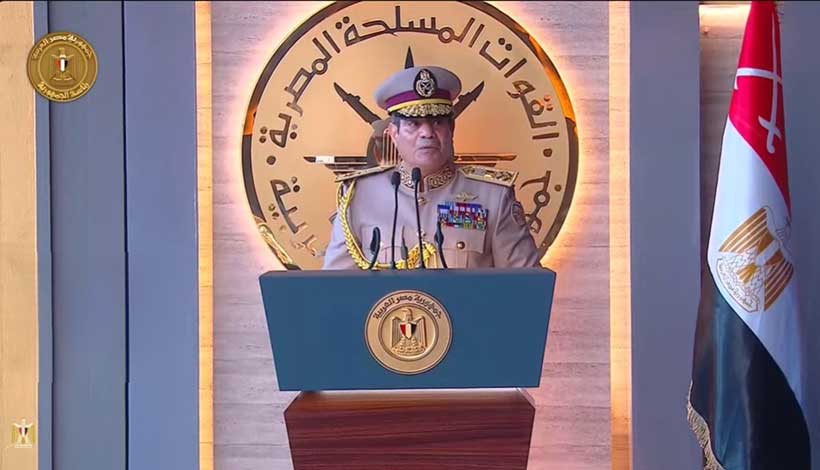
The editorials of major Chinese newspapers and media outlets highlighted the content of Egyptian President Abdel Fattah El-Sisi’s speech at the new strategic command headquarters of the Egyptian Ministry of Defense, known as The Octagon, in the New Administrative Capital. Wearing a military uniform, he directly linked the content of his speech and this modern Egyptian military achievement to the June 30th Revolution in Egypt and the popular expulsion of the Muslim Brotherhood. They supported President El-Sisi’s description of the revolution as a cry for justice and a decisive declaration that Egypt cannot and will not be governed except by its own people. All official Chinese media outlets, such as Xinhua News Agency and CGTN, also covered the event of the opening of the Octagon strategic command headquarters in Egypt, which was analyzed from a strategic and engineering perspective. The overall analysis of the Octagon event by all official Chinese media outlets and newspapers affiliated with the ruling Communist Party of China viewed it as a symbol of power and technological advancement.
Chinese news agencies highlighted the significance of President El-Sisi’s wearing of a military uniform as a symbol of Egyptian sovereignty, interpreting it as a message of deterrence, stability, and reassurance from the Egyptian presidency to both domestic and international audiences. This coincided with the inauguration of the largest military command complex in the Middle East and Africa, the Egyptian Octagon, which surpasses the Pentagon in engineering and technology. Chinese state media praised the engineering of the Egyptian Octagon, with Chinese military analyses focusing on its intelligent design that blends Pharaonic architectural elements with modern digital engineering, describing the headquarters as a comprehensive nerve center for crisis management. The Chinese also drew a connection between the June 30th Revolution in Egypt and the ouster of the Muslim Brotherhood. They viewed this inauguration (and the military uniform worn by President El-Sisi) as closely linked to the history of the June 30th Revolution in Egypt, a direct continuation of the events that led to the removal of the Muslim Brotherhood from power and saved the Egyptian state from total institutional collapse. The Chinese considered the opening of the new headquarters of the Egyptian military a safeguard for Egypt’s national security. For them, the June 30th Revolution represents the starting point when the Egyptian military regained its prestige and standing to protect the country’s borders and purge it of extremist groups. Beyond its modernization and development aspects, the construction of the Octagon was a strategic Egyptian step, supported by China, within a comprehensive plan to modernize Egypt’s defense and security capabilities. This plan involved providing the Egyptian military, defense, and security establishment with the latest Chinese military equipment. This support began after President El-Sisi assumed power following the Egyptian people’s overthrow of the Muslim Brotherhood’s rule and the subsequent mandate given to the army to secure the country, thus contributing to regional stability. For Chinese military experts, this massive military complex (reflecting President El-Sisi’s vision as Supreme Commander of the Armed Forces) underscores Egypt’s determination to confront regional challenges and solidify its role as a force for peace and stability, a political stance that China has consistently supported diplomatically and economically to safeguard its interests and international trade routes in the region.
Stay ahead of the geopolitical week.
MD Briefing delivers expert analysis across five global fronts — the Indo-Pacific, energy, geoeconomics, European security, and the Middle East — every Monday morning. Free.
In this context, Chinese intelligence, security, military circles, and think tanks are paying exceptional attention to analyzing the movements of the Egyptian state, especially the Egyptian military and defense establishment, by the main organizational structure of the Chinese advisory bodies concerned with this file and the most prominent aspects of their analysis of the messages of President El-Sisi’s speech during his inauguration of the new strategic command headquarters of the Egyptian state, the Octagon. The most prominent Chinese institutions and think tanks involved in academic, intelligence, security, military, and defense analysis of President El-Sisi’s speech and the significance of the timing of the inauguration of the Egyptian Octagon headquarters were the Chinese Institute of Contemporary International Relations (CICIR). Military speeches and sovereign inaugurations in Egypt and throughout the Middle East are subject to intensive analysis by a network of research and security institutions in Beijing. Among the most prominent of these analyses was that of the Chinese Institute of Contemporary International Relations (CICIR). This research and analytical arm of the Chinese Ministry of State Security, which represents China’s civilian intelligence service, provides regular reports to the Chinese leadership. CICIR’s strategic analysis linked the Egyptian Octagon’s role to protecting energy security and maritime routes, such as the Suez Canal, given its crucial importance to Beijing. Analyses were also published by the Middle East Studies Institute at Shanghai International Studies University (SISU), a prominent academic center with experts specializing in the political and security affairs of the Arab world and Egypt in particular. These analyses linked the significance of the opening of the Egyptian Octagon headquarters to the protection of both Egyptian and Chinese national security, specifically through safeguarding Chinese projects and investments within its Belt and Road Initiative. Analyses were also published by Chinese military, research, and strategic think tanks, as well as relevant intelligence circles in Beijing, regarding the implications of the Egyptian Octagon headquarters opening.
These included analyses from the Academy of Military Sciences of the People’s Liberation Army (AMS), which focused on the defense infrastructure and command and control systems of the Octagon complex in Egypt. On another front, analyses by the Institute of West Asian and African Studies (CASS) at the Chinese Academy of Social Sciences, as a consulting center providing comprehensive policy papers to the Chinese government on political stability in Egypt and the profound transformations that occurred after 2013, including the removal of the Muslim Brotherhood from power, the significance of the opening of the new Egyptian Ministry of Defense headquarters The Octagon was linked to this event, emphasizing its role in preserving the sovereignty, prestige, and stability of the Egyptian state and its long-standing allies, such as China.
On the other hand, analyses by prominent Chinese experts specializing in Egyptian and defense affairs have addressed the significance of the opening of the Egyptian Octagon. This Chinese analysis is led by a group of prominent academic and intelligence figures, including Professor Liu Zhongmin. As president of the Chinese Association for Middle Eastern Studies, he is considered one of the most insightful analysts of the Egyptian political landscape and the roots of the June 30th Revolution in Egypt and the departure of the Muslim Brotherhood’s rule. He offered his interpretation of the connection between important events in Egypt, such as the opening of the Egyptian Octagon headquarters, and the protection of the Egyptian state’s resources and the preservation of China’s Belt and Road Initiative in Egypt and the region. Also contributing to this analysis is Chinese expert Zhu Weilie. As a senior advisor to the Chinese Ministry of Foreign Affairs and a specialist in security and counterterrorism studies in North Africa, he emphasizes the importance of stabilizing the Egyptian military establishment and providing it with a secure foothold in the context of eliminating extremism and terrorism, particularly the terrorism of the Muslim Brotherhood. The analysis of Chinese researcher Sun Degang is also significant; as an expert in regional defense and security affairs, he is particularly interested in Egyptian military events and their role in monitoring the balance of military power in the Mediterranean and Red Sea basins, given the profound implications and importance this holds for the Chinese.
The most prominent aspects of Chinese analysis of El-Sisi’s speech and its strategic, political, and intelligence implications, as expressed through official Chinese media, Chinese intelligence, military, defense, and security think tanks, and their experts, focused on key dimensions through which they interpreted the contemporary Egyptian landscape. Their analyses included the significance of Egyptian President Abdel Fattah El-Sisi wearing a military uniform at the Octagon. Chinese military analysts at the Academy of Military Sciences of the People’s Liberation Army believe that President El-Sisi’s appearance in military uniform at this time was a firm strategic deterrent message. Furthermore, his appearance at the technologically fortified command complex of the Octagon reflects the readiness of the Egyptian armed forces, affirms the unity of military and political decision-making within the Egyptian state, and sends a reassuring message both domestically and internationally about Egypt’s ability to protect its territorial borders, which President El-Sisi described in his speech as a red line. Chinese military and intelligence analyses have highlighted the connection between the opening of the Egyptian Octagon headquarters and the June 30th Revolution in Egypt and the ouster of the Muslim Brotherhood as a cornerstone of strategic independence for the Egyptian state. Chinese think tanks, such as the China Institute of Contemporary International Relations (CICIR), have analyzed President Sisi’s characterization of the June 30th Revolution as a turning point that saved Egypt from chaos and institutional collapse. They link this to the strategic geographic location of both China and Egypt and the presence of external threats, given the external attacks and ongoing interference in internal affairs that both countries have faced. This necessitates a strong military infrastructure, exemplified by the Egyptian Octagon headquarters and Beijing’s military city, to counter the American Pentagon. Chinese military experts believe that the expulsion of the Muslim Brotherhood allowed Cairo to regain its sovereign decision-making power and build a purely national defense doctrine, embodied in the New Administrative Capital project and the Octagon complex. They interpret El-Sisi’s statement that Egypt can only be governed by its own people as a firm and sustained rejection of any external interference or ideological dictates, just as is the case according to Chinese security, defense, and military doctrine. Furthermore, analyses by Chinese military and intelligence think tanks have characterized the Egyptian Octagon as a fully integrated electronic brain. Security experts in Beijing have expressed admiration for the engineering and technology of the Octagon complex as a unified command and control center, secure from cyberattacks. According to their military and intelligence reports and analyses, consolidating data servers and crisis management centers in one location enhances the speed of decision-making within the Egyptian state apparatus. This strengthens the state internally and enables it to protect massive Chinese investments and logistics projects (including Chinese projects in the Suez Canal Economic Zone and the Belt and Road Initiative).
Accordingly, we summarize the main points raised by Chinese media outlets, official press, think tanks, research centers, and strategic, military, defense, security, and intelligence institutions. These reports and analyses, presented to Chinese decision-makers, address the connection between the opening of the Egyptian Octagon headquarters and significant transformations in Egypt. These transformations are occurring both domestically, with the establishment of a strong Egyptian political system under President Abdel Fattah El-Sisi and a development-oriented Egyptian military establishment modeled on the Chinese development experience, and internationally, through the adoption of a Look East policy, particularly towards China, its Belt and Road Initiative, and its various projects and investments in Egypt and other countries in the region.
