When seven B-2 Spirit stealth bombers flew a 36-hour round-trip mission from Whiteman Air Force Base, Missouri to Iran on 22nd June 2025, they carried a message as much as a payload, the era of hiding nuclear and military assets underground no longer guarantees safety. Fourteen GBU-57 bombs were dropped on the Iranian nuclear facilities. The strike, known as Operation Midnight Hammer, was rooted in a classified effort that the Pentagon says began more than a decade earlier. Nearly a year later, the operation has reshaped how militaries think about both attacking and building underground.
The Race to Destroy Underground Fortresses
During the strike, B-2 bombers dropped fourteen GBU-57/B Massive Ordnance Penetrators on Iran’s Fordow and Natanz nuclear sites, six bombs on Fordow and two on Natanz, while more than two dozen Tomahawk cruise missiles hit surface targets at a third site, Isfahan. It marked the first-ever operational use of the 30,000-pound bunker buster, a weapon designed to strike facilities buried hundreds of feet underground.
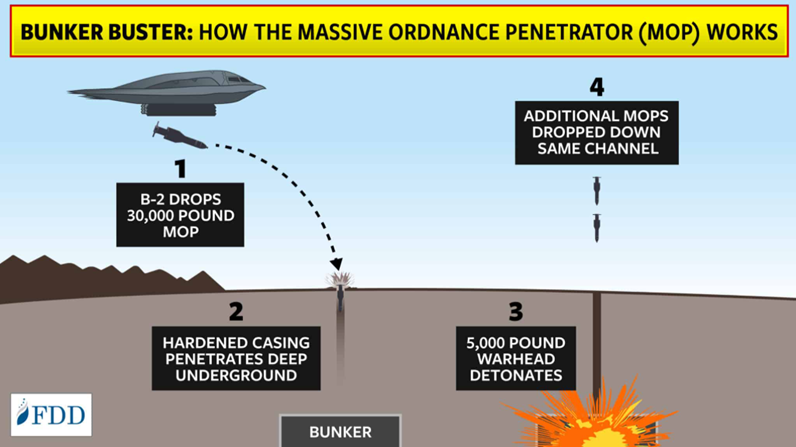
Source: Foundation for Defense for Democracies
Stay ahead of the geopolitical week.
MD Briefing delivers expert analysis across five global fronts — the Indo-Pacific, energy, geoeconomics, European security, and the Middle East — every Monday morning. Free.
The numbers behind the weapon are staggering. The GBU-57 measures roughly 20.5 feet long, 2.5 feet thick, and carries a guidance package that lets it strike within meters of its target. Of that total weight of 30,000 pounds, the warhead alone accounts for roughly 5,740 pounds, and the bomb is rated to penetrate up to 200 feet of earth or 60 feet of reinforced concrete. On impact it is estimated to exceed the speed of sound, delivering 800 to 900 megajoules of kinetic energy, comparable to a 285-ton Boeing 747 touching down at 170 mph.
Yet the mission also exposed the limits of even the world’s largest conventional bomb. Fordow and the newer excavated halls at Natanz are believed to sit more than 80 to 90 meters underground, while Iranian-developed concrete reportedly exceeds 30,000 psi in compressive strength, far above the 5,000 psi material the MOP was built to defeat. During the strike, six MOPs had to be dropped in rapid succession down each of two ventilation shafts at Fordow just to drill deep enough to damage the facility below. The Pentagon has not stayed quiet about the cost of that approach. The Department of War awarded Boeing a $61.5 million contract simply to replenish the tail kits, fuze cable guides, and containers expended during the raid, with deliveries running into 2030.
The campaign did not end in 2025. By early 2026, joint U.S.-Israeli operations had resumed, and satellite imagery showed a newly hardened Iranian facility called Taleghan 2, encased in fresh concrete and buried under soil in the months before being struck, evidence that adversaries are adapting almost as fast as the bombs built to defeat them.
How Militaries are Going Underground
Iran is far from alone in burrowing for survival. North Korea has turned underground construction into a national doctrine. Open-source researchers have publicly verified more than 2,500 underground sites across the country, spanning hardened artillery positions, underground factories, storage depots, air bases, and missile facilities, with some broader estimates — including covered civilian shelters. U.S. assessments, drawn partly from defector accounts, put the number of leadership shelters alone at between six thousand and eight thousand, while one underground air base at Wonsan reportedly houses a runway nearly 5,900 feet long carved straight through a mountain.
China’s underground buildout is on an even larger scale. A report on Chinese military power found that the People’s Liberation Army has various underground facilities protecting nuclear forces, missile storage, and command centers, and is constructing more every year as part of its broader military expansion. Nationwide, these complexes are estimated to include more than 3,000 miles of tunnels, rail lines, and factories. The most striking example may be the 816 Nuclear Military Plant near Chongqing, the largest man-made tunnel structure in the world. Its total area reaches 104,000 square metres, roughly equivalent to the size of 15 football pitches. The logic is the same everywhere, depth is deterrence. Burying command centers, missile silos, and weapons production lines under rock and reinforced concrete is far cheaper than matching an adversary’s air power, and it complicates targeting even for the most advanced precision weapons. The result is a slow-motion arms race conducted in tunnels rather than skies, one side digs deeper, the other builds bigger bombs.
The Future of Deep Strike Warfare
That race is already producing a successor to the MOP. The U.S Air Force has initiated the development of its next bunker buster the GBU-76/B, formally known as the Next Generation Penetrator, intended to replace the GBU-57. The service has requested roughly $73.7 million in fiscal year 2026 to fund the program, with full prototype demonstrations expected by the end of fiscal year 2027. The new weapon is meant to weigh closer to 22,000 pounds, and is capable of blast, frag and penetration effects.
All of this is unfolding against a backdrop of record global rearmament. World military expenditure rose 2.9 percent in real terms to $2.887 trillion in 2025, the eleventh consecutive year of growth, pushing the global military burden to 2.5 percent of GDP. The United States remained the largest spender at $954 billion despite a 7.5 percent decline, while China’s military budget rose to roughly $336 billion and Russia’s to about $190 billion.
Fordow proved that even the most fortified mountain bunker can be cracked open. It also proved that doing so takes fifteen years of development, a fleet of stealth bombers, dozens of multi-million-dollar precision weapons, and still leaves room for doubt about how much damage was actually done. As nations dig deeper and pour harder concrete, the next generation of bunker-busters, which will be lighter, smarter, and possibly rocket-boosted, will determine whether underground still means safe.