


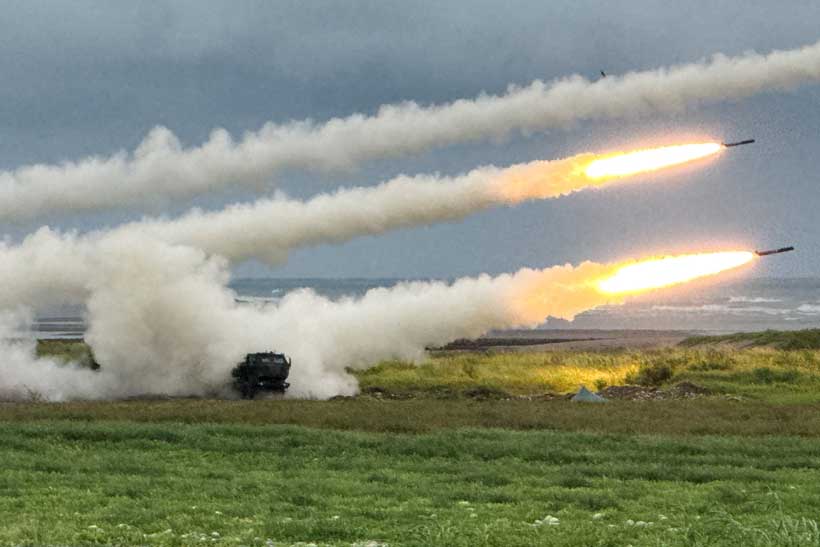
Taiwan’s Defence Minister Wellington Koo said the island’s military is increasingly concerned that China could launch military action with little warning, forcing Taiwan to accelerate its readiness and response capabilities. The comments came as Taiwan conducted five days of immediate combat readiness drills aimed at testing how quickly troops can shift from peacetime operations to wartime deployment.
The exercises reflect a major change in Taiwan’s defense planning. Rather than preparing only for a clearly signaled invasion, military planners are now considering scenarios in which China suddenly converts one of its frequent military drills around Taiwan into a real attack. Chinese warships and aircraft regularly operate near the island, making it more difficult to distinguish routine military activity from preparations for actual combat.
Taiwan’s warning underscores growing concerns that China’s military pressure campaign is narrowing the window for detection and response in a potential conflict. The shorter warning time raises the risk of miscalculation and places greater emphasis on rapid mobilization, command coordination, and military resilience.
The issue has implications beyond Taiwan. Any conflict in the Taiwan Strait could disrupt global trade routes, affect semiconductor supply chains, draw in regional powers, and increase tensions between China and the United States.
Stay ahead of the geopolitical week.
MD Briefing delivers expert analysis across five global fronts — the Indo-Pacific, energy, geoeconomics, European security, and the Middle East — every Monday morning. Free.
Taiwan Shifts Toward Rapid Response Defense Strategy
Taiwan’s military is increasingly focused on ensuring that forces can react immediately if a crisis erupts. According to Defence Minister Wellington Koo, the latest drills are designed to verify whether units can quickly transition from peacetime operations to combat readiness without delays.
A key element of the exercises is testing decentralized command structures. Military planners want to ensure regional commanders can continue operating effectively even if communications are disrupted or central command facilities come under attack. The drills also assess how quickly troops, equipment, and support systems can be deployed during the opening stages of a conflict.
The emphasis on speed reflects concerns that traditional warning indicators may no longer provide sufficient preparation time if China decides to act suddenly.
China’s Expanding Military Presence Fuels Security Concerns
China has steadily increased military activity around Taiwan over recent years, sending fighter jets, drones, and naval vessels near the island on an almost daily basis. Beijing says such operations are necessary to safeguard its sovereignty claims, while Taiwan views them as intimidation and coercion.
Adding to concerns, China’s newest aircraft carrier sailed through the Taiwan Strait this week, demonstrating Beijing’s growing naval capabilities. Chinese forces have also conducted several large scale military exercises around Taiwan, often involving simulated blockades, missile launches, and joint operations by air and naval units.
Taiwanese officials fear that such exercises could one day serve as cover for actual military action, reducing the time available for defensive preparations.
Beijing Reaffirms Reunification Goal While Keeping Military Option Open
China’s Taiwan Affairs Office criticized Taiwan’s latest military drills, accusing the ruling Democratic Progressive Party of pursuing independence through military means. Beijing reiterated its position that it seeks peaceful reunification but refuses to renounce the use of force.
Chinese officials maintain that military pressure is directed at separatist activities rather than the broader Taiwanese population. However, Taiwan’s government argues that Beijing’s actions are increasing instability and threatening regional peace.
The competing narratives highlight the deep political divide between the two sides and the absence of meaningful progress toward resolving the sovereignty dispute.
Taiwan Strengthens Military Capabilities
Taiwan has been investing heavily in military modernization to deter potential aggression. Recent exercises included the use of U.S. supplied HIMARS rocket systems, which have gained attention for their effectiveness in Ukraine.
The island is also expanding training programs, improving reserve force readiness, enhancing missile defenses, and developing strategies focused on asymmetric warfare. These measures are intended to make any potential military operation against Taiwan more difficult and costly.
The upcoming Han Kuang military exercises, Taiwan’s largest annual war games, are expected to place even greater emphasis on realistic combat scenarios and rapid response operations.
Stakeholders
- Taiwan government
- Taiwan Defence Ministry
- Defence Minister Wellington Koo
- Taiwan armed forces
- Chinese government
- China’s Taiwan Affairs Office
- Chinese military
- President of Taiwan
- United States government
- Regional allies including Japan and Australia
- Global semiconductor industry
- International shipping and trade sectors
Future Outlook
Taiwan is expected to continue adapting its defense strategy around the assumption that warning times before a Chinese attack could become increasingly limited. Future military exercises will likely focus on rapid mobilization, decentralized command structures, civil defense preparedness, and cooperation with international partners.
Meanwhile, China is expected to maintain or expand military activities around Taiwan as it seeks to increase pressure on the island. As both sides strengthen their preparations, tensions in the Taiwan Strait are likely to remain elevated, making crisis management and deterrence critical to preventing an unintended conflict.
With information from Reuters.
